Share This Article
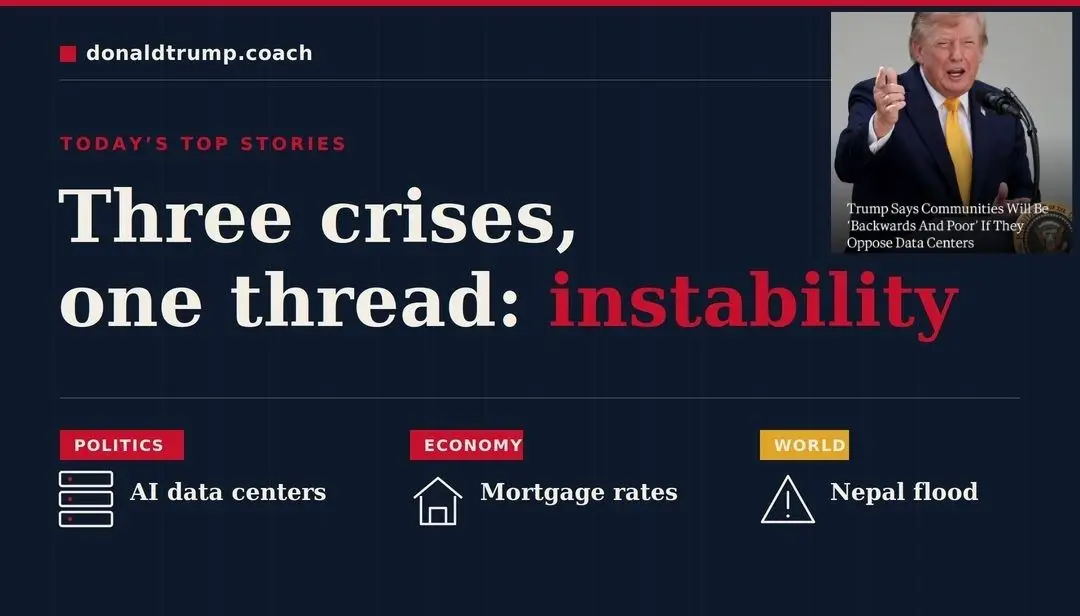
Today’s biggest stories collide at the intersection of politics, the economy, and global disaster response. President Trump escalated his fight with Trump data centers backwards and poor rhetoric aimed squarely at Republican-held districts ahead of the midterms, mortgage rates jumped to levels unseen in more than a year as Middle East oil shocks ripple through Wall Street, and the U.S. Embassy in Nepal sharpened its travel warning after a catastrophic Himalayan flood. Here’s everything you need to know, in one place.
Trump Says Communities Opposing AI Data Centers Could End Up “Backwards and Poor”
President Trump used Truth Social on Monday to blast local communities pushing back against new AI data center construction, arguing that rejecting the facilities is a losing bet for local economies. “The only reason that communities throughout the U.S.A. should not want Data Centers is if they want to end up being backwards and poor,” Trump wrote, adding that towns willing to host the projects would see “far lower taxes and jobs all over the place.”
The comments land at a politically sensitive moment. The AI data center backlash has become one of the most volatile issues heading into the November midterms, which will decide control of both chambers of Congress. According to Wolfe Research, net public support for local data center construction has dropped 60 points over the past year across party lines a shift researchers described as unlike anything they’ve tracked before.
Polling backs up the scale of the resistance. A Gallup survey found that seven in ten Americans oppose building AI data centers in their own communities, with nearly half “strongly opposed.” A more recent Fox News poll put opposition at 70%, including 60% of Republicans and 76% of Democrats meaning the issue now crosses party lines almost evenly, a rarity in the current political climate.
Republican strategists are watching Ohio especially closely. The National Republican Senatorial Committee has flagged data center opposition as a real threat to Sen. Jon Husted in his special election matchup against Democratic challenger Sherrod Brown, one of several races where the issue could swing outcomes.
Trump framed the stakes bluntly, warning that opponents who “kill the Golden Goose” of AI infrastructure “will only have themselves to blame,” and argued that hesitation plays directly into China’s hands in the broader AI race. The administration has continued cutting regulatory red tape and freeing up federal land to accelerate data center construction nationwide, even as local water usage, electricity strain, and environmental concerns keep fueling grassroots pushback in both red and blue states.
Why This Matters for the Midterms
With control of Congress on the line, data centers have quietly become a top-tier kitchen-table issue competing with inflation and housing affordability for voter attention in swing districts. Expect this storyline to keep intensifying through Election Day.
Mortgage Rates Surge as Renewed Middle East Attacks Push Oil Prices Higher
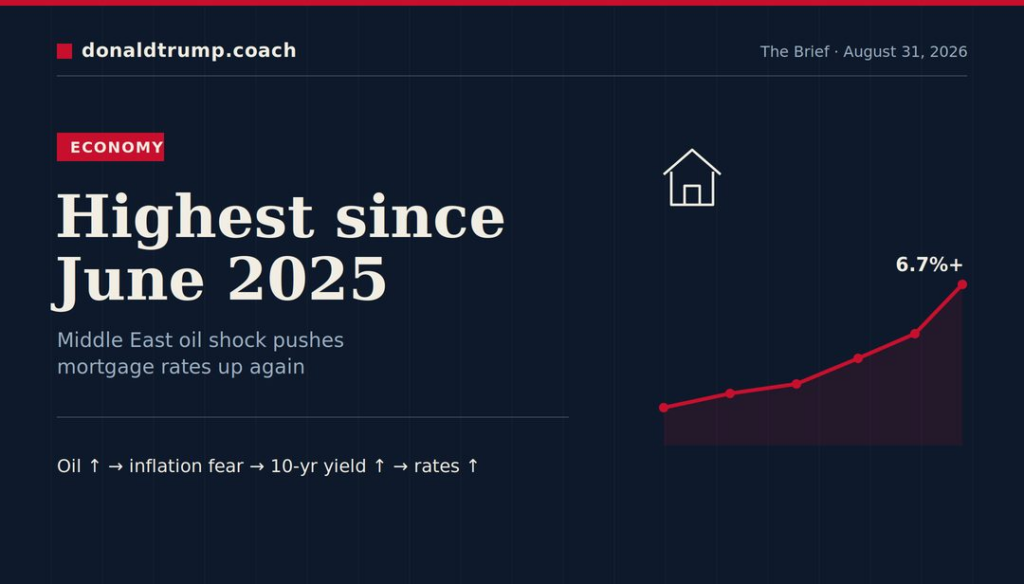
Homebuyers are getting squeezed again. Mortgage rates surge 2026 headlines are back after fresh escalation in the Middle East sent oil prices climbing, reigniting inflation fears that flow directly into borrowing costs. As of Monday, the average 30-year jumbo mortgage sat at 6.732%, up from 6.709% the previous day, while the 30-year FHA rate ticked up to 6.094%. Freddie Mac data has shown 30-year conventional rates hovering near 6.6%–6.9% in recent weeks, levels not seen since the summer of 2025 with 15-year rates recently touching their highest point since June 2025.
The mechanism is familiar by now: renewed fighting tied to the ongoing Iran conflict pushes crude oil prices higher, oil above $100 a barrel stokes inflation expectations, and that pressure flows into the 10-year Treasury yield the benchmark mortgage rates track most closely. Freddie Mac’s chief economist has repeatedly urged borrowers to shop around aggressively, noting that even small rate differences can save thousands of dollars over the life of a loan.
The affordability squeeze is already visible in the data. Pending home sales posted their steepest monthly drop of the year in June, mortgage applications have fallen in back-to-back weeks, and refinance activity particularly FHA and VA refinancing has slowed to its weakest pace since June 2025, according to the Mortgage Bankers Association. Adjustable-rate mortgages are gaining a bigger share of applications as buyers search for any way to lower monthly payments.
What Homebuyers Should Watch
- Oil price direction tied to Middle East developments remains the single biggest swing factor for weekly rate moves.
- 10-year Treasury yield movement is the most reliable early signal of where mortgage rates head next.
- Fannie Mae and Freddie Mac forecasts still call for modest easing later in 2026, though actual rates have repeatedly overshot those predictions this year.
US Embassy in Nepal Advises Against Non-Essential Travel North of Hard-Hit Flood Village
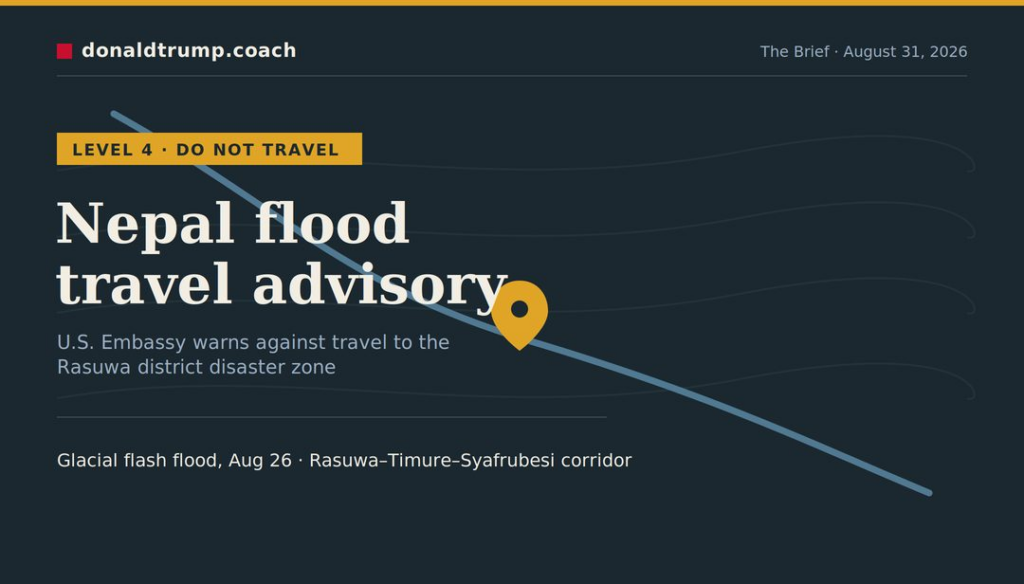
The U.S. Embassy in Kathmandu has issued an updated Nepal flood travel advisory, directing American citizens not to travel to the Rasuwagadhi-Timure-Syafrubesi corridor in Rasuwa district including the Nepal-China border crossing following a catastrophic glacial-triggered flash flood on August 26, 2026. The area has been placed under a Level 4 “Do Not Travel” designation, the U.S. government’s highest warning tier.
The flood surged into Nepal from Tibet, tearing through communities along the Bhote Koshi, Trishuli, and Narayani rivers. Local authorities have reported more than 800 deaths across Nepal and Tibet combined, with over 3,000 people still listed as missing. The State Department has activated $3.6 million in emergency humanitarian assistance, including up to three months of emergency food support for roughly 10,000 flood-affected households, and has deployed a disaster response adviser to the region.
The embassy’s guidance is direct: stay away from riverbanks, low-lying areas, damaged bridges, and unstable slopes; follow evacuation orders from Nepali authorities; and do not attempt to enter the disaster zone independently, even to search for a missing person. Road damage has also disrupted major travel corridors connecting Kathmandu to popular trekking gateways, including sections of the Prithvi Highway and the Galchhi-Nuwakot-Rasuwa-Syafrubesi road.
Nepal’s broader national travel advisory remains at Level 2 (“Exercise Increased Caution”), reflecting both the lingering flood risk and the tail end of civil unrest that began in September 2025, even though large-scale demonstrations have since stopped.
Travel Safety Takeaways
- Avoid the Rasuwa district disaster zone entirely; it is under the strictest U.S. travel warning level.
- Enroll in the State Department’s STEP program for real-time alerts if traveling anywhere in Nepal.
- Expect continued road and bridge disruptions on routes toward Tibet and popular trekking regions through the rest of the 2026 monsoon season.
The Bigger Picture
Three very different stories, one shared thread: instability. Political instability is reshaping the data center debate ahead of the midterms, geopolitical instability in the Middle East is reshaping what Americans pay to buy a home, and climate-driven instability in the Himalayas is reshaping travel safety across South Asia. Expect all three storylines to keep developing through the rest of the week, check back for updates.
Read More News Here
- Get the full picture on where this war is headed – more Trump-era geopolitical coverage at DonaldTrump.Coach.
- Tuesday’s missiles didn’t come out of nowhere, Iran has been digging out hidden missile stockpiles after rejecting Trump’s peace offer
- Not everyone in Trump’s own camp agrees on strategy, JD Vance claims Hegseth has been misleading Trump on the Iran war
- This isn’t the only recent flashpoint at sea, a US Navy destroyer just fired on and seized an Iranian cargo ship
- The strikes haven’t ended Iran’s nuclear ambitions either, US intel says recent strikes did only limited damage to Iran’s nuclear program
- That brief pause before Tuesday’s attack wasn’t random, Trump had deliberately paused Hormuz operations to force Iran into a deal
- The missiles are only half the story, Iran and Israel’s spy war is heating up amid claims of stolen F-15 secrets
- Trump’s fights aren’t confined to Tehran, he’s now clashing with his own SCOTUS picks back home
- Global supply chains are already bracing for impact, Goyal’s courting 50 US leaders in New York over exactly that.
- Stay ahead of the story track it live or get the full background on how the US-Iran war escalated to this point.
Frequently Asked Questions
What did Trump say about communities that oppose AI data centers?
Trump said on Truth Social that U.S. communities rejecting AI data centers would “end up being backwards and poor,” arguing that hosting communities would instead see lower taxes and more jobs.
Why are Trump data centers backwards and poor comments controversial right now?
The remarks come as polling shows roughly seven in ten Americans oppose local data center construction, and as Republican strategists worry the backlash could cost them competitive midterm races like Ohio’s Senate special election.
Why are mortgage rates surging in 2026?
Mortgage rates are climbing because renewed Middle East conflict has pushed oil prices higher, which is reigniting inflation expectations and driving up the 10-year Treasury yield that mortgage rates closely track.
How high are mortgage rates right now?
Recent data shows 30-year jumbo rates near 6.73%, 30-year FHA rates near 6.09%, and conventional 30-year rates hovering close to their highest levels since mid-2025.
Why did the US Embassy in Nepal issue a flood travel advisory?
The embassy warned Americans against traveling to the Rasuwagadhi-Timure-Syafrubesi area north of Rasuwa’s hard-hit villages after an August 26, 2026 glacial flash flood killed hundreds and left thousands missing.
Is it safe to travel to Nepal right now?
Nepal’s general advisory remains at Level 2 (Exercise Increased Caution), but the specific flood-hit corridor in Rasuwa district is under a Level 4 Do Not Travel warning, the strictest designation the U.S. government issues.
References & Sources
- The Hill – Trump AI data centers economy comments
- Forbes – Trump says communities will be “backwards and poor” if they oppose data centers
- CNBC – Trump data centers backlash elections Congress
- CNBC – Treasury yields, the Fed, and mortgage rates
- Fortune – Mortgage rates, August 31, 2026
- CNBC – Mortgage rates surge, Middle East attacks, oil prices
- U.S. Embassy in Nepal – Travel Advisory: Nepal, August 2026
- The Hill – State Department travel warning, Nepal flash flooding
- CNN – Nepal-China flood, live updates

Oil & Energy Markets
A look at crude price swings, OPEC supply moves, and how energy markets react to geopolitical shocks.

Geopolitics & Conflict
Breaking down how wars, ceasefires, and diplomatic deals ripple through global trade and security.
US Foreign Policy
Coverage of Trump administration negotiations, sanctions, and strategic decisions shaping world events.
Economy & Inflation
Tracking how commodity prices, gas costs, and supply chains affect everyday consumers.