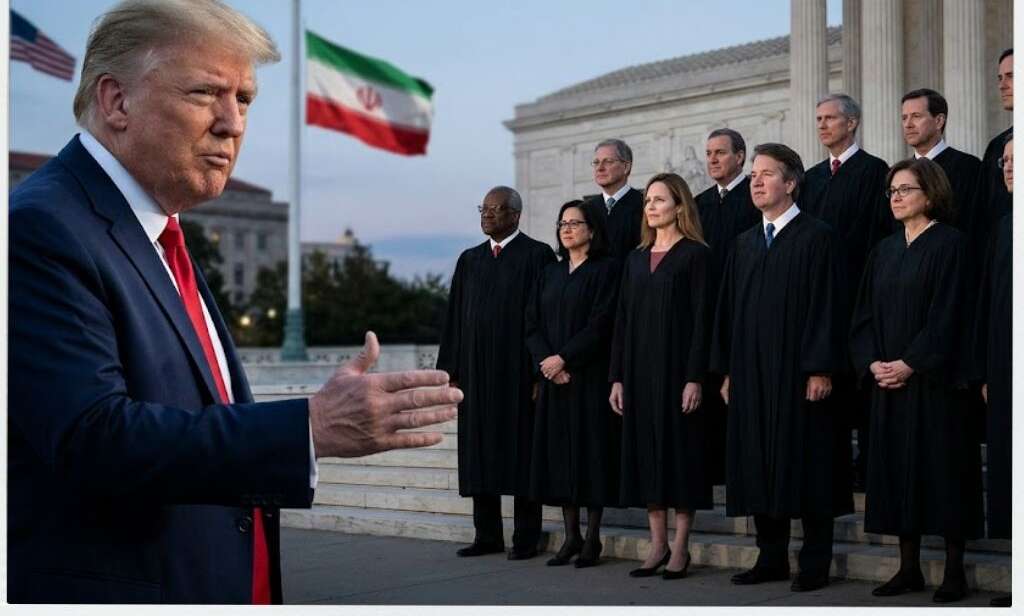
He handpicked them. He fought Senate battles to confirm them. He called them his greatest legacy. Now Donald Trump is calling two of his own Supreme Court justices “a disgrace to our nation” and saying they “sicken” him. Welcome to the most extraordinary judicial soap opera in American political history. The story of Trump versus
He handpicked them. He fought Senate battles to confirm them. He called them his greatest legacy. Now Donald Trump is calling two of his own Supreme Court justices “a disgrace to our nation” and saying they “sicken” him. Welcome to the most extraordinary judicial soap opera in American political history.
The story of Trump versus his own Supreme Court is not just inside-the-beltway drama. It is a live stress test of the US Constitution — playing out in real time, with consequences for everything from trade policy to birthright citizenship to the basic question of whether any institution in America can tell this president no.
The Honeymoon Is Over
In 2025, the Supreme Court was Trump’s best friend. The administration won 20 of 24 emergency docket cases, compiled 21 total victories, and the White House openly boasted about its SCOTUS scorecard. The court — stacked 6-3 with conservatives after Trump’s three appointments of Neil Gorsuch, Brett Kavanaugh, and Amy Coney Barrett — was widely expected to remain reliably deferential to the administration’s expansive vision of executive power.
That assumption collapsed on February 20, 2026. – In a 6-3 ruling in Learning Resources Inc. v. Trump, the Supreme Court struck down most of Trump’s sweeping “Liberation Day” tariffs — the cornerstone of his second-term economic agenda. The court held that the International Emergency Economic Powers Act (IEEPA) does not grant the president unilateral authority to impose global tariffs, ruling that tariffs are taxes, and the Constitution reserves taxation power to Congress.
Two of the six justices in the majority: Neil Gorsuch and Amy Coney Barrett — both Trump appointees.
“They Sicken Me” – What followed was a presidential meltdown without modern precedent. At the National Republican Congressional Committee dinner in Washington, Trump pointed directly at Gorsuch and Barrett and said: “They sicken me. They’re bad for our country.”
He went further. At a press conference, he called them “a disgrace to our nation” and said the ruling was “an embarrassment to their families.” He described his own appointees as “lap dogs for the RINOs and the radical left Democrats” and accused them of being “very unpatriotic and disloyal to our Constitution.”
When asked if he regretted nominating them, he declined to answer — but the implication was clear.
Within hours of the ruling, Trump signed a new 10% global tariff under the Trade Act of 1974 — a separate legal statute — effectively daring the court to strike it down again. Chief Justice John Roberts, meanwhile, had already delivered his own quiet rebuke during oral arguments on a separate case. When the Trump administration argued that courts needed to adapt to “a new world,” Roberts cut the argument short: “It’s the same Constitution.”
The Birthright Battle — And Another Loss Looming
If the tariff ruling was a blow, the birthright citizenship case may deliver the knockout. On April 1, 2026, Trump — in an unprecedented move — personally attended Supreme Court oral arguments on his executive order to end automatic birthright citizenship for children born on US soil to undocumented parents.
He sat in the courtroom for 90 minutes. It was the first time a sitting president had attended SCOTUS arguments in modern history.
It didn’t go well. Multiple justices — again including Barrett and Gorsuch — aggressively questioned the administration’s legal logic. When the government’s lawyer argued for a “new interpretation” of the 14th Amendment, the justices pushed back hard. SCOTUS blog reported the court “appears likely to side against Trump” in its ruling, expected by June. Outside the courthouse, Trump posted on Truth Social, calling the US “STUPID” for having birthright citizenship at all.
The Defiance Question No One Wants to Answer
Behind the insults and the Truth Social posts lies a more dangerous subtext. JD Vance has publicly stated that “judges aren’t allowed to control the executive’s legitimate power.” Elon Musk amplified calls for Trump to simply ignore court orders. Legal experts at NBC News and the Brennan Center warned of an emerging constitutional crisis — with analysts at Justia noting the administration defied judges in roughly one-third of all cases brought against it.
The Brennan Center asked the question that hangs over every ruling: what can courts actually do if a president simply refuses to comply?
The answer, unsatisfyingly, is: it depends on political will, congressional action, and ultimately public pressure — none of which have so far produced firm guardrails.
Why This Drama Matters Beyond Washington – Trump’s war with SCOTUS is not really about tariffs or birthright citizenship in isolation. It is about whether a president who helped build a supermajority on the nation’s highest court is now willing to delegitimize that same institution the moment it rules against him — and whether his allies in Congress and the Republican base will follow him there.
He built the court. He’s now at war with it. And in the most politically charged Supreme Court term in a generation, the next ruling could ignite the next chapter — one that no political expert saw in the script.
Market Analysis
A quick snapshot of market trends, customer behavior, and competitor movements.