Share This Article
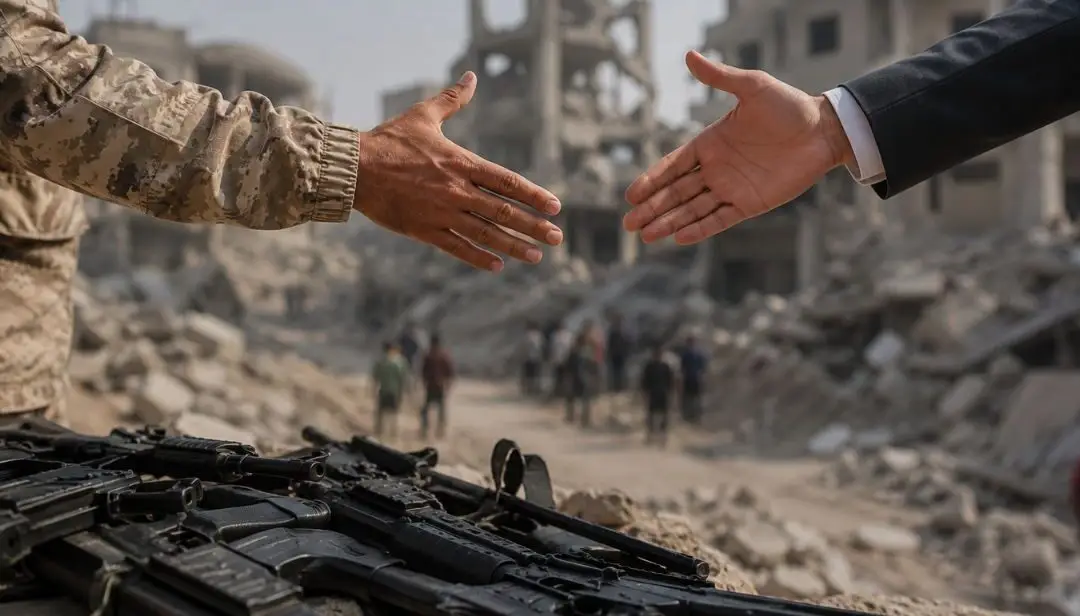
In the biggest development in the Gaza peace process since last October’s ceasefire, Hamas says it has agreed to disarm on the condition that Israel first meets its own obligations under the US-led plan. President Donald Trump called it a historic agreement. The details, and the skepticism, matter. And it lands even as the wider Iran war flares again elsewhere in the region.
What happened
Hamas has agreed to relinquish its weapons in stages, a senior official for the group confirmed on Friday. The agreement was reached with the Board of Peace, the US-led body created to implement the long-term Gaza ceasefire plan signed in October 2025. President Trump announced the deal late Thursday, describing it as a historic step toward ending the war in Gaza.
While Washington and Tehran trade missiles, allies aren’t sitting still, the UK just sent a mine-hunter to Hormuz, and it signals more than routine patrol duty.
For nearly a year, Hamas’s refusal to disarm had been the single biggest obstacle blocking the next phase of that plan. This agreement, if it holds, is the first time the group has publicly committed to a path for giving up its arsenal.
Iran isn’t the only one moving assets into the strait, see what the UK’s mine-hunter deployment really signals.
But the commitment comes wrapped in conditions, and both the mediators and outside analysts are warning that agreeing to a roadmap is not the same as completing one.
The catch: it is a package deal
Ghazi Hamad, a key Hamas negotiator, told CNN the agreement is a package, and that Hamas will not begin any weapons-related steps until Israel implements its own commitments first. In his framing, if Israel does not follow through, Hamas will not proceed.
Global supply chains are already bracing for impact — Goyal’s courting 50 US leaders in New York over exactly that.
Those Israeli commitments, under the US-led plan, include halting attacks on Palestinians in Gaza, withdrawing troops to the so-called “yellow line,” allowing a surge of humanitarian aid, and letting a Palestinian technocratic committee take over administration of the territory. The deal is also tied to the deployment of an International Stabilization Force to Gaza.
How the disarmament would actually work
According to officials briefed on the process and speaking to the Associated Press, the mechanism is more gradual and more limited than a straightforward surrender. Hamas and other armed groups agreed to “collect and store” their weapons inside Gaza, under the supervision of the Palestinian technocratic committee. Crucially, the arms would not be handed over to Israel or to any non-Palestinian party. The process would be phased and linked step-by-step to Israeli withdrawal.
This missile exchange lands right in the middle of a bigger fight, Trump and Senate Republicans are already clashing over war powers in Iran.
That structure matters, because it is designed to address a core sticking point: Hamas has consistently rejected handing its weapons to its adversary, while Israel has demanded the group fully disarm. Storing arms internally under a third-party Palestinian body is the compromise that made an agreement possible.
Israel’s position
Israel has been deeply skeptical throughout that Hamas would ever genuinely give up its weapons or relinquish control of Gaza. A US official told the Associated Press that Israel was consulted at every step of the negotiations, and that the plan does not ask Israel to do more than it already committed to under Trump’s original 20-point framework namely, withdrawing its forces and ending airstrikes.
Not everyone in Washington is on board with this posture, the Senate just passed a resolution aimed at stopping Trump from attacking Iran.
At the time of publication, Israel had not signed off on the agreement in the way Hamas and the Board of Peace had described it. That gap between announcement and implementation is where the hardest work now begins.
The mediators and what comes next
The roadmap was finalized by mediators from Egypt, Qatar, Turkey and the United States. Nickolay Mladenov, the Board of Peace’s high representative for Gaza, said the deal followed months of very difficult negotiations, and stressed that what happens next matters even more that implementation and verification have to be real, and that withdrawal must move in step with the decommissioning of weapons.
Allied diplomacy is moving fast on every front, Modi’s Sweden visit just delivered six new strategic outcomes for India.
Egypt is expected to host a meeting of the truce mediators in Cairo soon, focused on this second phase of the ceasefire plan.
The wider war has not paused
While the Gaza announcement dominated headlines, the broader regional conflict the iran trump war that reignited earlier this month was still active on the same day. Iranian forces struck an air base in Kuwait, according to state media; Kuwait’s army said it intercepted the attack, with damage from falling shrapnel but no casualties. Earlier in the week, Egypt reported a drone strike that no party has claimed.
In other words, a major step toward ending one front was announced even as another front widened. The two are connected: the same US-led diplomacy driving the Gaza deal is also trying to wind down the Iran conflict, and progress on one can shape the other.
Why it matters and why to stay cautious
If the agreement is implemented, it would mark the beginning of the end of a war that has reshaped the region. If it stalls as an earlier ceasefire and a June memorandum on the Iran front both did, it could become one more announcement that outpaced events on the ground. The AP, quoting officials directly involved, noted the move is significant but faces many hurdles and could take a long time to achieve, if it happens at all.
The honest summary for readers: this is real progress, it is conditional, and the next few weeks of implementation will decide whether it holds.
Frequently Asked Questions
What exactly did Hamas agree to?
Hamas agreed to give up its weapons in stages, storing them inside Gaza under the supervision of a Palestinian technocratic committee rather than handing them to Israel. The commitment is conditional on Israel meeting its own obligations first.
What conditions did Hamas attack?
Hamas says it will not take any weapons-related steps until Israel halts attacks in Gaza, withdraws troops to the “yellow line,” allows a surge in aid, and permits a Palestinian technocratic committee to govern. Deployment of an International Stabilization Force is also part of the package.
Has Israel accepted the deal?
Israel was consulted throughout the negotiations, according to a US official, but has long been skeptical of Hamas’s intentions. As of publication, the implementation, not just the announcement, is what remains to be tested.
Who is the Board of Peace?
It is the US-led body established under the October 2025 ceasefire plan and endorsed by the UN Security Council to oversee Gaza’s transition, chaired by President Trump. Its high representative for Gaza is Nickolay Mladenov.
Does this end the war in Gaza?
Not yet. It is a roadmap for the next phase, not a completed settlement. Officials involved describe it as significant but warn it faces major hurdles and could take a long time to implement, if it succeeds at all.
Is the Iran war over?
No. The broader conflict remained active on the same day the Gaza deal was announced, with an Iranian strike reported on an air base in Kuwait. The US-led diplomacy is trying to wind both fronts down, but the Iran front has flared repeatedly through July.
References & Sources
- CNN — live coverage; Ghazi Hamad’s confirmation that the deal is contingent on Israel’s obligations.
- Associated Press — the “collect and store” disarmament mechanism and the US official on Israel’s role.
- Al Jazeera — the Board of Peace and International Stabilization Force roadmap announcement.
- News24 / Reuters wire — Hamas’s confirmation and the Mladenov statement.
- Nickolay Mladenov (Board of Peace), official post on X — “implementation and verification have to be real.“
- UN Security Council Resolution 2803 (November 2025) — the framework endorsing the Comprehensive Plan to End the Gaza Conflict, for background context.

Oil & Energy Markets
A look at crude price swings, OPEC supply moves, and how energy markets react to geopolitical shocks.

Geopolitics & Conflict
Breaking down how wars, ceasefires, and diplomatic deals ripple through global trade and security.
US Foreign Policy
Coverage of Trump administration negotiations, sanctions, and strategic decisions shaping world events.
Economy & Inflation
Tracking how commodity prices, gas costs, and supply chains affect everyday consumers.