Share This Article
Oil prices climbed again on Tuesday. The reason: renewed tension between Washington and Tehran. Trump Iran oil prices became a top trending search as Iran signaled it would return to the June interim deal, but only if the US honors its own side first. Meanwhile, President Trump vowed to hit Iran “hard” after a fresh exchange of strikes.
So, what’s driving the latest spike? Markets are once again pricing in the risk of a full shutdown of Strait of Hormuz shipping.
Tehran’s Offer to Return to the June Deal
Iranian President Masoud Pezeshkian spoke at the Shanghai Cooperation Organisation Summit this week. There, he said Tehran remains ready to reciprocate. In other words, if Washington resumes its obligations under the deal, Iran will too.
This deal is the 14-point Islamabad memorandum. It was signed on June 17 as an interim peace framework between the two countries.
The Strait of Hormuz Tanker Attack
Just hours before Pezeshkian’s comments, a tanker was struck. Unknown projectiles hit the vessel while it was transiting the Strait of Hormuz tanker attack corridor near the Omani coast. The UK Maritime Trade Operations agency (UKMTO) confirmed the incident on Monday. Fortunately, no casualties were reported.
However, this attack didn’t happen in isolation. It followed a rapid escalation over the weekend:
- First, the US struck Iranian rocket launchers on Larak Island on Sunday. Reports say three people were killed. The US claimed Tehran intended to fire rockets carrying sea mines into Hormuz.
- Then, Iran retaliated on Monday. It struck two American bases in Jordan.
- As a result, this became the first direct exchange of fire between the two sides in roughly a month.
Why oil prices are rising
The market reacted the way it has all year: the international benchmark, Brent crude, climbed back above $90 a barrel as the strikes resumed and the Strait of Hormuz came under fire again.
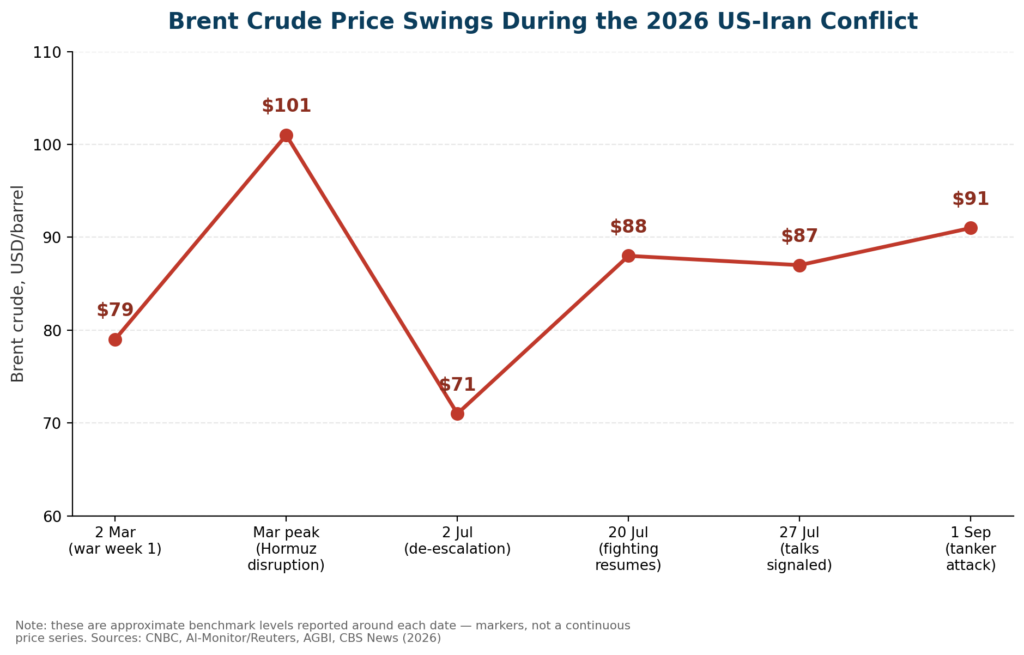
The reason is the strait itself. A large share of the world’s seaborne oil passes through that narrow passage, which Iran has effectively closed to shipping during the conflict. When traders see tankers attacked and strikes resuming, they price in the risk that supply could be cut, and crude rises worldwide. That risk premium is what has driven oil’s sharp swings throughout 2026 up on each escalation, down on each pause.
The effects reach beyond the pump. As oil rose, US Treasury yields climbed, with the 10-year yield touching its highest level since January 2025, and bond markets came under pressure as higher energy costs revived inflation concerns.
The 2026 Oil-Price Rollercoaster
Oil has whipsawed with every turn of the war. The chart below shows approximate Brent levels at key moments, drawn from news reports; it is a set of markers, not a continuous price series.
| Date (2026) | Event | Approx. Brent (USD/barrel) |
| 2 March | War underway, week one | ~$79 |
| March peak | Hormuz disruption peaks | ~$101 |
| 2 July | De-escalation, talks progress | ~$71 |
| 20 July | Fighting resumes | ~$88 |
| 27 July | Trump signals talks | ~$87 |
| 1 September | Strikes resume, tanker attack | ~$91 |
Figures are approximate benchmark levels reported in the news on or around each date, for illustration.
Trump’s Response: “We’re Going to Hit Them Hard”
Speaking from the Oval Office, President Trump offered his own assessment. According to him, Iran’s financial system, armed forces, and governing apparatus have been “largely degraded” by sustained US pressure.
Still, he warned that this degradation doesn’t mean the US is finished. In his words, Washington “won’t smack them to see what happens” unless provoked further.
This Trump hit Iran hard posture isn’t new. In fact, it has defined the administration’s Iran strategy throughout the 2026 midterm cycle. The approach relies on three pillars: economic coercion, a naval blockade posture in the Gulf, and the threat of further targeted strikes.
Notably, policy analysts believe this strategy is deliberately calibrated. Jason Brodsky, policy director at United Against Nuclear Iran, offered some insight here. He described the Larak Island strike as reinforcing “the blockade.” The goal, he explained, is to degrade Tehran’s capacity to mine the Strait of Hormuz. Meanwhile, sanctions do the slower work of squeezing Iran’s economy ahead of the midterms.
What’s Next in the US Iran Conflict 2026?
Tehran has publicly signaled openness to reviving the June framework. So, will Washington reciprocate, or will it stick with sanctions and blockade tactics? Here’s what to watch next:
- Diplomatic mediation – Qatar, Oman, and Pakistan have all emerged as possible mediation channels.
- Shipping traffic data – Daily Hormuz transit counts remain a leading indicator of real de-escalation.
- Oil price volatility – Continued uncertainty over the strait will likely keep Brent and WTI elevated.
- Further US strikes – Trump’s “hit them hard” rhetoric suggests more targeted action could follow.
Read More News Here
- NATO chief calls US strikes on Iran “absolutely necessary”
- Will gold rally as US-Iran tensions escalate
- Oil jumped but the market stayed calm
- 5 takeaways from Tuesday’s 2026 primaries
- US tariff system reset across 60 economies
- Trump tariffs Section 122 surcharge expires
- Trump had deliberately paused Hormuz operations to force Iran into a deal
- JD Vance claims Hegseth has been misleading Trump on the Iran war
- Iran has been digging out hidden missile stockpiles after rejecting Trump’s peace offer
- US Navy destroyer just fired on and seized an Iranian cargo ship
- Iran and Israel’s spy war is heating up amid claims of stolen F-15 secrets
- he’s now clashing with his own SCOTUS picks back home
- see what the UK’s mine-hunter deployment really signals.
- Trump-era geopolitical coverage at DonaldTrump.Coach
Frequently Asked Questions
What is the June deal between the US and Iran?
The June deal, also called the Islamabad memorandum, is a 14-point interim agreement. Signed on June 17, it aimed to halt direct military conflict and reopen the Strait of Hormuz to commercial shipping.
Why are oil prices rising because of Iran?
Renewed strikes and a tanker attack near the Strait of Hormuz have raised fears of further disruption. Since the strait carries roughly one-fifth of the world’s oil supply, markets are pricing in that supply risk.
What did Trump say about hitting Iran hard?
Trump said Iran’s financial system, military, and government have been significantly degraded. Still, he signaled the US could strike again “to see what happens.”
Is Iran willing to return to the ceasefire deal?
Yes. President Pezeshkian said Tehran would immediately reciprocate, but only once Washington resumes honoring its own commitments under the June agreement.
What happened in the Strait of Hormuz tanker attack?
A tanker was struck by three unknown projectiles on Monday. The incident occurred in the southern shipping lane near the Omani coast, according to UKMTO. No casualties were reported.
How is the US pressuring Iran economically?
Washington has intensified secondary sanctions. These penalize any country or business that purchases Iranian crude oil, adding pressure alongside the US naval presence in the Gulf.
References & Sources
- CNBC – Tehran urges return to June deal, oil prices rise as Trump vows to hit Iran ‘hard’
- Al-Monitor / Reuters – Iran urges US to comply with interim deal after Trump threatens further strikes
- AGBI – Tanker hit in Hormuz while Trump threatens to hit Iran ‘hard’
- CBS News – U.S.-Iran War Latest: Tankers hit in Strait of Hormuz as Trump mulls more strikes

Oil & Energy Markets
A look at crude price swings, OPEC supply moves, and how energy markets react to geopolitical shocks.

Geopolitics & Conflict
Breaking down how wars, ceasefires, and diplomatic deals ripple through global trade and security.
US Foreign Policy
Coverage of Trump administration negotiations, sanctions, and strategic decisions shaping world events.
Economy & Inflation
Tracking how commodity prices, gas costs, and supply chains affect everyday consumers.