A ship seizure in the Persian Gulf has pushed the already-fragile US-Iran ceasefire to its breaking point. Tehran is vowing revenge. The Islamabad talks are stalling. The April 21 deadline is three days away. And oil markets are pricing in exactly what traders feared most — this ceasefire was never as solid as the headlines
A ship seizure in the Persian Gulf has pushed the already-fragile US-Iran ceasefire to its breaking point. Tehran is vowing revenge. The Islamabad talks are stalling. The April 21 deadline is three days away. And oil markets are pricing in exactly what traders feared most — this ceasefire was never as solid as the headlines suggested.
TEHRAN / ISLAMABAD / WASHINGTON — The ceasefire was always one incident away from collapse. That incident has now happened.
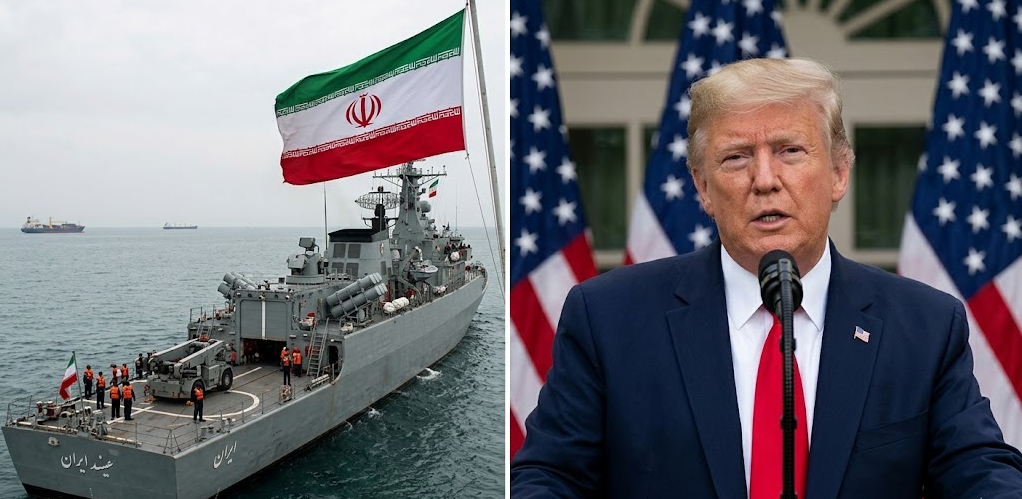
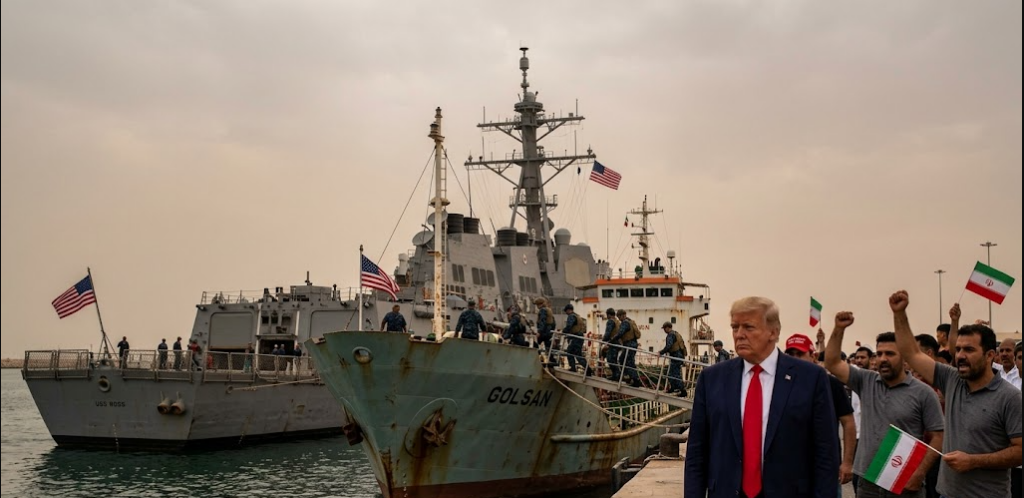
Iranian Revolutionary Guard Corps naval forces seized a commercial vessel in the Persian Gulf on Thursday, claiming it was operating in violation of the $2 million per-tanker transit coordination protocol Iran’s parliament approved in March — a mechanism Tehran insists is legally binding under the ceasefire framework, and which Washington has consistently refused to recognize as legitimate. Hours later, the vessel — a Marshall Islands-flagged tanker carrying crude oil destined for European markets — was boarded, its crew detained, and its cargo impounded at Bandar Abbas port.
The United States called the seizure an “act of piracy” and a direct violation of the April 7 ceasefire terms, which required the “COMPLETE, IMMEDIATE, and SAFE OPENING of the Strait of Hormuz.” The Islamabad talks, already stalled on the core enrichment impasse, were immediately suspended pending clarification of Iran’s intentions.
Iran’s response came within hours. Foreign Minister Abbas Araghchi issued a statement calling the vessel’s detention “a lawful enforcement action under sovereign maritime authority” and warned that any US attempt to forcibly recover the ship would constitute “an act of war that will be met with consequences of the same magnitude.”
Tehran was not finished. A senior IRGC commander — speaking on condition of anonymity to Iranian state media — went further: “The enemies of Iran have seized our assets, bombed our infrastructure, killed our leaders, and now patrol our waters with their warships. Every action has a proportional response. We have not forgotten. We have not forgiven. And we are not finished.”
Iran is vowing revenge. The ceasefire clock reads 72 hours.
The Ship Seizure in Context
This is not the first time a vessel detention has detonated a diplomatic process in the Persian Gulf. In 2019, Iran’s seizure of the British-flagged tanker Stena Impero — in apparent retaliation for the UK’s detention of an Iranian vessel off Gibraltar — escalated tensions that had already been building under Trump’s first-term maximum pressure campaign and brought the region within hours of direct military confrontation.
The 2026 seizure carries higher stakes on every dimension.
The ceasefire that the April 7 ship incident is threatening was built on the narrowest possible foundation — a Truth Social post, a phone call from Pakistan, and 126 words that both sides interpreted differently from the moment they were posted. Iran has consistently maintained that the ceasefire includes an implicit recognition of its right to regulate Hormuz transit — including the $2 million per-tanker fee its parliament approved on March 22. The United States has consistently refused to acknowledge that fee structure, calling it “extortion” and “a violation of international freedom of navigation principles.”
That gap — never resolved in the April 7 ceasefire text, never addressed in the Islamabad talks — has now produced its first physical confrontation.
The Islamabad Talks: Already on Life Support
The ship’s seizure landed into negotiations that were struggling long before Thursday’s incident.
The core dispute — Iran’s demand for domestic uranium enrichment rights versus the US demand for complete dismantlement of facilities at Natanz, Fordow, and Isfahan — remains as unbridgeable today as it was on April 10 when the talks opened. Iran’s 460-kilogram stockpile of 60%-enriched uranium sits in a calculation that neither side has publicly moved on. Iran’s 10-point framework demands full sanctions removal, frozen asset returns, and war compensation. The US 15-point counter-proposal offers none of those terms unconditionally.
The Islamabad talks were already, in the diplomatic community’s private assessment, functioning less as negotiations and more as a ceasefire extension mechanism — a way to keep both sides talking past April 21 without either having to formally acknowledge the gap between their positions. The ship seizure has disrupted even that minimal function.
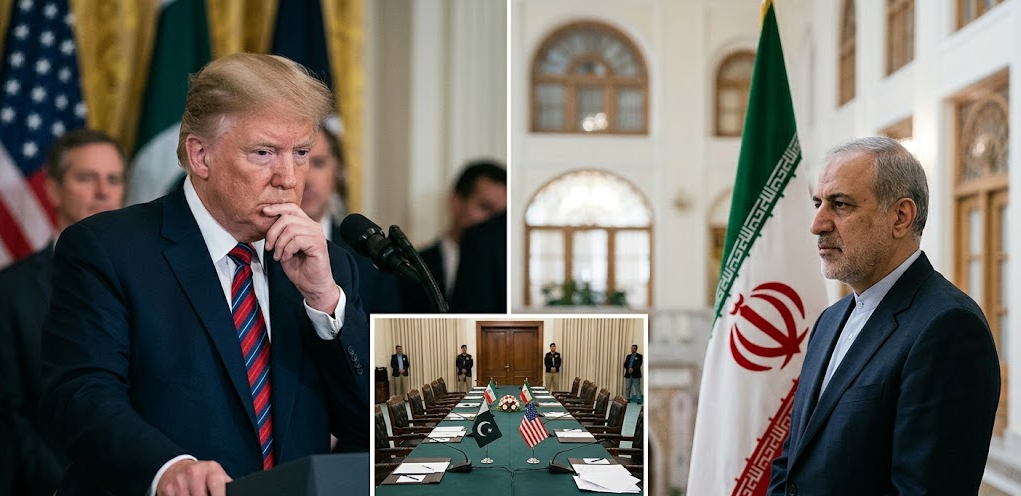
VP JD Vance’s delegation suspended formal sessions Thursday afternoon. A senior US negotiator told Reuters the suspension was “temporary and tactical” — giving both sides space to de-escalate without publicly collapsing the framework. Iranian FM Araghchi has not confirmed whether his delegation will return to the table before the April 21 deadline.
The Naval Blockade Dimension
The ship seizure did not happen in a vacuum. It happened inside a Persian Gulf where 15 US warships — including a carrier strike group — have been maintaining a naval blockade formation around Iranian ports since April 14.
That blockade was designed, in Pentagon framing, as a pressure mechanism to prevent Iran from reconstituting Hormuz interdiction capability during the negotiating window. It has instead created the precise conditions under which a maritime incident was most likely: two heavily armed naval forces operating in the same confined waterway, with overlapping and contradictory claims about who has the right to board, inspect, and detain commercial vessels transiting Iranian-adjacent waters.
The Marshall Islands-flagged tanker was operating in the northern Gulf approaches — the same corridor where Iran has selectively allowed Pakistani-flagged vessels to transit freely since late March while blocking or charging others. The vessel’s detention may reflect Iran testing the boundaries of what the blockade allows it to enforce, or it may reflect a deliberate escalation designed to force a US response that gives Tehran justification to formally declare the ceasefire dead.
Both interpretations are being actively analyzed in Washington. Neither produces a reassuring conclusion.
What the Markets Are Saying
Oil markets reacted to the ship seizure with immediate, decisive movement. WTI crude jumped $6.40 per barrel in after-hours trading following news of the detention — recovering nearly a third of its April 8 ceasefire crash in a single session. Dated Brent, which had never meaningfully fallen below $90, pushed back toward $98. Goldman Sachs traders flagged the seizure as a potential “ceasefire-ending event” in internal notes leaked to Bloomberg, estimating a return to $130–$140 per barrel if the April 21 deadline passes without agreement.
Gas prices — which had only partially receded from their $4.10 per gallon peak during the war — showed no meaningful improvement at the pump despite the ceasefire. The physical supply disruption from 38 days of Hormuz closure cannot be unwound in two weeks regardless of diplomatic outcomes. Andy Lipow of Lipow Oil Associates had warned as much: “It is likely to be months before the average price is back to the pre-war level.” Thursday’s seizure suggests those months may begin counting from a higher baseline than the ceasefire optimists projected.
Three Days, Three Scenarios
The April 21 deadline now arrives against a backdrop of active maritime incident, suspended talks, Iranian revenge threats, and a naval blockade that has moved from pressure tool to potential flashpoint.
Scenario 1 — De-escalation and extension: Iran releases the vessel, both sides accept a face-saving formula, talks resume, and the ceasefire is extended on a rolling basis. Probability: declining rapidly.
Scenario 2 — Frozen standoff: Vessel remains detained, talks remain suspended, April 21 passes with neither formal agreement nor formal collapse — a limbo state that preserves the ceasefire in name while destroying it in practice.
Scenario 3 — Full breakdown: US forces attempt to recover the vessel. Iran responds. The IRGC activates remaining Hormuz interdiction assets. The blockade converts from pressure tool to active combat posture. The ceasefire is formally over.
Secretary of State Rubio — who had warned from the beginning that “I’m not sure you can reach a deal with these guys” — has not commented publicly on the seizure. His silence may be the most eloquent assessment of where things stand.
Three days. One seized tanker. Two navies in the same strait. The world is watching the same Persian Gulf it has watched for 47 years — wondering, again, whether this time it finally breaks.
Market Analysis
A quick snapshot of market trends, customer behavior, and competitor movements.