John Yep helped elect Donald Trump. He ran Catholics for Catholics, one of the most active conservative Catholic organizations in the 2024 campaign, and he delivered. Trump won 55% of the Catholic vote that November — a 12-point margin over Kamala Harris, with white Catholics breaking for him at nearly 60%. Yep was part of
John Yep helped elect Donald Trump. He ran Catholics for Catholics, one of the most active conservative Catholic organizations in the 2024 campaign, and he delivered. Trump won 55% of the Catholic vote that November — a 12-point margin over Kamala Harris, with white Catholics breaking for him at nearly 60%. Yep was part of that machinery. So when Trump posted an AI-generated image depicting himself as a Christ-like savior and then called Pope Leo XIV “terrible,” “weak,” and bad for the Church, Yep described his reaction in a single word: sadness.
He was not alone.
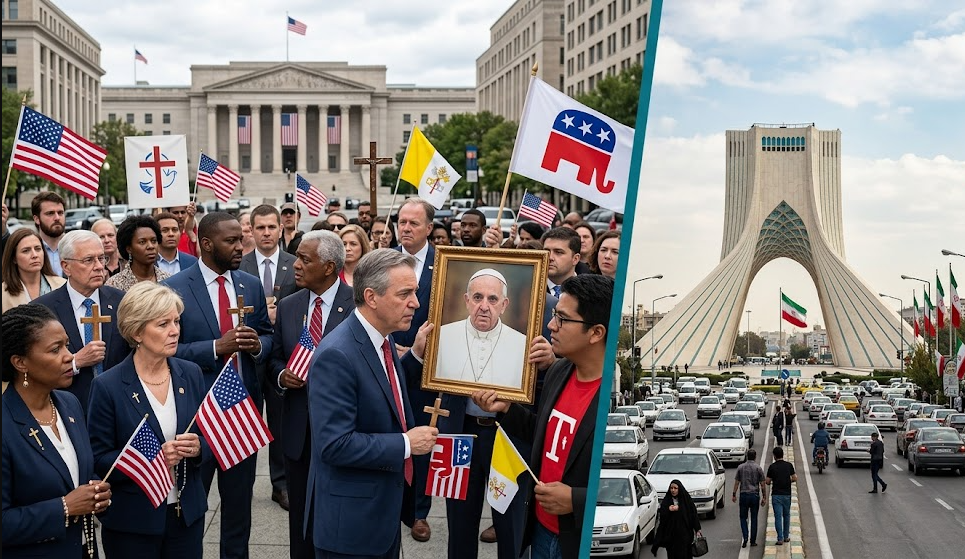
What has unfolded over the past two weeks between the White House and the Vatican is not a standard partisan clash. It is something rarer and more politically dangerous for Trump: a conflict that is fracturing the very coalition that helped put him back in office.
The Feud, Escalated
The dispute did not begin with one post. It accumulated.
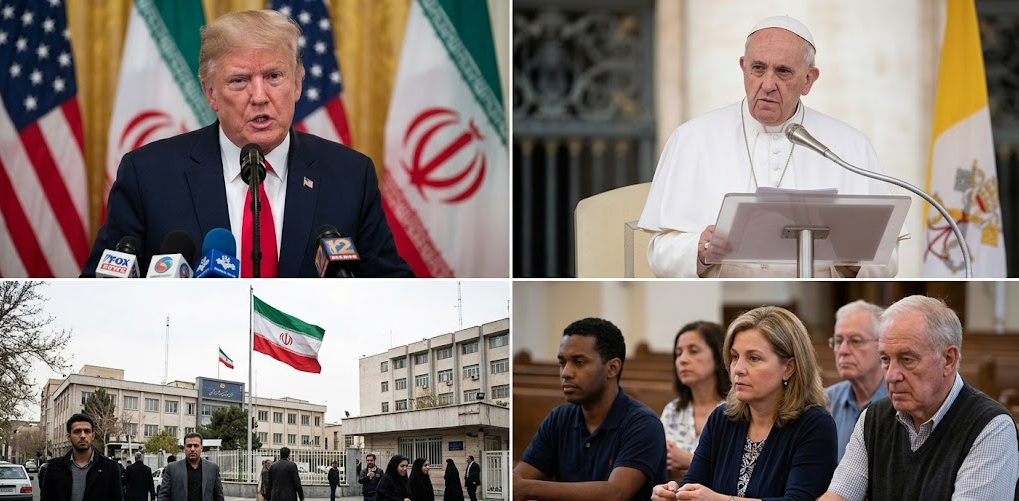
Pope Leo XIV — the first American pope, a Chicago native, and a man who spent more than two decades as a missionary in Peru — has been increasingly direct about his opposition to the Iran war and to the political use of religious imagery. On Palm Sunday, he invoked Isaiah 1:15 to suggest that warmakers’ prayers go unheard. He called the world “ravaged by a handful of tyrants” from Cameroon. He warned that “woe” comes to those who manipulate religion for military and political gain.
Trump responded on Truth Social with characteristic bluntness: “Leo should get his act together as Pope, use Common Sense, stop catering to the Radical Left, and focus on being a Great Pope, not a Politician.” He added: “If I wasn’t in the White House, Leo wouldn’t be in the Vatican.”
Hours later, Trump posted an AI image appearing to cast himself in a Jesus-like pose. He deleted it after the backlash — but the image had already circulated widely. Notre Dame students called it “textbook blasphemy.” The university’s president, Rev. Robert A. Dowd issued a formal statement of support for Pope Leo without mentioning Trump by name, saying the pope’s message “transcends partisan political divisions in this or any country.”
Leo responded to Trump’s attacks with five words that became their own headline: “I have no fear.”
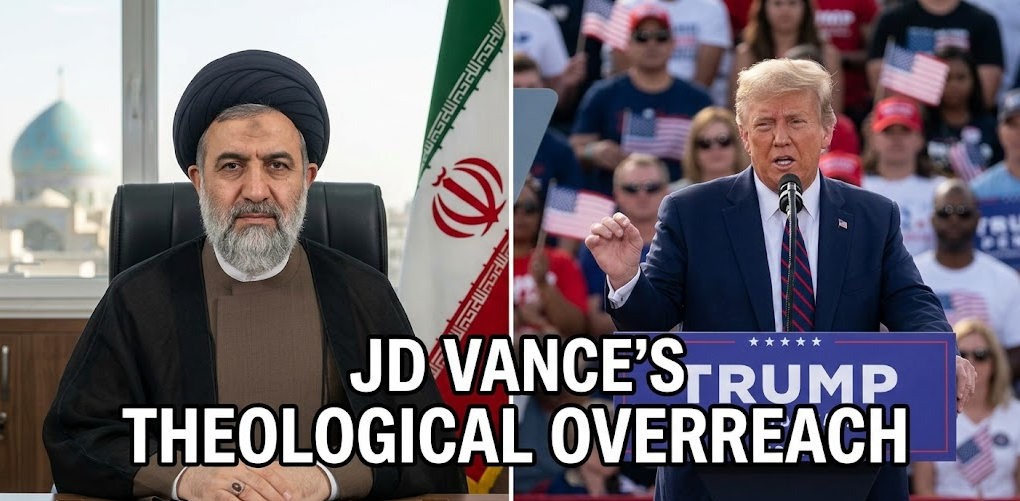
JD Vance’s Theological Overreach
Vice President JD Vance — a Catholic convert who has publicly built much of his political identity around his faith — made the situation considerably worse.
On Fox News, Vance declared that “it would be best for the Vatican to stick to matters of morality” and that the president should be left to dictating American public policy without Vatican interference. At a Turning Point USA rally in Georgia, he told the crowd the pope should “be careful when he talks about matters of theology.”
The response from Catholic leadership was swift and unified in a way that surprised even political observers who track the Church closely. The U.S. bishops’ Committee on Doctrine issued a formal statement — published within twelve hours of Vance’s remarks — defending Pope Leo XIV’s teaching authority on just war doctrine. The statement was not a suggestion. It was a correction of a sitting vice president’s theological claims by the institution whose doctrine he claims to follow.
The U.S. Conference of Catholic Bishops’ president, Archbishop Paul S. Coakley, was equally direct: “Pope Leo is not his rival; nor is the Pope a politician. He is the Vicar of Christ who speaks from the truth of the Gospel and for the care of souls.” Cardinal Timothy Dolan — no progressive firebrand — had already called a prior Vance attack on bishops over immigration “scurrilous” and “not true.”
Rolling Stone reported that Catholics serving inside the Trump administration are effectively trapped, unwilling to publicly criticize the president and equally unwilling to publicly endorse his attacks on their Church’s leader.
The Political Math
None of this is abstract. The numbers are moving.
Trump won 66% of weekly Mass-attending Catholics in 2024 — the most religiously observant slice of the Catholic electorate, the cohort most likely to feel genuine allegiance to the pope as a figure of moral authority. The National Catholic Register reported this week that Catholic support for Trump has now dropped below 50% — a significant erosion from his 2024 margins, and one that tracks precisely with the escalation of the pope feud.
Catholics represent roughly 22% of voters in swing states. White Catholics alone accounted for 15% in key battleground states including Pennsylvania, Michigan, and Wisconsin — states Trump cannot afford to lose in 2026 midterms or beyond.
ABC News reported that Republican strategists were privately describing Trump’s attacks on Pope Leo as damaging to “recent GOP gains with Catholic Americans” — gains that took years to build and that a single Truth Social post can erode overnight.
A Divide the Administration Didn’t See Coming
NPR described American Catholics as now caught in “an awkward spot” — a constituency that supported Trump’s economic and immigration priorities but had not signed up to choose between their president and their pope. The National Catholic Reporter noted the bishops are “more united than ever” — an observation with its own implicit warning. When a historically fractured American bishops’ conference finds consensus, it is usually because something significant has crystallized their shared concern.
For Trump, the calculation has always been that loyalty to his political project outweighs institutional religion. That calculation has generally been held with evangelical Christians. Among Catholics — whose relationship with Rome is doctrinal, not merely cultural — it is proving considerably more complicated.
John Yep felt sadness. Multiply that by millions of weekly Mass-goers in Pennsylvania, Michigan, and Wisconsin, and it becomes something the White House cannot dismiss as a media narrative.
Market Analysis
A quick snapshot of market trends, customer behavior, and competitor movements.