
Share This Article
By Staff Reporter | May 18, 2026
Global financial markets are navigating one of their most turbulent stretches in decades as the US dollar firms, government bond markets crack under pressure, and crude oil prices continue their relentless climb all converging forces rooted in the escalating US-Iran war that has fundamentally altered the calculus of Crush Risk Appetite for traders, institutions, and central banks worldwide.
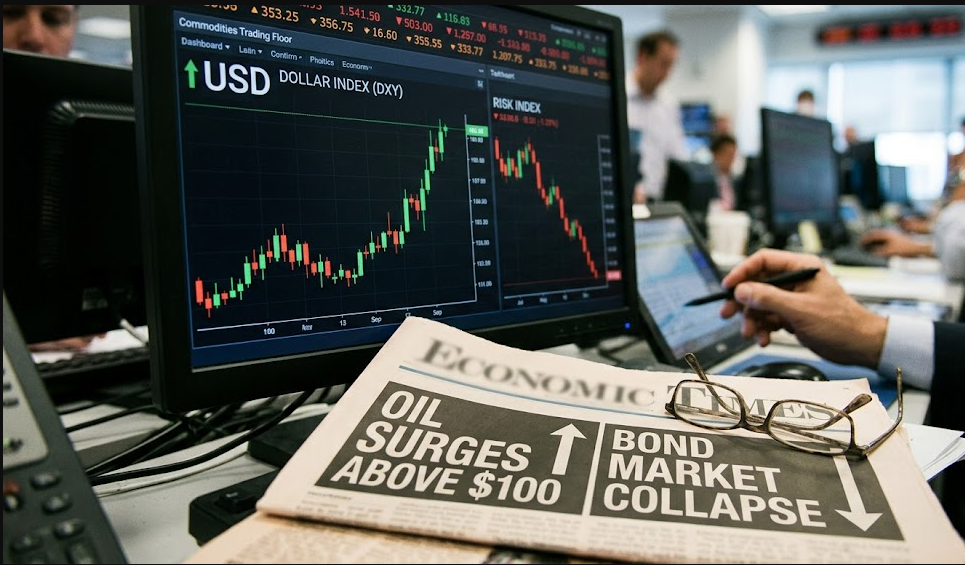
The US Dollar Index (DXY) surged to approximately 99.3 in recent sessions, its strongest reading in roughly a month, as investors fled riskier assets in favor of the greenback’s perceived safety. The move reflects a broader retreat from risk appetite that has been building since the joint US-Israel military operation against Iran on February 28, 2026 an event that killed Iran’s Supreme Leader Ali Khamenei and triggered a cascade of retaliatory strikes across the Middle East.
Bond Markets Buckle Under the Weight of War
The bond collapse that market watchers had warned about for years is no longer a hypothetical. US 10-year Treasury yields have remained stubbornly above 4.00%–4.50%, with prices falling sharply as investors reassess the safety of holding sovereign debt in an inflationary war environment.
The sell-off reflects multiple pressure points converging simultaneously. Foreign central banks including the People’s Bank of China have been reducing Treasury holdings in substantial monthly quantities, shrinking the traditional buyer base. Meanwhile, US debt-to-GDP has ballooned to 123%, against a long-term historical average of 67%, leaving bond markets structurally vulnerable to any shock that pushes inflation higher.
Here are Some Related Blogs to Read
- Get the full picture on where this war is headed – more Trump-era geopolitical coverage at DonaldTrump.Coach.
- Tuesday’s missiles didn’t come out of nowhere, Iran has been digging out hidden missile stockpiles after rejecting Trump’s peace offer
- Not everyone in Trump’s own camp agrees on strategy, JD Vance claims Hegseth has been misleading Trump on the Iran war
- This isn’t the only recent flashpoint at sea, a US Navy destroyer just fired on and seized an Iranian cargo ship
- The strikes haven’t ended Iran’s nuclear ambitions either, US intel says recent strikes did only limited damage to Iran’s nuclear program
- That brief pause before Tuesday’s attack wasn’t random, Trump had deliberately paused Hormuz operations to force Iran into a deal
- The missiles are only half the story, Iran and Israel’s spy war is heating up amid claims of stolen F-15 secrets
- Trump’s fights aren’t confined to Tehran, he’s now clashing with his own SCOTUS picks back home
- Global supply chains are already bracing for impact, Goyal’s courting 50 US leaders in New York over exactly that.
- Stay ahead of the story track it live or get the full background on how the US-Iran war escalated to this point.
The April 2025 bond market plunge triggered by Trump’s sweeping tariff announcements was a preview. The US-Iran war has deepened the wound. As Harvard Business School researchers noted in early 2026, “the dollar is still king but Treasury bonds have lost their crown.” For decades, US Treasuries and the dollar moved in lockstep as twin safe havens. That correlation is fracturing.
For a detailed breakdown of the bond market’s structural vulnerabilities, see Axios’s coverage of the 10-year Treasury yield crisis.
Oil Surge Rewrites the Energy Map
If the bond market tells a story of long-term structural stress, the oil surge is an immediate, visceral shock. Brent crude prices have risen more than 55% since the war began, jumping from approximately $72 per barrel in late February to a peak near $120 per barrel. WTI crude crossed $106.88 per barrel, while US gas prices hit $4.00 per gallon by the end of March a 30% surge in weeks.
The trigger: Iran’s military response to the US-Israel operation included strikes on the Ras Laffan energy facility in Qatar and a partial blockade of Strait of Hormuz transit routes a chokepoint through which nearly 20% of global oil supply flows daily. The International Energy Agency has characterized this disruption as the “largest supply shock in the history of the global oil market.”
J.P. Morgan Global Research has warned that if Brent prices remain elevated through mid-2026, global GDP growth could be depressed by 0.6% annually. The European Central Bank has gone further, flagging the risk of stagflation pushing energy-dependent economies Germany and Italy chief among them into technical recession by year’s end.
Dollar Firms, But for How Long?
The dollar firms on crisis instinct markets reaching for the world’s reserve currency when everything else feels unstable. Yet the same inflationary dynamics that are driving oil prices higher complicate the Federal Reserve’s position considerably. War-driven inflation may force rate hikes even as growth slows, a stagflationary scenario that historically punishes risk assets across the board.
Currency analysts at Morgan Stanley project that US dollar depreciation could resume through the first half of 2026 if the US-Iran war moves toward a ceasefire and the safe-haven premium begins to unwind. The DXY has already pulled back from its peak to around 97.7 on days when diplomatic signals turn positive evidence of how tightly the currency is now tethered to geopolitical headlines rather than economic fundamentals.
Markets Brace for the Next Shock
The collapse and oil surge dynamic is not merely a trading story. It is a structural realignment. Commodity supply chains beyond crude fertilizers, helium, aluminum, and naphtha face disruption from the same conflict zone. Developing economies are staring down an average inflation rate of 5.1% in 2026, a full percentage point above pre-war forecasts, according to World Bank projections.
Goldman Sachs analysts have framed the central question bluntly: “How long and how bad?” For markets trying to price that uncertainty, the answer remains deeply unclear and until it isn’t, the dollar will keep its bid, bonds will stay under pressure, and oil will do what wars always make it do.

Oil & Energy Markets
A look at crude price swings, OPEC supply moves, and how energy markets react to geopolitical shocks.

Geopolitics & Conflict
Breaking down how wars, ceasefires, and diplomatic deals ripple through global trade and security.
US Foreign Policy
Coverage of Trump administration negotiations, sanctions, and strategic decisions shaping world events.
Economy & Inflation
Tracking how commodity prices, gas costs, and supply chains affect everyday consumers.