Deal or War: Inside the 48-Hour Countdown That Almost Ended Iran
Theo Jorden
Share This Article
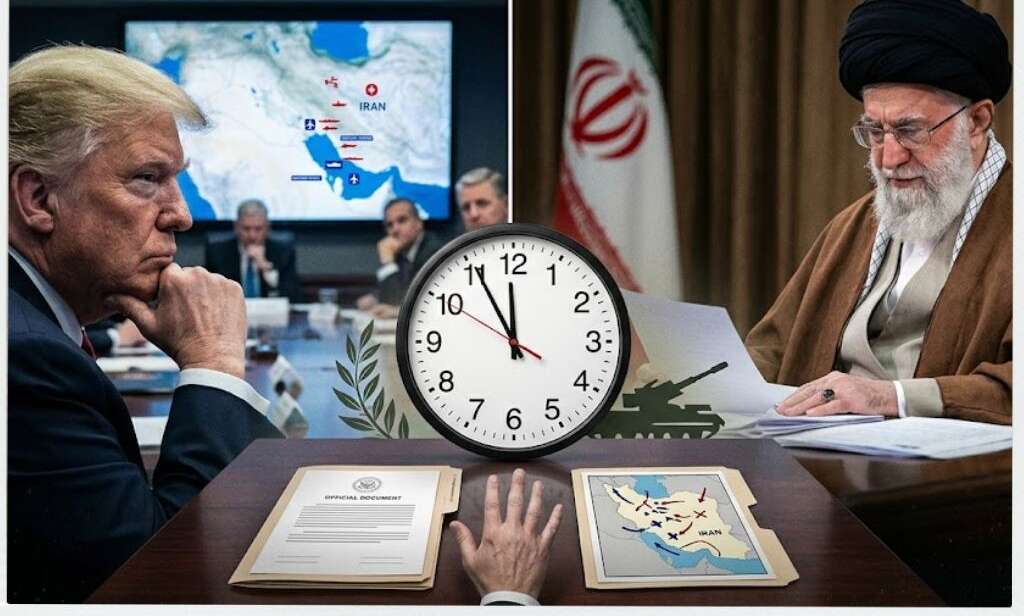
Donald Trump posted on Truth Social: “Remember when I gave Iran ten days to MAKE A DEAL or OPEN UP THE HORMUZ STRAIT. Time is running out — 48 hours before all Hell will reign down on them.” The clock had started. What followed was the most dangerous 48 hours in US foreign policy since
Donald Trump posted on Truth Social: “Remember when I gave Iran ten days to MAKE A DEAL or OPEN UP THE HORMUZ STRAIT. Time is running out — 48 hours before all Hell will reign down on them.”
The clock had started. What followed was the most dangerous 48 hours in US foreign policy since the Cuban Missile Crisis — a compressed, chaotic sprint between civilization-ending threats, a daring special forces rescue in enemy mountains, frantic back-channel diplomacy, and a ceasefire that arrived with ninety minutes to spare.
The War That Made It Possible
To understand those 48 hours, you need to understand the 40 days before them.
On February 28, 2026, the United States and Israel launched coordinated strikes on Iran that killed Supreme Leader Ali Khamenei, Defense Minister Aziz Nasirzadeh, IRGC Commander Mohammad Pakpour, and dozens of top security officials. Khamenei’s daughter, son-in-law, and grandchildren died in the same strike. Iran’s new Supreme Leader — Khamenei’s son Mojtaba — was elected on March 8, inheriting a country under bombardment and a Strait of Hormuz that Tehran immediately closed to all commercial shipping.
The closure triggered the largest energy disruption since the 1970s oil crisis. Brent crude hit $126 per barrel. Over 400 tankers anchored outside the strait. The global economy tipped toward stagflation.
Day One: The Threat Escalates Beyond Any Precedent
By Saturday, April 5, Trump’s language had crossed into territory that alarmed allies and adversaries alike.
In an Easter Truth Social post, he demanded Iran “Open the Fuckin’ Strait, you crazy bastards, or you’ll be living in Hell.” He threatened to destroy every bridge and power plant in the country by midnight Tuesday: “Tuesday will be Power Plant Day, and Bridge Day, all wrapped up in one.”
The UN Secretary-General warned that targeting civilian infrastructure violates international law. The European Council president called it “illegal and unacceptable.” Democrats in Congress demanded Trump be removed under the 25th Amendment. Even Trump ally-turned-critic Marjorie Taylor Greene joined the calls.
Trump’s response, asked if he was concerned about committing war crimes: “Not at all.”
The Rescue Mission Nobody Was Talking About
Beneath the rhetorical firestorm, another crisis was unfolding simultaneously. On April 3, an F-15E — the first US fighter jet shot down in combat in over 20 years — was downed over southwestern Iran. One crew member was rescued quickly. The second, a senior Air Force colonel, ejected into a mountain range and spent more than 24 hours hiding at 7,000 feet as Iranian officials publicly offered a $60,000 reward for his capture and local search parties combed the terrain.
The CIA launched a deception campaign inside Iran to misdirect the search. Hundreds of special forces personnel, dozens of warplanes, and multiple helicopters executed the extraction. The colonel was pulled from a mountain crevasse on Sunday morning, April 5 — the same morning Trump’s 48-hour countdown began. The rescue operation required US forces to destroy two disabled aircraft and four helicopters on Iranian soil to prevent capture of classified technology.
Trump cited the successful rescue as proof of American military dominance — and as additional leverage in the hours that followed.
Day Two: The Back Channel Opens
Monday, April 6. Iran formally rejected the latest ceasefire proposal, with its Foreign Ministry declaring: “Negotiation is in no way compatible with ultimatum, crime, or the threat to commit war crimes.” Markets whipsawed. Oil spiked. Regional governments braced.
But behind the public defiance, Pakistani Army Chief Field Marshal Asim Munir was already on the phone — simultaneously with US Vice President JD Vance, Special Envoy Steve Witkoff, and Iranian Foreign Minister Abbas Araghchi. Pakistan, Egypt, and Turkey were all pushing a framework: a 45-day ceasefire, beginning with a two-week pause, in exchange for Hormuz reopening.
Trump met with his national security team. Vance and Witkoff advised him plainly: take a deal if you can get one.
The Final Hours: Civilization-Level Brinkmanship
Tuesday, April 7. Morning.
Trump escalated one final time. He posted that “a whole civilization will die tonight, never to be brought back again” if Iran didn’t comply by 8 p.m. EDT. The post ricocheted across global newsrooms. Oil markets froze. Algorithmic traders watched Truth Social in real time. Billions of dollars of futures contracts changed hands.
At the UN, Secretary-General António Guterres issued an emergency statement. In Tehran, citizens stockpiled food and fuel. In Islamabad, Pakistani officials worked the phones in both directions simultaneously.
6:32 p.m. EDT — ninety minutes before the deadline. – Trump posted again. This time, the tone had flipped entirely: “I agree to suspend the bombing and attack of Iran for a period of two weeks.” Iran had agreed to reopen the Strait of Hormuz. Its 10-point peace proposal was, Trump said, a “workable basis on which to negotiate.”
WTI crude dropped 16.4% in minutes. The Dow rocketed 1,325 points. Global markets exhaled.
What the 48 Hours Revealed – The countdown exposed every contradiction of Trump’s foreign policy in concentrated form — the genuine military leverage, the deliberate rhetorical extremism, the quiet back-channel pragmatism, and the last-second pivot from annihilation to deal-making.
It also exposed the stakes beneath the drama. This was not a negotiation over tariffs or trade routes. It was a confrontation between a militarily degraded but nuclear-capable Iran, a US president willing to threaten civilian infrastructure on a public platform, and a global energy system already operating at crisis levels.
The 48-hour countdown ended — barely — with a ceasefire. Peace talks began in Islamabad on April 10, led by Vance, Witkoff, and Kushner. The structural gaps between the two sides’ positions remain enormous. Iran’s enrichment rights. US sanctions. Regional proxy militias. The future of the Strait itself.
The clock stopped. The countdown, in every meaningful sense, is still running.
Oil & Energy Markets
A look at crude price swings, OPEC supply moves, and how energy markets react to geopolitical shocks.