On the morning of April 10, 2026, a US Air Force aircraft carrying Vice President JD Vance, Special Envoy Steve Witkoff, and Senior Adviser Jared Kushner touched down in Islamabad, Pakistan. The delegation’s mission: negotiate a permanent end to a war that has killed thousands, shut down 20% of the world’s oil supply, and brought
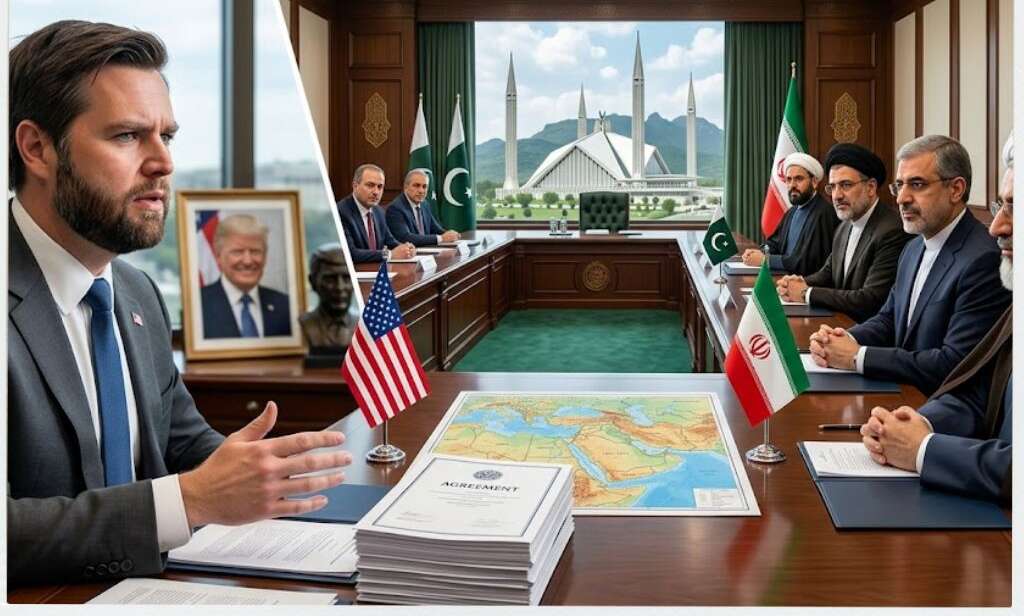
On the morning of April 10, 2026, a US Air Force aircraft carrying Vice President JD Vance, Special Envoy Steve Witkoff, and Senior Adviser Jared Kushner touched down in Islamabad, Pakistan.
The delegation’s mission: negotiate a permanent end to a war that has killed thousands, shut down 20% of the world’s oil supply, and brought the United States and Iran closer to full-scale conflict than at any point since the 1979 Islamic Revolution.
It is, by any measure, the highest-stakes diplomatic assignment in JD Vance’s career — and arguably one of the most consequential single negotiating sessions any American vice president has ever walked into.
A Man Built for Anti-War — Sent to End One
The central irony of Vance’s Islamabad mission runs deep. He spent years building his political brand as a principled anti-interventionist — a Marine veteran of the Iraq War who returned home convinced America’s appetite for foreign military adventures was its greatest strategic weakness. He led the charge against US support for Ukraine. He publicly opposed NATO expansion. He was, by his own framing, the MAGA movement’s foremost voice against endless war.
Then, on February 28, 2026, Donald Trump launched the Iran war. And Vance backed it publicly — while reportedly voicing private opposition to Trump and top White House aides for weeks, according to sources cited by MSNBC. He kept out of the limelight as the bombs fell, Tehran’s infrastructure burned, and the Strait of Hormuz shut down.
Now he is the one sent to stop it. Multiple analysts have noted the political calculus beneath the assignment: Vance is treading a tightrope between loyalty to Trump and the conflict-skeptic MAGA base he will need to win the Republican nomination in 2028. A successful peace deal in Islamabad would be the perfect resolution — ending a war he privately opposed while cementing his legacy as a statesman, not a warmonger. The question is whether Iran will let him.
Why Iran Chose to Show Up
Remarkably, Iranian officials have signaled that they view Vance as more sympathetic than other US negotiators. After its pre-war talks with Witkoff and other envoys collapsed when Trump launched the February 28 strikes — a move Iranian officials believe was deliberate, with diplomacy used as cover for military positioning — Tehran was left deeply skeptical of American good faith.
Vance’s anti-interventionist record offered a different signal. CNN, quoting regional sources, reported that Iran entered the Islamabad framework partly because it believed Vance represented a genuine faction within the Trump administration that wanted out of the conflict. Pakistan’s assessment, which helped bring Tehran to the table, reinforced that reading.
Iran’s delegation is formidable: Parliament Speaker Mohammad Bagher Ghalibaf — a former IRGC commander — and Foreign Minister Abbas Araghchi are leading Tehran’s team. Both are hardliners with deep institutional ties to Iran’s military establishment. Ghalibaf, in particular, is not a diplomat by instinct.
The Agenda — And the Minefield – The formal agenda for the Islamabad talks covers four explosive pressure points simultaneously.
First, the Strait of Hormuz. Trump made reopening it the non-negotiable price of the ceasefire. The White House insisted on passage “without limitation, including tolls” — a direct rebuke of Iran’s demand for controlled transit under its military coordination. Over 400 tankers remain anchored outside the strait as of today, with shipping companies waiting for hard guarantees before risking passage.
Second, Lebanon. Iran insists the ceasefire covers all regional hostilities, including Israel’s ongoing bombardment of Lebanon — which killed at least 254 people on April 8 alone. The US position is that Lebanon was never included. Vance called Iran’s objection on this point “dumb” but a “misunderstanding,” and confirmed that Israel has offered to restrain its Lebanon strikes during the negotiating window. Whether that restraint holds is another matter entirely.
Third, nuclear enrichment. The Trump administration’s hard red line — zero uranium enrichment on Iranian soil — crashes directly into Iran’s 10-point proposal, which explicitly includes “acceptance of enrichment” as a foundational demand. White House Press Secretary Leavitt has not wavered: “The president’s red line has not changed.”
Fourth, sanctions. Iran wants all primary and secondary sanctions lifted, frozen assets released, and war reparations paid before it considers further concessions. The US 15-point counter-proposal offers none of that upfront.
“Don’t Try to Play Us” – Before boarding his flight, Vance delivered a message calibrated to project both openness and menace: “If the Iranians are willing to negotiate in good faith, we’re certainly willing to extend the open hand. If they’re going to try to play us, they’re going to find the negotiating team is not that receptive.”
He called the current ceasefire a “fragile truce” and said Trump was “impatient to make progress.” Translation: the two-week window is real, the deadline is real, and the military option remains live.
What Success Actually Looks Like
No one in Islamabad today expects a comprehensive nuclear treaty to emerge from a single session. The realistic outcome analysts are watching for is a framework agreement: an extension of the ceasefire beyond two weeks, a commitment to the IAEA monitoring of Iranian nuclear sites, a phased sanctions relief roadmap, and a mutually agreed Hormuz transit protocol that avoids the word “control” in both English and Persian.
Even that would be historically extraordinary. The last time US and Iranian officials met at this level was before the Islamic Revolution. Vance, Witkoff, and Kushner are sitting across a table from officials of a government that has defined itself for nearly five decades in opposition to American power.
The ceasefire is fragile. The agenda is vast. The trust is nearly nonexistent. And the world is watching a 41-year-old former Marine from Ohio attempt to negotiate the peace agreement that every diplomat, think-tank expert, and foreign policy veteran said could never happen. No pressure.
Market Analysis
A quick snapshot of market trends, customer behavior, and competitor movements.