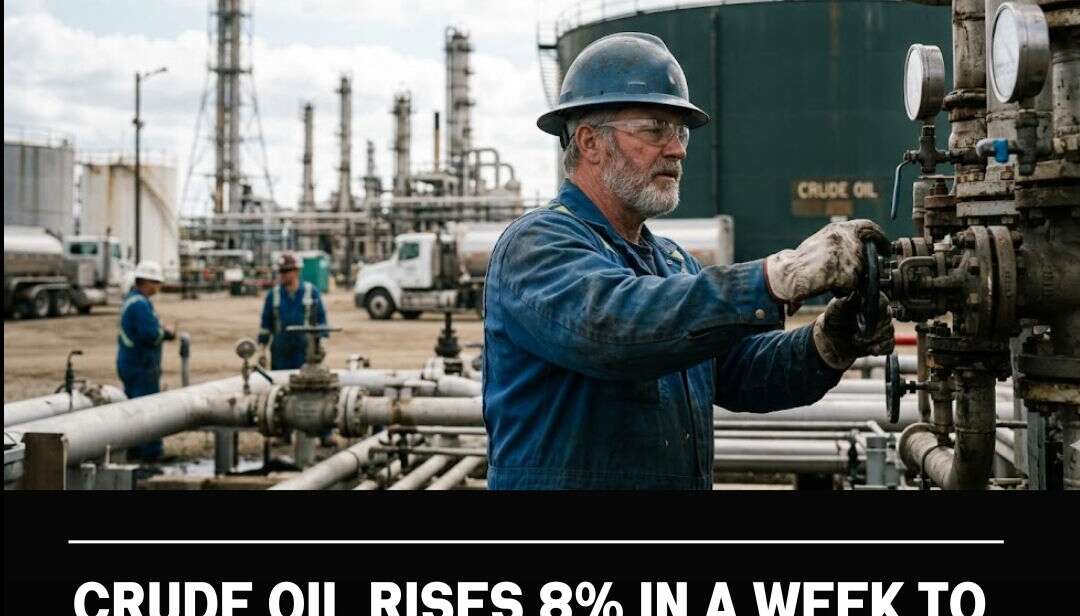
Crude oil has done it again. After a brief dip on peace deal optimism, Brent crude surged nearly 8% in a single week to touch $110 per barrel — a move that has energy traders, central bankers, and household budgets all asking the same question: how much higher can this go before something breaks?
Brent crude futures climbed to approximately $109–$110 per barrel by late May, posting a weekly gain of around 8% as the Iran war peace process stalled once more and the Strait of Hormuz remained effectively closed to commercial traffic. West Texas Intermediate followed closely, surpassing $105 per barrel. The moves came on the back of two converging pressures: renewed pessimism about a US-Iran deal after Trump declared the ceasefire was on “massive life support”, and fresh military incidents in and around the strait that reminded markets just how fragile the energy situation remains.
How We Got Here: A Price Timeline
The story of oil in 2026 is unlike anything energy markets have experienced in living memory.
On February 27, the day before the US and Israel launched strikes on Iran, Brent crude was trading at approximately $72 per barrel — elevated by regional tensions but broadly within a normal trading range. By March 5, just five days into the war, Brent had surged to $83 per barrel — a 15% jump in less than a week as the Strait of Hormuz closure became clear.
By the end of March, Brent had registered one of the largest single-month gains in modern history — climbing 51% from its February close to settle around $112 per barrel. The closure of the strait on March 4, through which 25% of the world’s seaborne oil and 20% of global LNG normally transit, had removed more supply from global markets than any event since the Arab oil embargo of the 1970s.
The market touched its wartime high of $126 per barrel briefly in late April, before retreating on peace deal speculation and the announcement of Project Freedom — Trump’s naval operation to guide stranded ships through Hormuz. But those hopes have repeatedly been undercut by the reality that Iran’s response to the US peace memorandum has been slow, contested, and ultimately insufficient to satisfy Washington’s red lines on nuclear enrichment and uranium transfer.
The result: oil that refuses to fall below $100 and surges sharply on any escalation signal.
What Is Driving the Latest 8% Weekly Move
The week’s 8% surge toward $110 was triggered by a convergence of bearish supply signals:
Stalled peace negotiations. Iran’s foreign ministry confirmed the US peace proposal remained under review, dismissing Washington’s deadlines as meaningless. Trump’s rejection of Tehran’s counter-proposal as “TOTALLY UNACCEPTABLE” ended a brief period of market optimism.
Hormuz shipping data. Ship transits through the strait remain at approximately 6 per day — down from the pre-war average of 130 — a 95% collapse in commercial traffic that is depleting global oil inventories at what the IEA calls a “record pace.”
OPEC production cuts. OPEC’s collective output has fallen by more than 9.7 million barrels per day since the war began — a 30% decline — as Gulf producers lose shipping access, infrastructure is disrupted, and investment confidence evaporates.
Goldman Sachs analysis estimates the Hormuz closure has removed 14.5 million barrels per day from effective global circulation when including the knock-on effects on regional LNG and refined product flows.
Where Are Prices Going? Analyst Forecasts
The range of expert forecasts for oil prices reflects genuine uncertainty about how and when the Israel-Iran war ends.
The IEA’s baseline scenario — which assumes the acute phase of disruptions ends in May and Middle Eastern exports recover by Q4 2026 — projects Brent averaging approximately $106 per barrel through the steepest inventory draw period of May and June, before gradually retreating to an $80–$90 range by late 2026 as supplies normalise.
ING Think has revised its oil forecast higher, noting that prolonged Hormuz disruption keeps the market structurally tighter than previously modelled. J.P. Morgan Global Research acknowledges significant upside risk in its commodity models, placing worst-case Brent scenarios in the $115 per barrel range under current conditions.
The most alarming projections come from Wall Street analysts gaming extreme scenarios: if the Hormuz closure persists into Q3 without resolution and global inventories are fully depleted, some models project Brent climbing toward $150 to $170 per barrel — a level that would represent an inflation shock of historic proportions for oil-importing economies. US government officials and some analysts have even floated the theoretical possibility of $200 oil if a broader regional escalation disrupts Saudi and UAE production simultaneously.
Saudi Aramco’s CEO has warned that the oil market will not normalise until 2027 if the Hormuz closure extends beyond mid-June — a timeline that, as of Day 75 of the crisis, is already under serious threat.
The Human Cost of Every Dollar
For every $10 per barrel that Brent rises above $72 — its pre-war level — the global economy pays a measurable price. US gasoline has already crossed $4.50 per gallon. India’s LPG imports have collapsed by over 50%. European industrial energy costs are surging. Asian manufacturing competitiveness is being eroded by fuel cost pressures.
With the US Iran war still unresolved, the Oman-India pipeline still years from construction, and the Trump-Xi summit producing a Hormuz principle agreement but no operational ceasefire, the $110 Brent crude price of today may look like a modest entry point for what comes next — unless diplomacy finally catches up with the cost.