Share This Article
For 47 years, the United States dictated the terms to Iran. On April 7, 2026, Iran submitted a 10-point peace plan and the President of the United States said it was a reasonable starting point. Read that again slowly.
ISLAMABAD / WASHINGTON – Something historically extraordinary happened inside the April 7 ceasefire announcement and it was buried beneath the oil price crash, the stock market surge, and the “whole civilization will die” headline.
Iran wrote the proposal. Trump accepted it as the basis for negotiation.
Not the other way around. In every prior iteration of US-Iran diplomacy the JCPOA negotiations of 2013–2015, the Obama-era back channels, the Trump first-term maximum pressure campaign the United States set the terms and Iran responded. Washington defined the acceptable framework. Tehran accepted, modified, or rejected it. That was the structural logic of every engagement for nearly five decades.
On April 7, 2026, Trump posted on Truth Social:
“We received a 10-point proposal from Iran, and believe it is a workable basis on which to negotiate. Almost all of the various points of past contention have been agreed to between the United States and Iran.”
Iran wrote the framework. The US called it workable. That is a seismic shift in the diplomatic architecture of the Middle East and almost nobody is talking about it.
What Iran Actually Proposed
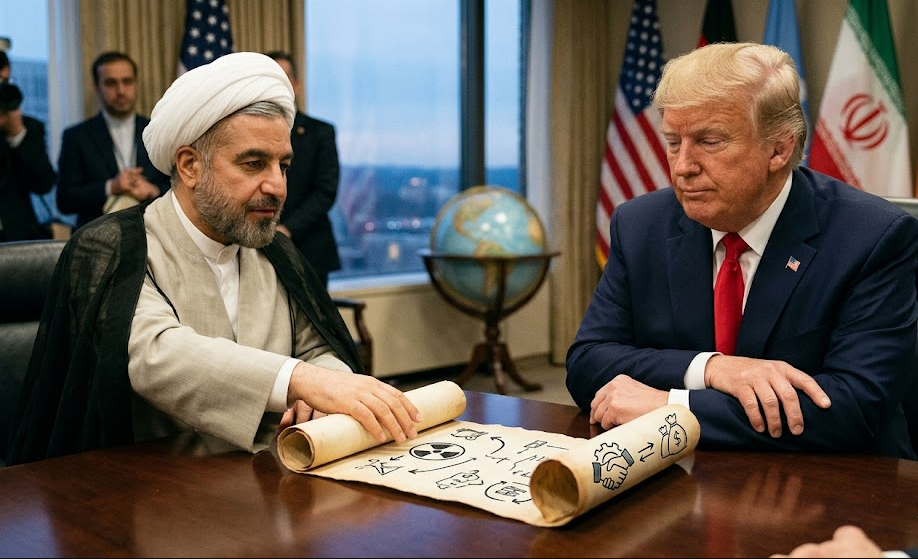
Iran’s 10-point peace plan is not a modest document. It is a maximalist framework that, if accepted in full, would represent the most significant Iranian diplomatic victory since the 1979 Revolution.
The plan demands: a complete and permanent cessation of all US and Israeli military operations against Iran; the lifting of all US, UN, and IAEA sanctions simultaneously; the return of all frozen Iranian assets held abroad; full compensation for war and reconstruction damages; Iran’s explicit right to domestic uranium enrichment with no dismantlement of existing facilities; and a binding UN Security Council ratification of any final agreement giving Russia and China veto power over future US enforcement.
It also demands the withdrawal of all US combat forces from Middle East bases, an end to US military support for operations against Iran’s regional allies Hezbollah, the Houthis, Iraqi militias and a permanent halt to what Tehran calls “economic warfare.”
This is not a negotiating opener designed to split the difference. Every single point reflects a core Iranian strategic interest that the US has actively opposed for decades. Iran did not offer concessions as an opening position. It offered demands and Trump called the document “workable.”
What the US Counter-Proposal Says – The United States entered Islamabad with its own 15-point counter-proposal not fully published, but extensively reported by Reuters, CNN, and Al Jazeera that is structurally the mirror image of Iran’s framework.
The US demands Iran completely dismantle enrichment facilities at Natanz, Fordow, and Isfahan. It demands the transfer of all highly enriched uranium Iran’s 460-kilogram stockpile of 60%-enriched material, enough for approximately 11 nuclear devices to a third country. It demands Iran end all support for Hezbollah, the Houthis, and regional proxy networks. It demands strict, unconditional IAEA inspections with no sunset clauses. Sanctions relief, in the US framework, comes gradually and conditionally not immediately and in full as Iran requires.
Iranian Foreign Minister Abbas Araghchi confirmed Washington had accepted the “general framework” of Tehran’s 10-point plan as a basis. Iran in turn is “considering” the US 15-point counter. Both delegations arrived in Islamabad knowing these two documents are not yet compatible on their most fundamental question: Iran insists it has the sovereign right to enrich uranium on its own soil. The United States insists those facilities must be dismantled entirely.
Every other issue sanctions, assets, proxies, verification flows downstream from that one unresolved core.
Why Trump Said ‘Workable’ – The word “workable” was not accidental. It was precisely calibrated.
Trump did not say Iran’s proposal was acceptable which would have been a concession. He did not say it was unacceptable which would have killed the ceasefire. “Workable basis on which to negotiate” is diplomatic language engineered to keep both sides at the table without committing the US to any specific term. It allowed Iran to present the ceasefire domestically as a diplomatic victory the Supreme Leader’s successor could tell the Iranian public that Washington was responding to their framework while giving Trump the headline, the oil crash, the stock surge, and the “total and complete victory” framing simultaneously.
Both sides walked away from April 7 claiming they had won. That is either masterful ambiguity or the setup for a catastrophic collapse when the ambiguity has to be resolved.
Secretary of State Marco Rubio did not hide his skepticism: “I’m not sure you can reach a deal with these guys.” BCA Research’s Matt Gertken predicted hostilities would “ignite later this year, if not later this month.” Ed Yardeni warned that “financial markets will remain sensitive to any breakdown.” And VP Vance who will lead the US delegation in Islamabad called the entire arrangement a “fragile truce” before the ink was dry.
The 14-Day Test – The Islamabad talks that opened April 10 must now translate “workable” into actual treaty language on enrichment rights, sanctions timelines, proxy disarmament, asset returns, and verification in 14 days. That is the same gap that collapsed six rounds of negotiations across 2025. It is the same gap that four US administrations and twelve years of multilateral diplomacy never successfully closed.
Iran wrote the proposal because it understood something important: whoever writes the first draft controls the frame of every subsequent negotiation. Trump called it workable because he needed a deal announcement more urgently than he needed the details resolved.
Now the details have to be resolved. And “workable” will either become a historic agreement or the most expensive word Trump ever posted on Truth Social.

Oil & Energy Markets
A look at crude price swings, OPEC supply moves, and how energy markets react to geopolitical shocks.

Geopolitics & Conflict
Breaking down how wars, ceasefires, and diplomatic deals ripple through global trade and security.
US Foreign Policy
Coverage of Trump administration negotiations, sanctions, and strategic decisions shaping world events.
Economy & Inflation
Tracking how commodity prices, gas costs, and supply chains affect everyday consumers.