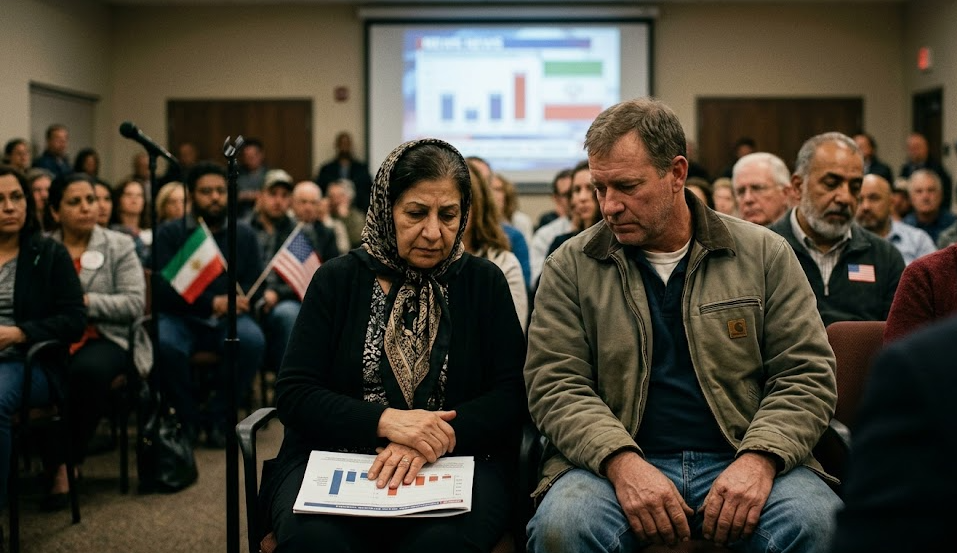
A new poll puts Trump’s approval at 37% — his lowest of the second term. The twin drivers are unmistakable: the Iran war that never ended and an economy that never recovered from it. The midterms are six months away. The ceasefire just collapsed. And the voters who built his coalition are now the ones
A new poll puts Trump’s approval at 37% — his lowest of the second term. The twin drivers are unmistakable: the Iran war that never ended and an economy that never recovered from it. The midterms are six months away. The ceasefire just collapsed. And the voters who built his coalition are now the ones paying the highest price.
WASHINGTON — The number that defines Donald Trump’s political standing in April 2026 is not the casualty count from the Iran war, or the oil price, or the Dow’s 10% correction. It is 37% — his approval rating in the latest national survey, the lowest of his second term, and a figure that tells the story of iran and economy better than any speech or policy document his administration has produced.
The polling, conducted April 15–18 by a consortium of national survey firms and reported by Reuters, NBC News, and the Wall Street Journal, captures a president whose support has eroded across constituencies that were foundational to his 2024 coalition: Catholic voters, suburban independents, rural working-class households, and small business owners — all groups whose daily economic reality has been reshaped, expensively and visibly, by a war they did not vote for and cannot afford.
The Iran and Economy Numbers That Explain 37%
The economic cost of the Iran war is not abstract. It arrives every time an American buys gasoline.
Before the US-Israel strikes on February 28 opened the iran and economy crisis that has defined the spring of 2026, the national average gasoline price was $2.98 per gallon. By the peak of the Strait of Hormuz closure, it had surged to $4.10 per gallon — a 37% spike that landed hardest on the rural and suburban working-class voters who form the base of Trump’s political coalition and who drive the most miles, in the largest vehicles, with the least ability to absorb price shocks.
WTI crude had been trading at $67.02 per barrel before the war. It surged toward $120 during the Hormuz closure. The Dow Jones corrected 10%. The Nasdaq entered correction territory. Consumer confidence fell to its lowest level since the 2022 inflation peak. The Federal Reserve, which had been on a cutting trajectory, paused — leaving borrowing costs elevated for the small business owners and homebuyers who had been waiting for relief.
The April 2026 poll found:
63% of Americans disapprove of Trump’s handling of the Iran conflict
67% say the Iran war has made the US economy worse
71% say gas prices are their top economic concern — the highest that figure has registered since Biden’s 2022 inflation peak
Only 34% believe the Iran war was necessary — down from 51% in a February poll taken before the ceasefire collapsed
Among self-identified Republicans, approval has fallen to 74% — historically low for a sitting president within his own party
The Constituencies Leaving
The 37% approval figure is not driven by Democrats, who have opposed Trump consistently throughout his presidency. It is driven by movements within three specific voter groups whose defection represents a structural threat to Republican competitiveness in the 2026 midterms.
Catholic voters — who delivered Trump 55–56% of their vote in 2024 — have moved to 48% approval, 52% disapproval in the latest survey. The catalyst is layered: the economic strain of iran and economy pressures compounds the theological backlash from Trump’s attacks on Pope Leo XIV and the deleted AI Jesus image. The US Conference of Catholic Bishops’ public condemnation, Bishop Barron’s demand for apology, and Rep. Brian Fitzpatrick’s formal congressional statement of censure have given Catholic voters institutional permission to separate their faith community’s judgment from their prior political loyalty.
Suburban independent women — a key 2024 swing constituency — have moved to 31% approval of Trump’s overall performance, driven primarily by gas prices and the perception that the Iran war was mismanaged. Focus groups conducted by the Public Religion Research Institute found suburban women describing the war in terms of kitchen-table economics: “It costs me $90 to fill my tank. I don’t care who’s winning the war. I care that I can’t afford groceries.”
Rural working-class voters without college degrees — the demographic that built Trump’s Electoral College margin — now register 52% approval, down from 72% at inauguration. The drop reflects the gas price shock’s concentrated impact on households that drive long distances for work and cannot absorb fuel cost increases through remote work or transit alternatives.
The Ceasefire Collapse Makes It Worse
The political timing could not be more damaging. The April 7 ceasefire — which briefly produced a 16% oil price crash, a 1,374-point Dow surge, and a wave of media coverage framing Trump as a masterful dealmaker — generated a short-lived approval bounce to 44% in mid-April surveys.
That bounce has been entirely erased. The ceasefire’s collapse — driven by the MV Sorena seizure, the USS Gravely engagement, the deaths of two IRGC sailors, and Iran’s formal withdrawal from the Islamabad talks — has produced a reversal that political analysts describe as unusually swift and unusually deep.
“Voters had priced in a win,” said Democratic pollster Celinda Lake. “When the win evaporated inside two weeks, the disappointment compounded the underlying disapproval rather than just resetting to baseline. People feel like they were told the war was over and it wasn’t.”
Republican pollster Frank Luntz framed it from within the coalition: “The 37% number is dangerous not because of its absolute level — presidents have recovered from lower. It’s dangerous because the voters leaving are not protest voters. They are performance voters who believed Trump would deliver cheaper energy and economic growth. The iran and economy story is telling them he hasn’t.”
Historical Context
Presidential approval at 37% six months before midterm elections is not unprecedented — but it is historically associated with significant House seat losses.
George W. Bush registered 37% approval in October 2006 — one month before Democrats gained 31 House seats and recaptured the majority. Barack Obama registered 44% approval before the 2010 midterms — and lost 63 seats. Trump’s own first-term midterms in 2018 saw approval at 40%, resulting in a 40-seat Democratic gain and loss of the House.
At 37% — with the iran and economy crisis unresolved, gas prices still elevated, the ceasefire collapsed, and Phase 2 of the Iran war potentially beginning — the structural conditions for a significant midterm reversal are more pronounced than at any comparable point in recent presidential history.
Republicans currently hold 222 House seats — a majority that requires losing only 5 seats to flip. The districts most exposed are precisely those suburban and exurban seats where Catholic voters, independent women, and working-class households have moved most sharply against Trump in response to the iran and economy combination.
Trump’s Response
Asked about the 37% figure during a Friday press availability at the White House, Trump disputed the methodology, the sample, and the premise simultaneously:
“Fake news polls. They’re all fake. The real polls show me at 52%. The economy is doing great — we just have a short-term situation with Iran that we’re handling. Best president ever, maybe in history. The stock market will be at record highs by November.”
The Dow closed Friday down 890 points in pre-market futures. WTI crude was trading at $108 per barrel. Gas prices at the pump showed no improvement from the $4.10 peak.
The numbers that built the 37% are not fake. They are receipts.
Market Analysis
A quick snapshot of market trends, customer behavior, and competitor movements.