Share This Article
Today in the US-Iran war Tuesday, April 21, 2026. In Tehran, Iran it is currently 8:30 a.m. local time (UTC+3:30). The ceasefire expires at midnight GMT tonight 8:00 p.m. Eastern, 11:30 p.m. Tehran time. No second round of talks has been confirmed.
The nuclear question at the center of the Iran-US war took a sharp new turn Monday when President Trump, posting on Truth Social which experienced brief access disruptions overnight amid a surge in traffic acknowledged for the first time that retrieving Iran’s buried uranium stockpile will not be the swift, clean resolution he had previously implied.
“Operation Midnight Hammer was a complete and total obliteration of the Nuclear Dust sites in Iran,” Trump wrote. “Therefore, digging it out will be a long and difficult process.”
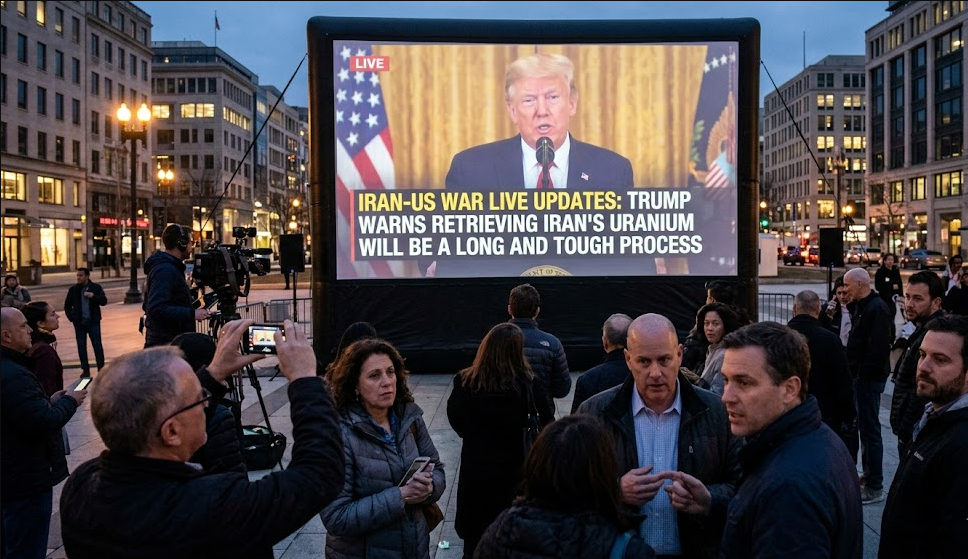
It was a significant concession wrapped in a boast. The same strikes Trump has repeatedly called historic were, he now acknowledged, so thorough that they buried the very material the United States needs to extract under tons of rubble, at facilities that satellite imagery confirms are sealed beneath compacted soil.
What the Strikes Actually Left Behind
Operation Midnight Hammer launched on June 21, 2025 a precision campaign deploying seven B-2 stealth bombers and more than two dozen Tomahawk cruise missiles against three Iranian nuclear facilities: Fordow, Natanz, and Isfahan. It was the first operational use of the GBU-57 Massive Ordnance Penetrator the United States’ largest bunker-busting bomb with 14 MOPs dropped across two targets alone.
The Pentagon called it “historically successful.” The IAEA had assessed, before the strikes, that Iran had stockpiled enough enriched uranium to construct nine nuclear bombs.
What the strikes produced physically is only now becoming clearer. Satellite imagery from February 2026 shows all three tunnel entrances to the Isfahan nuclear complex are completely buried under soil. New imagery around the same period shows Iran actively hardening a second facility Pickaxe Mountain, a clandestine site approximately one mile south of Natanz against future strikes.
The War on the Rocks assessment was blunt: “Twice Bombed, Still Nuclear: The Limits of Force Against Iran’s Atomic Program.” A senior Israeli official acknowledged that enriched uranium at Isfahan is believed to have survived, but may be buried and inaccessible not destroyed.
Trump’s “nuclear dust” framing, however resonant as political branding, does not reflect physical reality. Highly enriched uranium does not vaporize under conventional explosives. It gets buried. And buried uranium, in sufficient quantities and with the right recovery effort, remains usable.
Tehran’s Response: “It Is Not Going Anywhere”
Iran has flatly rejected Trump’s framing that the uranium would be transferred to U.S. territory as part of any deal.
“Enriched uranium is not going anywhere,” Iranian officials said in a statement that directly contradicted Trump’s Truth Social posts from last week, in which he claimed Iran had “agreed” to hand over its stockpile. PBS News confirmed that Iran has not confirmed any agreement to work with the U.S. to “dig up” its enriched uranium.
The Foundation for Defense of Democracies, analyzing the negotiations, warned that uranium removal alone was insufficient that without irreversible dismantlement of Iran’s enrichment infrastructure, any deal would leave the nuclear program recoverable within months. CSIS echoed the concern, noting that bombed facilities have historically been rebuilt faster than anticipated once political conditions shift.
U.S. demands currently require Iran to dismantle Fordow, Natanz, and Isfahan entirely, surrender its remaining stockpile of approximately 440 kilograms of highly enriched uranium, and agree to a 20-year suspension of enrichment. Iran has offered five years and has not agreed to permanent dismantlement of any facility.
Here are Some Related Blogs to Read
- Tuesday’s missiles didn’t come out of nowhere, Iran has been digging out hidden missile stockpiles after rejecting Trump’s peace offer.
- Not everyone in Trump’s own camp agrees on strategy, JD Vance claims Hegseth has been misleading Trump on the Iran war.
- This isn’t the only recent flashpoint at sea, a US Navy destroyer just fired on and seized an Iranian cargo ship.
- The strikes haven’t ended Iran’s nuclear ambitions either, US intel says recent strikes did only limited damage to Iran’s nuclear program.
- That brief pause before Tuesday’s attack wasn’t random, Trump had deliberately paused Hormuz operations to force Iran into a deal.
- The missiles are only half the story, Iran and Israel’s spy war is heating up amid claims of stolen F-15 secrets.
- Trump’s fights aren’t confined to Tehran, he’s now clashing with his own SCOTUS picks back home.
The Ceasefire Clock: Hours Remaining
As of this morning in Tehran, Iran and the United States are hours from the expiration of the ceasefire that has nominally halted active hostilities since April 8. The truce ends at midnight GMT 8:00 p.m. Eastern, 11:30 p.m. Tehran time tonight.
The US-Iran war today is defined by simultaneous contradictions: Trump threatening to “knock out every single Power Plant and every single Bridge in Iran” if no deal is reached, while also claiming a deal is imminent. Iran’s foreign ministry saying “no decision has been made” on whether to send negotiators to Islamabad, while Pakistani and Turkish mediators insist back-channel contacts are ongoing.
Vice President Vance, Special Envoy Steve Witkoff, and Jared Kushner are reportedly prepared to travel to Islamabad for a second round but a negotiation requires two delegations at the table.
Euronews described the situation as a ceasefire “on the brink of collapse.” NBC News reported Iran vows retaliation for the Touska seizure and has made “no decision” on new peace talks. The Strait of Hormuz remains closed to most commercial traffic. Brent crude is trading above $95 a barrel.
Trump’s uranium admission changes the strategic calculus in a specific way: even if Iran were to agree today to hand over its stockpile, the physical process of excavating, securing, and transferring buried nuclear material from a strike-damaged facility could take months to years. A deal signed Wednesday would not mean uranium leaves Iranian soil Wednesday. It would mean negotiations about how and when the uranium leaves Iranian soil negotiations that would continue long after any ceasefire formalities are signed.
“Long and difficult” is how the president described it. For a war he said was over in the first hour, the timeline keeps extending in every direction.

Oil & Energy Markets
A look at crude price swings, OPEC supply moves, and how energy markets react to geopolitical shocks.

Geopolitics & Conflict
Breaking down how wars, ceasefires, and diplomatic deals ripple through global trade and security.
US Foreign Policy
Coverage of Trump administration negotiations, sanctions, and strategic decisions shaping world events.
Economy & Inflation
Tracking how commodity prices, gas costs, and supply chains affect everyday consumers.