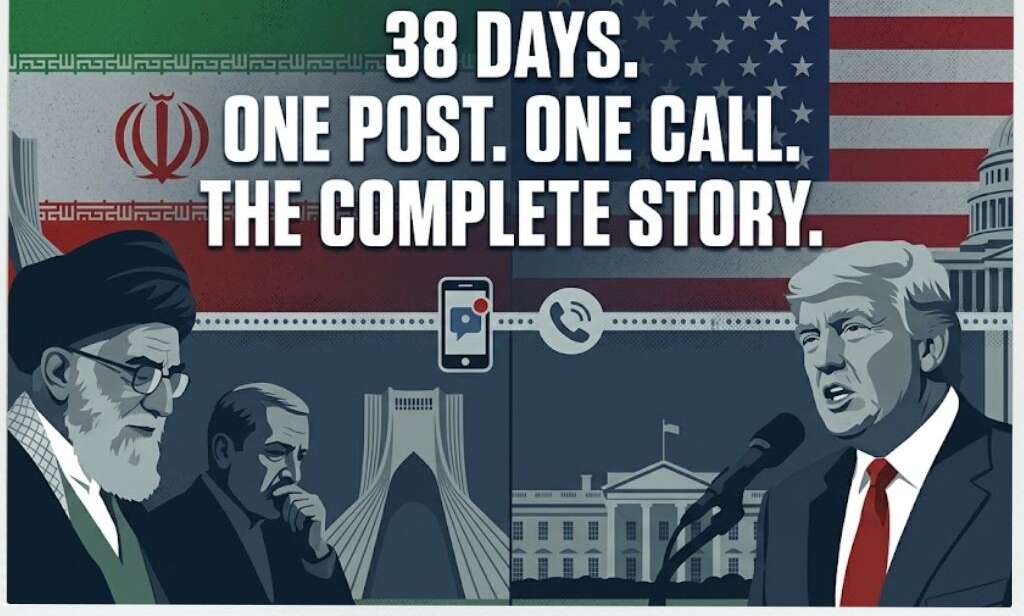
It began with 900 strikes before breakfast. It ended with a phone call from Islamabad and 126 words on Truth Social. Between those two moments: 38 days, 1,497 deaths, $144 oil, a closed strait, and the most consequential geopolitical crisis of the 21st century. Here is the complete story. WASHINGTON / TEHRAN / ISLAMABAD —
It began with 900 strikes before breakfast. It ended with a phone call from Islamabad and 126 words on Truth Social. Between those two moments: 38 days, 1,497 deaths, $144 oil, a closed strait, and the most consequential geopolitical crisis of the 21st century. Here is the complete story.
WASHINGTON / TEHRAN / ISLAMABAD — Start at the beginning.
Day 1: February 28, 2026 — 9:45 a.m.
The order came from Air Force One at 3:38 a.m. the night before. By morning, it was executing.
Nearly 900 US and Israeli strikes in 12 hours — the largest single-day military operation in the Middle East since the 2003 Iraq invasion. Targets: Iranian missile systems, air defense networks, command infrastructure, and leadership compounds. Supreme Leader Ali Khamenei was killed. Defense Minister Aziz Nasirzadeh was killed. IRGC Commander Mohammad Pakpour was killed. Four senior intelligence officials were killed. Seven of Iran’s most powerful figures — eliminated before noon.
Iran had one card left. I played it.
By February 28 evening, the Strait of Hormuz was closed — the first enforced closure of the world’s most critical oil chokepoint in modern history. Through that 21-mile channel flows 20 million barrels of oil per day — 20% of global petroleum supply, 34% of seaborne crude trade, 20% of global LNG. There is no realistic bypass for most of the world’s buyers. When it closes, the planet chokes.
Oil surged from $73 per barrel toward a physical Dated Brent peak of $144.42. A 97% war premium in five weeks. The Dallas Federal Reserve called it “the greatest global energy security challenge in history.”
Days 2–25: March 2026 — The World Tries to Stop It
The diplomats mobilized immediately. They failed repeatedly.
March 25: Pakistan delivered a US 15-point ceasefire proposal to Tehran. Iran rejected it.
March 31: Pakistan and China jointly submitted a 5-point peace initiative. Iran studied it.
April 5: Pakistani PM Shehbaz Sharif introduced the “Islamabad Accord” — a 45-day two-phase framework. Iran considered it.
Meanwhile the war continued. Israeli strikes. Iranian drone attacks on Gulf states. US carrier groups holding position. 800 vessels stranded in the region. Asian economies scrambling for alternative supply routes that did not exist. South Korea, Japan, India — collectively dependent on Hormuz for the majority of their crude imports — watching their energy security erode in real time.
The casualties mounted. 1,497 killed by the time it ended. Cities shaken. Infrastructure destroyed. Iran’s economy — already running at 43% inflation, a rial above 1 million to the dollar, food prices up 70% — collapsing under the combined weight of war, sanctions, and supply disruption.
Day 38: April 7, 2026 — 8:00 a.m.
Trump posted the threat.
“A whole civilization will die tonight, never to be brought back again. I don’t want that to happen, but it probably will.”
WTI crude surged above $116 per barrel. Tehran’s leadership — decapitated, economically shattered, militarily exhausted after 38 days — read the post. The deadline was 8:00 p.m. EDT. Ten hours. Open the Strait or face strikes on civilian infrastructure. Not military targets. Civilization itself.
Day 38: April 7, 2026 — The Call
Somewhere in those ten hours, Pakistan moved.
PM Shehbaz Sharif and Army Chief General Asim Munir — who had spent weeks shuttling between Washington and Tehran, who had delivered proposals and absorbed rejections and kept the channel alive through every breakdown — made the call. They reached Trump. They told him Iran was ready. They told him the framework was there. They asked him to hold back the “destructive force.”
Trump listened.
Day 38: April 7, 2026 — 6:30 p.m.
Ninety minutes before his own deadline, one post appeared on Truth Social.
“Based on conversations with Prime Minister Shehbaz Sharif and Field Marshal Asim Munir, of Pakistan… I agree to suspend the bombing and attack of Iran for a period of two weeks. This will be a double sided CEASEFIRE!”
126 words. No press conference. No allied coordination. No official White House statement. The post was the announcement.
Within seconds, oil futures began collapsing.
Day 39: April 8, 2026 — Morning
The numbers arrived with the trading day.
WTI crude closed at $94.41 per barrel — down 16%, its biggest single-day decline since April 2020. The Dow surged 1,374 points, its best session in over a year. The S&P 500 jumped 2.56%. Japan’s Nikkei gained 5.39%. South Korea’s KOSPI surged 7% — triggering a circuit breaker. Germany’s DAX added 4.7%. Interest rate cut probabilities jumped from 14% to 43% overnight. Every major asset class on Earth repriced because of one post and one phone call.
Trillions of dollars moved. Thirty-eight days of accumulated geopolitical terror began unwinding in real time.
Day 40: April 9, 2026 — Reality
The physical oil market never fully believed it. Dated Brent held above $120 throughout the futures crash — because the people who move actual barrels knew what futures traders had momentarily forgotten.
The ceasefire was cracking before it was 24 hours old. Israel launched “Operation Eternal Darkness” on Lebanon — 100 airstrikes in ten minutes. The IRGC halted Hormuz shipping again. Iran’s Lavan Island refinery was struck. Tehran accused Washington of breach. Oil began climbing back from its lows.
VP Vance called it a “fragile truce.” Rubio admitted: “I’m not sure you can reach a deal with these guys.” BCA Research warned hostilities could “ignite later this month.”
What Comes Next – Formal talks opened April 10 in Islamabad. The ceasefire expires April 23. The same unresolved core dispute that killed six rounds of 2025 negotiations waits at the center of every conversation: Iran insists on domestic uranium enrichment rights; the US demands dismantlement. Every other issue — sanctions, assets, proxies, verification — flows from that one.
Thirty-eight days of war. One Truth Social post. One phone call from Pakistan.
The complete story has 38 chapters behind it.
Chapter 39 is still being written.
Market Analysis
A quick snapshot of market trends, customer behavior, and competitor movements.