Share This Article
THIRUVANANTHAPURAM / NEW DELHI – For decades, India’s maritime vulnerability had a single address: the Strait of Hormuz.
The 21-mile chokepoint through which roughly 20% of the world’s oil supply flows daily was also the gateway through which India received the crude it burns to power its $3.7 trillion economy. Saudi Arabia, Iraq, the UAE, Kuwait India’s four largest oil suppliers all load their tankers in Persian Gulf ports that empty into the Strait of Hormuz. When Iran enforced the first full Hormuz closure in modern history on February 28, 2026, it did not merely disrupt global energy markets. It directly threatened the energy security of the world’s most populous nation.
India’s response scrambled, expensive, and ultimately more strategically revealing than any policy document has centered on a port that opened for commercial operations barely eighteen months ago: Vizhinjam International Seaport, carved into the southwestern tip of Kerala, 10 nautical miles from the world’s busiest east-west shipping lane.
The strait of the Hormuz oil crisis has turned Vizhinjam India’s most consequential piece of new infrastructure into its most urgently needed one.
What Vizhinjam Is and Why It Matters Now
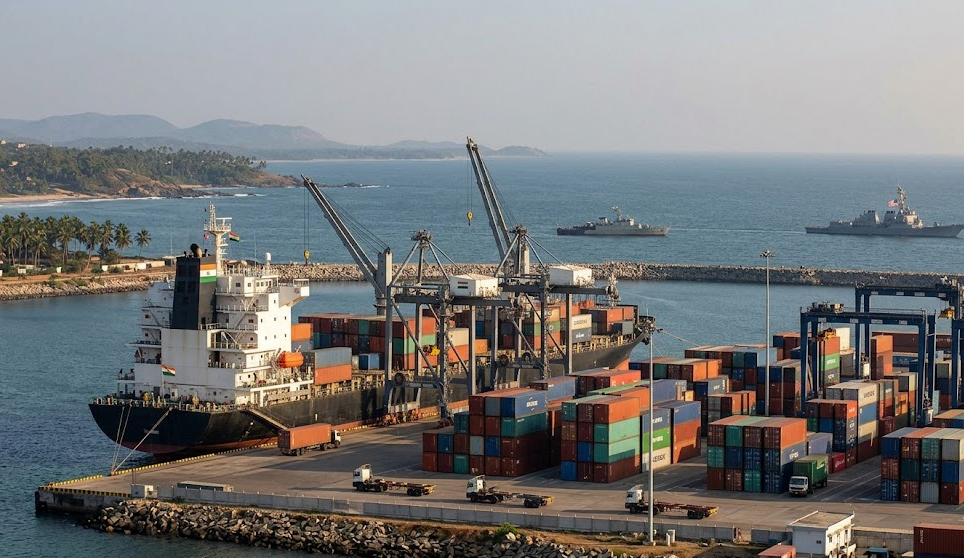
Vizhinjam International Seaport is India’s first genuinely deep-water transshipment port a facility designed to receive ultra-large container vessels that previously bypassed Indian ports entirely, offloading cargo at Colombo, Singapore, or Dubai’s Jebel Ali before smaller feeder vessels redistributed goods to Indian destinations.
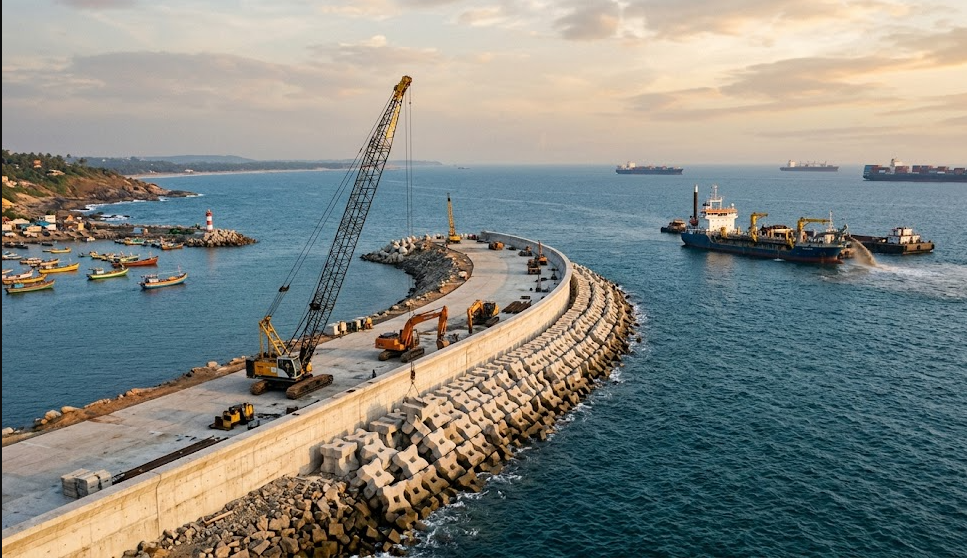
Developed by Adani Ports and Special Economic Zone under a concession agreement with the Kerala government, Vizhinjam has a natural draft exceeding 18 meters deep enough to accommodate the world’s largest container ships without dredging maintenance. Phase 1 capacity stands at approximately 1 million TEUs (twenty-foot equivalent units), with Phase 2 expansion already approved. The total Phase 1 investment reached approximately ₹7,525 crore (~$900 million).
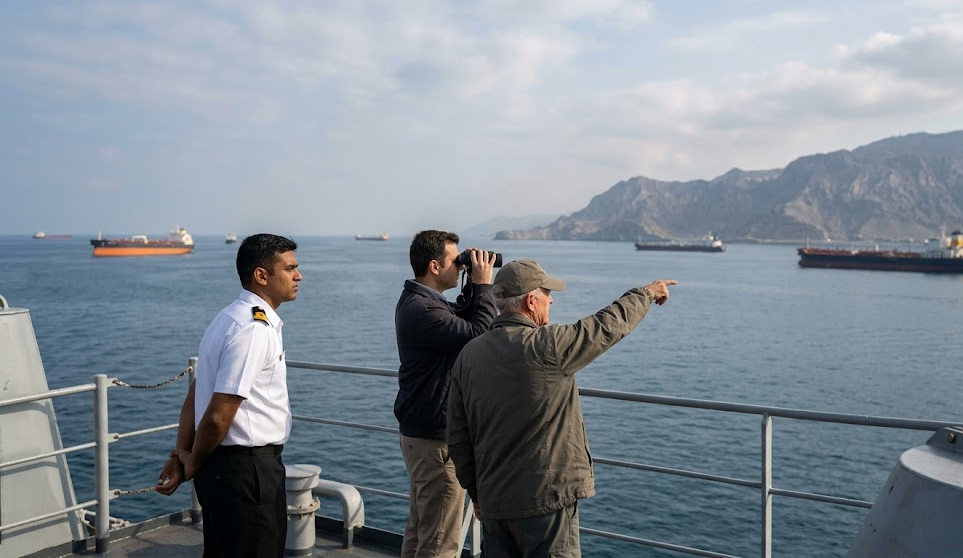
Its strategic location is the critical variable. Vizhinjam sits approximately 10 nautical miles from the international shipping lane connecting Europe, the Middle East, and East Asia the same lane that vessels rerouting around the Cape of Good Hope must now traverse to bypass the Hormuz-Suez corridor. Before the straits of hormuz oil crisis, roughly 30% of global container traffic passed within direct reach of Vizhinjam’s berths. After the crisis rerouted shipping through the Cape of Good Hope, that percentage surged dramatically and Vizhinjam was positioned to capture it.
India’s Hormuz Exposure, The Numbers
To understand Vizhinjam’s emergency strategic importance, the scale of India’s Hormuz dependency must be stated clearly.
India is the world’s third-largest oil consumer, importing approximately 4.7 million barrels per day to meet roughly 85% of its crude requirements. Of that volume, the Persian Gulf and therefore the Strait of Hormuz has historically supplied approximately 60–65% through Saudi Arabia, Iraq, UAE, and Kuwait collectively. When oil surged from $72.87 to a physical peak of $144.42 per barrel during the Hormuz oil crisis, India’s monthly crude import bill effectively doubled adding an estimated $8–10 billion per month in additional costs to an economy already managing post-pandemic fiscal pressures.
The Modi government moved on multiple fronts simultaneously. Emergency procurement agreements with Russia whose Urals crude travels overland and through non-Hormuz maritime routes were accelerated. US LNG import volumes were expanded under existing agreements. India’s strategic petroleum reserve of approximately 38 million barrels sufficient for roughly 9–13 days of consumption at normal rates was partially activated to buffer domestic refinery throughput during the peak disruption weeks of March 2026.
But none of those measures addressed the structural shipping disruption that the strait of hormuz crisis created for India’s broader supply chain the container cargo, the chemical tankers, the LPG shipments, the dry bulk vessels all rerouting away from the Gulf and through new corridors that Indian infrastructure had never been designed to handle at crisis scale.
That is where Vizhinjam India stepped into a role its planners had anticipated but not yet stress-tested.
Vizhinjam’s Crisis Moment
When global shipping operators began mass-rerouting vessels via the Cape of Good Hope in March 2026 adding 10–14 days to average transit times between Asia and Europe but avoiding the Hormuz-Suez closure entirely Vizhinjam’s position on the Cape route suddenly transformed from competitive advantage to operational necessity.
Three dynamics converged simultaneously.
First, vessels that previously called at Dubai’s Jebel Ali the Gulf’s dominant transshipment hub and itself Hormuz-adjacent needed an alternative transshipment point for Indian-bound cargo. Vizhinjam, positioned directly on the Cape route with deep-water berths capable of receiving ultra-large vessels, absorbed a significant share of that diverted traffic. Port authority data cited by the Economic Times indicated berth utilization at Vizhinjam surged to near-capacity within three weeks of the Hormuz closure a utilization rate that would have taken years to achieve under normal conditions.
Second, Indian refineries dependent on Gulf crude needed alternative loading arrangements. Vizhinjam’s deep draft enabled Very Large Crude Carriers (VLCCs) carrying Russian, African, and US crude on non-Hormuz routes to discharge directly at the Kerala coast rather than lightering into smaller vessels at anchor reducing per-barrel logistics costs and transit time for alternative supply sources.
Third, India’s position within the Pakistan-mediated Iran ceasefire framework produced an unexpected maritime benefit: Iran selectively allowed Indian-flagged vessels passage through Hormuz in late March, citing India’s non-belligerent status and Pakistan’s mediating role. That selective access while politically sensitive and operationally uncertain provided partial relief for Indian crude tankers even during the peak closure period, reducing India’s dependence on full rerouting compared to European and East Asian buyers.
The Strategic Dividend
The strait of hormuz oil crisis has done something that years of infrastructure advocacy could not: it has demonstrated Vizhinjam’s strategic value to every Indian policymaker, shipping executive, and energy minister simultaneously, and it has done so under live operational conditions.
Before February 28, Vizhinjam was a promising new port asset gradually building its shipper relationships and transshipment volumes. After February 28, it became a crisis infrastructure node absorbing diverted traffic, enabling alternative crude supply chains, and demonstrating India’s capacity to partially insulate itself from Hormuz dependency through domestic port development.
Shipping analyst Anil Devli of the Indian National Shipowners Association told Mint: “Vizhinjam’s timing could not have been more fortunate for India. The crisis has compressed five years of traffic development into five weeks. The port has proven itself under conditions that no port authority would have chosen but every port authority would have wanted.”
The Kerala government has already announced accelerated approval for Phase 2 expansion doubling berth capacity with central government infrastructure financing support. The crisis has generated the political will that peacetime planning rarely produces.
What Vizhinjam Cannot Fix
The strait of hormuz oil crisis has also exposed the limits of what any single port however well-positioned can resolve.
India’s fundamental Hormuz dependency is not a port problem. It is an energy sourcing problem. As long as Saudi Arabia, Iraq, the UAE, and Kuwait supply the majority of India’s crude, that crude must travel through or around the Persian Gulf regardless of where it ultimately offloads. Vizhinjam provides better logistics for alternative supply routes Russian, African, American. It does not change the geographic reality that India’s primary suppliers load their tankers in Hormuz-adjacent waters.
The Modi government’s longer-term response accelerating domestic renewable energy capacity, expanding strategic petroleum reserves from 13 to 30 days of consumption, deepening Russian and American energy partnerships reflects an understanding that Vizhinjam is infrastructure optimization, not energy independence.
But in the immediate crisis, infrastructure optimization has been exactly what India needed. And Vizhinjam India delivered it at the precise moment the strait of hormuz oil crisis made the need impossible to defer.

Oil & Energy Markets
A look at crude price swings, OPEC supply moves, and how energy markets react to geopolitical shocks.

Geopolitics & Conflict
Breaking down how wars, ceasefires, and diplomatic deals ripple through global trade and security.
US Foreign Policy
Coverage of Trump administration negotiations, sanctions, and strategic decisions shaping world events.
Economy & Inflation
Tracking how commodity prices, gas costs, and supply chains affect everyday consumers.