
Global Trends
Rupee Falls to 96.17 Versus the Dollar for the First Time: What’s Driving the Slide?
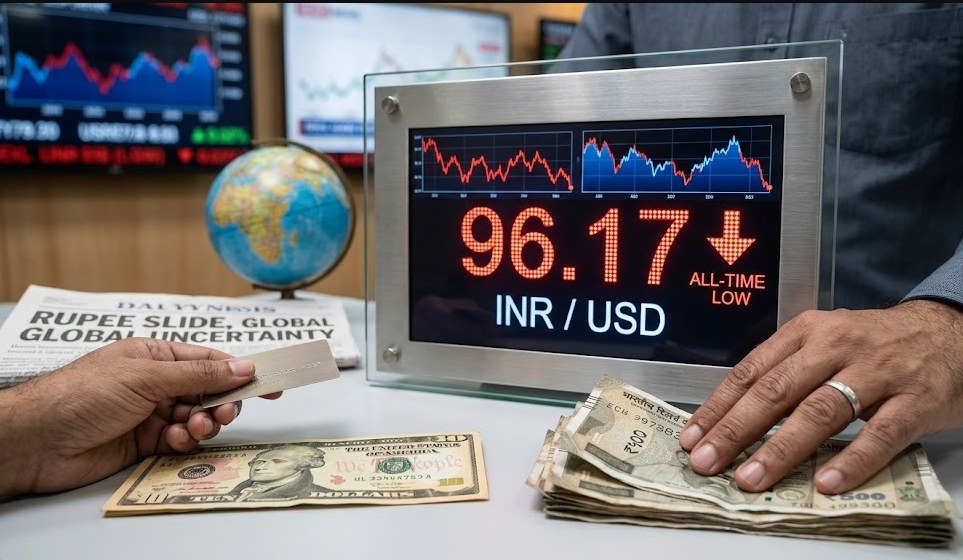
Mumbai / New Delhi, May 18, 2026 – The Indian rupee broke through yet another floor on Sunday, touching a record low of 96.17 against the US dollar a level that would have been unthinkable eighteen months ago and is now, grimly, a milestone in a slide that has made the rupee Asia’s worst-performing major…

Mumbai / New Delhi, May 18, 2026 – The Indian rupee broke through yet another floor on Sunday, touching a record low of 96.17 against the US dollar a level that would have been unthinkable eighteen months ago and is now, grimly, a milestone in a slide that has made the rupee Asia’s worst-performing major currency of 2026.
The number is not an aberration. It is the arithmetic of a perfect storm: a war that closed the world’s most important oil chokepoint, a $25 billion exodus of foreign capital, a trade deficit that blew out to $28.38 billion in April alone, and a central bank that has burned through over $30 billion in forex reserves since February trying with limited success to slow the fall.
The US-Iran War: Root Cause, Not Background Noise
Every serious analysis of the rupee’s collapse begins in the same place: February 28, 2026, the day US and Israeli forces launched strikes on Iran, killed Supreme Leader Ayatollah Ali Khamenei, and triggered the closure of the Strait of Hormuz. From that date, the rupee has depreciated approximately 5.5 percent a relentless, grinding move that has accelerated with each failed round of diplomacy.
India imports 89.44 percent of its crude oil. Oil accounts for 22 percent of total imports, costing $174.9 billion in the last fiscal year. Every $10 rise in Brent crude adds approximately ₹1.1–1.3 lakh crore to the annual import bill. Brent, which traded at $72.87 on February 27, peaked at $138 in April and sits near $111 today. India’s monthly oil import bill at current prices is running at approximately $19 billion a figure that demands a constant, massive flow of dollars out of the country and into global energy markets.
The rupee is the pressure valve for that outflow. As Business Standard reported, the rupee falls directly in tandem with each leg up in crude a mechanical relationship that no amount of RBI intervention can permanently sever so long as the US-Iran War keeps oil elevated.
The Capital Flight: ₹2.1 Lakh Crore and Counting
Oil is the structural cause. But the rupee’s sharpest moves have been amplified by a simultaneous, historic exodus of foreign capital. Foreign Portfolio Investors have pulled over ₹2.1 lakh crore approximately $25–27 billion out of Indian markets in 2026, making it the worst year for FPI outflows since 1993, according to data compiled by Multibagg.
March 2026 alone saw ₹1.17 lakh crore in outflows the largest single monthly exodus on record. April followed with ₹60,847 crore. May, through mid-month, has already clocked ₹27,048 crore more. The aggregate foreign holding in Indian listed stocks has fallen to a 14-year low of 14.7 percent.
The drivers are interlinked: geopolitical risk repricing, a strengthening US dollar as Treasury yields stay elevated, and a basic investor calculus that emerging market equities carry outsized downside when a country importing 89 percent of its crude faces a war in its primary supply region. Iran’s Foreign Minister Abbas Araghchi arrived in New Delhi on May 13 for the BRICS meeting and the rupee hit 95.50 the same day, reading the diplomatic deadlock in real time. When the BRICS meeting ended without a joint statement on the West Asia crisis, the currency slid further.
RBI’s Shrinking Arsenal
The Reserve Bank of India has not stood idle. Since February, it has deployed over $30 billion in intervention, drawing forex reserves down from a February peak of $728.49 billion to $696.99 billion as of May 8. RBI Governor Sanjay Malhotra has stated the bank is “targeting volatility, not specific rupee levels” careful language that acknowledges the limits of intervention when the underlying current account pressure is structural.
The RBI has reached for unconventional tools. On April 1, it banned authorised dealers from offering non-deliverable forward contracts to resident and non-resident corporates a dramatic move designed to cut offshore rupee speculation. It imposed a hard cap of $100 million on net open positions banks can hold in rupees. India raised customs duty on gold and silver from 6 percent to 15 percent to reduce non-essential import demand on forex reserves.
As MUFG Research noted, these capital control measures signal a strategic shift from burning reserves to defend a level, toward structural limits on speculative positioning. The RBI, in effect, is rationing the battlefield rather than trying to win it outright.
The Trade Deficit: April’s Alarming Number
The rupee’s path is also being shaped by a widening merchandise trade deficit. April 2026’s figure $28.38 billion, up sharply from $21 billion in March captures the full breadth of the import shock. Oil and gold deficits each rose approximately $2 billion. Electronics hit an all-time high deficit of $7.6 billion. As MarketScreener reported, imports are outpacing exports across nearly every major category the exact structural condition that sustains downward pressure on any currency.
SBI Research has warned starkly that “rupee depreciation can wipe out gains from the fuel price hike” the first retail petrol and diesel increase in 49 months, implemented earlier this year. The depreciation inflates the rupee cost of every dollar of oil, negating the government’s fiscal management at the retail level. Retail inflation, already at a 13-month high of 3.8 percent in April, is set to climb further as imported price pressures ripple through supply chains.
Who Wins, Who Loses at 96
Not every constituency suffers equally. IT exporters TCS, Infosys, Wipro, HCL Tech earn dollar revenues and book them in rupees; every rupee of depreciation is a margin tailwind. Pharmaceutical exporters share the same dynamic. For these sectors, 96 is a windfall, not a crisis.
For importers, manufacturers dependent on foreign inputs, and the 1.4 billion Indians paying for daily essentials, the calculus runs the other way. Higher import costs feed through to electronics prices, vehicle costs, and most painfully fuel. Oil Marketing Companies are absorbing an estimated ₹1,750–1,850 crore per day in under-recovery at current Brent levels, a fiscal time bomb that the government cannot indefinitely defuse.
The rupee’s next level depends on one variable above all others: whether the US-Iran War finds a diplomatic off-ramp that reopens the Strait of Hormuz and lets oil prices fall. Iran’s Foreign Minister Araghchi told the BRICS gathering in New Delhi that a “lack of trust” remains the biggest obstacle to US negotiations and that Tehran doubts American seriousness. Until that trust gap closes, the structural pressure on the rupee does not close with it.
As FXStreet’s analysis put it: the rupee’s record low is deepening. The floor, for now, remains elusive.