
Share This Article
New Delhi / Abu Dhabi / Washington, May 18, 2026 – Three drones entered UAE airspace on the evening of May 17. Two were intercepted. One was not.
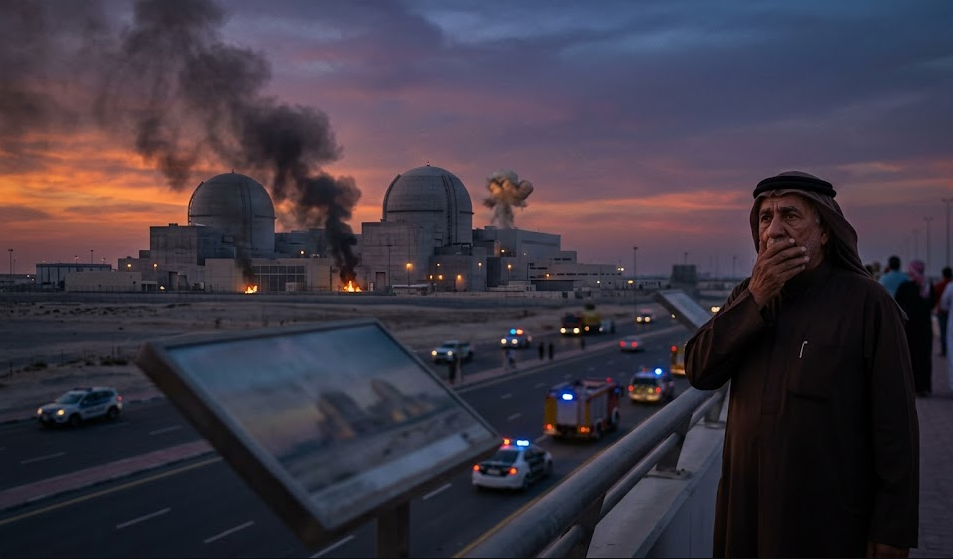
The surviving drone struck an electrical generator at the perimeter of the Barakah Nuclear Power Plant the UAE Nuclear facility, a four-reactor complex in Abu Dhabi’s Al Dhafra region capable of supplying 25 percent of the Emirates’ electricity. A fire broke out. Emergency response teams contained it. No radiation leaked. No reactor was compromised. No one died.
Here are Some Related Blogs to Read
- Get the full picture on where this war is headed – more Trump-era geopolitical coverage at DonaldTrump.Coach.
- Tuesday’s missiles didn’t come out of nowhere, Iran has been digging out hidden missile stockpiles after rejecting Trump’s peace offer
- Not everyone in Trump’s own camp agrees on strategy, JD Vance claims Hegseth has been misleading Trump on the Iran war
- This isn’t the only recent flashpoint at sea, a US Navy destroyer just fired on and seized an Iranian cargo ship
- The strikes haven’t ended Iran’s nuclear ambitions either, US intel says recent strikes did only limited damage to Iran’s nuclear program
- That brief pause before Tuesday’s attack wasn’t random, Trump had deliberately paused Hormuz operations to force Iran into a deal
- The missiles are only half the story, Iran and Israel’s spy war is heating up amid claims of stolen F-15 secrets
- Trump’s fights aren’t confined to Tehran, he’s now clashing with his own SCOTUS picks back home
- Global supply chains are already bracing for impact, Goyal’s courting 50 US leaders in New York over exactly that.
- Stay ahead of the story track it live or get the full background on how the US-Iran war escalated to this point.
And yet, in the careful language of nuclear risk management, a line was crossed that the world had hoped would never be approached. Striking any infrastructure at a functioning UAE Nuclear power plant even its electrical perimeter is an act in a category of its own. By Saturday morning, the condemnations were global, the ceasefire in the US-Iran War was facing its most severe test since April, and India had used two words that cut through the diplomatic noise: dangerous escalation.
India Speaks and the Words Are Deliberate
New Delhi’s response was swift and unusually direct for a government that has spent the entire US-Iran War navigating with studied neutrality. India’s Ministry of External Affairs condemned the drone attack on Barakah as a “dangerous escalation” and called such actions “unacceptable,” urging “restraint and a return to dialogue and diplomacy,” as India TV News reported.
External Affairs Minister S. Jaishankar moved immediately to the phones reaching counterparts in Qatar, the UAE Nuclear, and Iran. He spoke directly with Iran’s Foreign Minister Abbas Araghchi, the same diplomat who had sat across from him in New Delhi just three days earlier at the BRICS Foreign Ministers’ Meeting. He also spoke with Israeli FM Gideon Sa’ar. The message from every call was consistent: India is alarmed, India wants de-escalation, and India will not stay silent when nuclear infrastructure is targeted.
The timing made India’s reaction especially pointed. Araghchi had left New Delhi on May 15 after BRICS failed to produce a joint statement precisely because of the Iran-UAE clash with Iran and the UAE Nuclear trading accusations in front of the world’s press. Three days later, a drone was burning near a nuclear reactor in Abu Dhabi. New Delhi has been watching both sides of this conflict from a position of painful vulnerability: India imports 89 percent of its crude oil, the Iranian strikes have closed the Strait of Hormuz, and the rupee hit a record low of 96.17 against the dollar the same weekend Barakah was struck.
What Happened at Barakah and What Didn’t
The Barakah plant, built jointly by the Emirates Nuclear Energy Corporation and South Korea’s KEPCO, is one of the most significant civilian infrastructure projects in the Arab world. Its four APR-1400 reactors have a combined nameplate capacity of 5,600 megawatts. Unit 4 reached commercial production as recently as September 2024. At the time of the strike, all four units were operating normally. One temporarily switched to emergency diesel generators during the incident before returning to standard operation.
The IAEA’s Director General Rafael Mariano Grossi moved rapidly, expressing “grave concern” and stating that “auxiliary site buildings may contain vital safety equipment and must never be attacked,” calling for “maximum military restraint to avoid the danger of a nuclear accident,” as World Nuclear News reported. The UAE’s Federal Authority for Nuclear Regulation confirmed radiation levels remained entirely normal.
No one claimed the attack immediately. But The Jerusalem Post cited sources stating the strike was intended “to send a message to the Emiratis” a message rooted in the accusation Araghchi had levelled at the BRICS meeting: that the UAE had provided bases, airspace, territory, intelligence, and facilities to the United States and Israel for strikes on Iran. The UAE had intercepted more than 2,800 Iranian drones and missiles since February 28. This was Iran’s most consequential counter-message yet.
The UAE’s Response: ‘Treacherous Terrorist Attack’
Sheikh Abdullah bin Zayed, the UAE’s Deputy Prime Minister and Foreign Minister, did not mince language. The strike was a “treacherous terrorist attack,” a “dangerous escalation,” and an “unacceptable act of aggression” that represented a “flagrant violation of international law.” The UAE reserved its right to respond to protect its sovereignty, security, and territorial integrity without, notably, officially naming Iran in its statement, as The National reported.
Saudi Arabia, Jordan, Kuwait, Bahrain, Qatar, and the Arab League joined the condemnation. Saudi Crown Prince Mohammed bin Salman and UAE President Mohamed bin Zayed Al Nahyan warned jointly that continued Iranian strikes “may lead to a regional escalation” language that, coming from Riyadh and Abu Dhabi simultaneously, carries the weight of potential military consequence.
UN Secretary General António Guterres was unequivocal: “Attacks on nuclear infrastructure are unacceptable and risk dangerous escalation across the region. There must be no further attacks near civilian infrastructure, including nuclear power plants.”
Trump’s Clock and the Ceasefire’s Survival
The Barakah strike landed directly inside the US-Iran War’s most fragile diplomatic window. The ceasefire brokered by Pakistan on April 8 was already described by Trump as on “massive life support.” Iran’s 14-point peace proposal had been rejected as “TOTALLY UNACCEPTABLE.” Islamabad Talks had collapsed after 21 hours. And now a drone had hit a nuclear plant in a US-aligned Gulf state.
Trump’s response on Truth Social was volcanic: “For Iran, the Clock is Ticking, and they better get moving, FAST, or there won’t be anything left of them. TIME IS OF THE ESSENCE!” A Situation Room meeting was scheduled for May 19 to discuss potential military options, as the Washington Post reported. Iran’s IRGC warned in return that the US would face “new, aggressive, and surprise scenarios” if Trump carried through on his threats.
For India watching the rupee fall, watching the Strait stay closed, watching Iran’s Foreign Minister leave New Delhi and three days later watch a drone hit a nuclear power plant the phrase “dangerous escalation” is not diplomatic boilerplate.
It is a precise description of where the world now stands.

Oil & Energy Markets
A look at crude price swings, OPEC supply moves, and how energy markets react to geopolitical shocks.

Geopolitics & Conflict
Breaking down how wars, ceasefires, and diplomatic deals ripple through global trade and security.
US Foreign Policy
Coverage of Trump administration negotiations, sanctions, and strategic decisions shaping world events.
Economy & Inflation
Tracking how commodity prices, gas costs, and supply chains affect everyday consumers.