
Geopolitics
Rockets Are Flying Over Israel and Its Tech Industry Just Had Its Best Year Yet
JERUSALEM / NEW YORK, October 5, 2026 – Three years after the October 7 attacks put Israel on a war footing, and months after a second war with Iran in a single year, the country’s economy is sending a message that surprises many Americans: it is still growing, its currency is near its strongest level…

JERUSALEM / NEW YORK, October 5, 2026 – Three years after the October 7 attacks put Israel on a war footing, and months after a second war with Iran in a single year, the country’s economy is sending a message that surprises many Americans: it is still growing, its currency is near its strongest level in more than three decades, and its tech sector is posting numbers that rival the best years in its history.
The Israel war economy is not a simple story of collapse or boom. It is both at once. Here is what the data actually shows.
The Headline Numbers
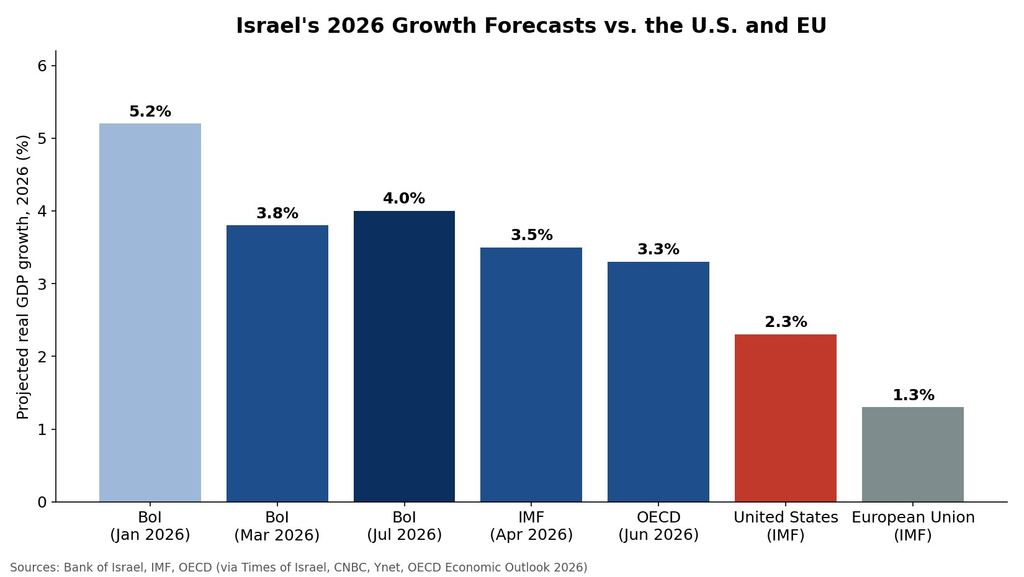
- GDP growth: The Bank of Israel now expects the economy to grow 4% in 2026 and 5.5% in 2027, an upgrade from the 3.8% it projected in March during the Iran war.
- Tech exits: Israeli tech exits hit a record $84 billion in 2025, counting the Wiz, CyberArk and Armis deals.
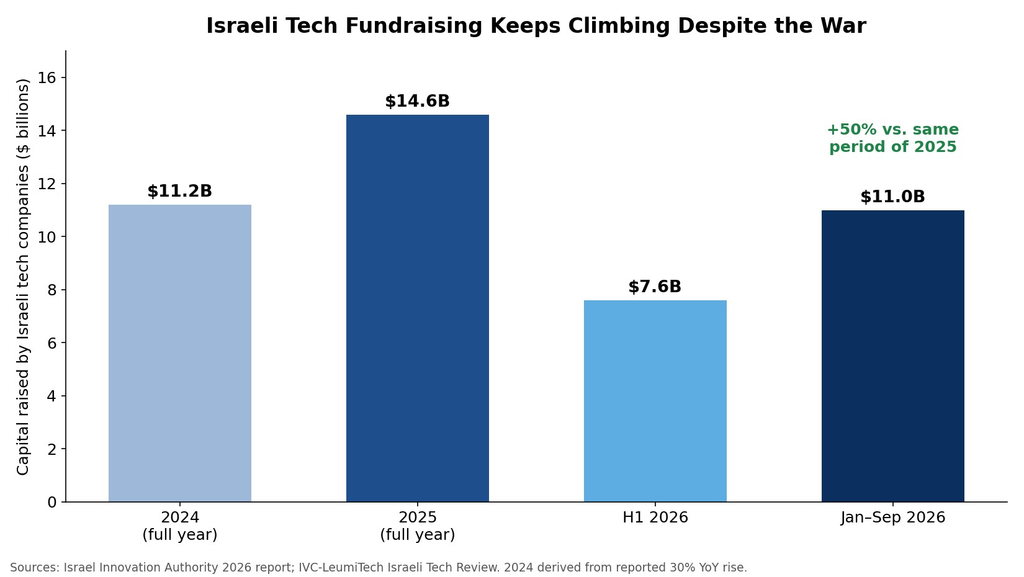
- Tech fundraising: Israeli companies raised about $11 billion in the first nine months of 2026, up roughly 50% from the same period last year.
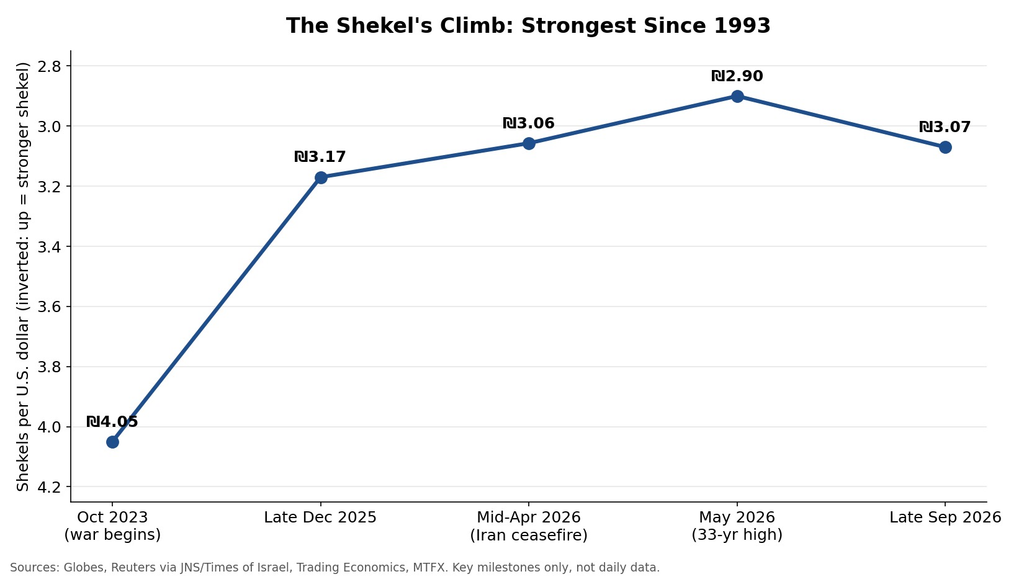
- The shekel: The currency touched 2.90 per dollar in May, its strongest level since October 1993.
- Interest rates: The central bank cut rates to 3.25% on September 1, its third straight cut.
Track the Fallout in Real Time
Israel’s recovery, and the shekel’s strength, depend on whether the ceasefires hold. Every flare-up shows up first in energy prices, so watch the numbers instead of waiting for the headlines:
Live Oil Price Tracker →
Brent and WTI in real time, the clearest early signal of whether Middle East risk is rising or fading.
Live Trump Tariff Tracker →
War, oil, and trade policy rarely move in isolation, so follow every tariff shift alongside the conflict.
A War Shock, Then a Sharp Rebound
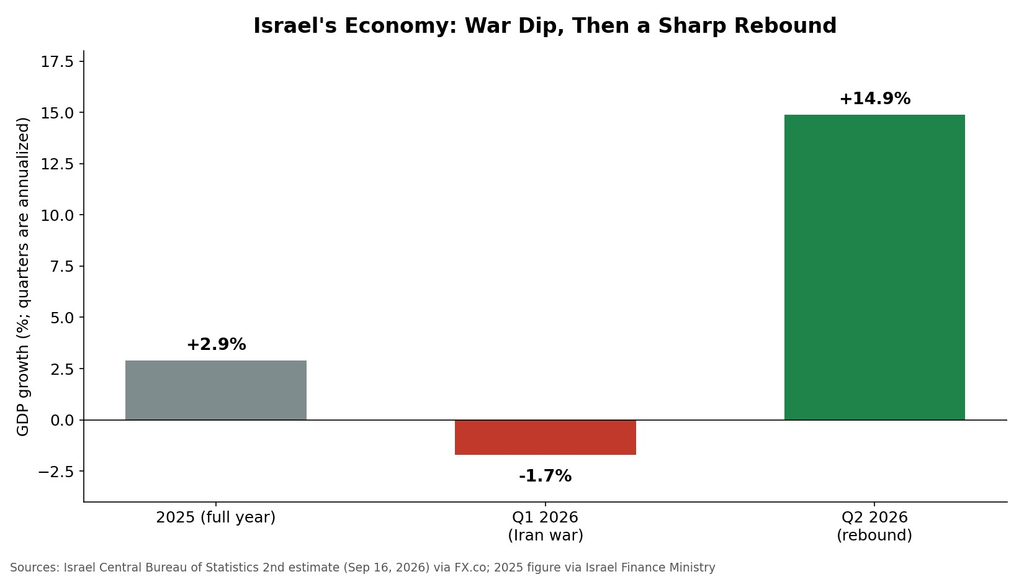
The impact of war on Israel’s economy showed up clearly in the first quarter. War with Iran ran from February 28 until a ceasefire on April 8, and economic activity slumped. GDP contracted at a revised annualized rate of 1.7% in Q1.
Then came the snapback. According to the Central Bureau of Statistics’ second estimate, the economy grew at a 14.9% annualized rate in Q2 2026, driven by surging private consumption, government spending and exports. Financial markets followed a similar arc. Our breakdown of why the S&P 500 kept hitting records despite the US-Iran war shows how investors treated the same February-to-April conflict as a temporary shock.
That headline number needs context. Analysts noted much of the jump came from activity that had been postponed during the fighting. Measured across the first half of 2026 against the second half of 2025, growth was a more modest 3.5% annualized.
Even so, Israel is outpacing much of the developed world. The IMF’s April projection had Israel growing 3.5% this year, ahead of the United States at 2.3% and the European Union at 1.3%.
Israel Tech News: Record Exits, Rising Funding
The engine behind all of this is the tech sector. In its 2026 High-Tech Status Report, the Israel Innovation Authority reported that high-tech generated $85 billion in exports, $84 billion in exits, and nearly $15 billion in fundraising in 2025. High-tech output rose 8.2%.
The biggest driver was Google’s acquisition of Wiz, the cloud security startup, alongside Palo Alto Networks’ deal for CyberArk and the Armis transaction. All three were signed in 2025 and cleared regulators in 2026.
The momentum has carried into this year. The IVC-LeumiTech Israeli Tech Review found that Israeli startups raised $7.6 billion in the first half of 2026, a 52% jump from the first half of 2025. Preliminary data puts the nine-month total at around $11 billion.
Cybersecurity remains the anchor. Cyber firms raised roughly $4.3 billion through the first three quarters of 2026, about 38% of all tech funding. Defense-tech, space and quantum computing are also attracting money fast. Those sectors pulled in $846 million in the first half alone, nearly 90% of their full-year 2025 total.
Foreign investors, many of them American, still supply most of the cash, accounting for about 69% of total fundraising.
Why Is the Shekel So Strong?
For U.S. readers, the currency story may be the most counterintuitive part. When the war began in October 2023, the shekel traded around 4.05 per dollar. By May 2026, it had strengthened to 2.90, a 33-year high, on hopes for a U.S.-Iran ceasefire deal. In late September it was trading near 3.05–3.08.
Analysts point to three main forces:
- Tech dollars flowing in – Mega-exits and foreign venture capital mean companies and investors must convert billions of dollars into shekels.
- Natural gas exports – Output from the Leviathan and Tamar fields, including a large long-term supply deal with Egypt, brings in steady dollar revenue.
- A shrinking risk premium – After the Iran ceasefire, the Bank of Israel said the country’s risk premium had returned to roughly pre-October 2023 levels.
A weaker U.S. dollar globally has added fuel.
The contrast with other war-exposed economies is striking. India, which imports most of its oil, saw its rupee fall to a historic low against the dollar over the same period, even as its GDP grew a strong 7.8%. Israel’s gas exports and tech inflows have put it on the opposite side of the oil shock.
The Catch: Strong Numbers, Real Strains
The boom has a downside, and Israeli economists are not hiding it.
The strong shekel is hurting exporters – Tech employers have increasingly blamed layoffs on the currency’s strength, since their revenue is in dollars while salaries are paid in shekels. Exporters pushed the central bank hard for rate cuts to slow the currency’s rise.
Talent and production are moving abroad – The Innovation Authority’s report recorded the first decline in a decade in the number of R&D employees in Israel. One analysis of the national accounts found that excluding production by Israeli-owned companies abroad, first-half growth was only about 1%.
Early-stage money is drying up – First-time investments made up just 35.5% of venture deals in the first half of 2026, the lowest share in a decade. Capital is concentrating in larger, later-stage companies.
War is expensive – The 2026 budget allocates 112 billion shekels (about $35 billion) for defense. The OECD expects the deficit to widen to 5.3% of GDP this year.
The Impact of the Iran-Israel War on the Global Economy
The impact of the Iran-Israel war on the global economy was felt most at the gas pump. During the fighting, the Bank of Israel pointed to a marked jump in global energy prices. When the Strait of Hormuz reopened, oil prices fell sharply, which the central bank cited as a reason inflation eased.
For Americans, the takeaway is twofold. Middle East flare-ups still move oil prices and inflation expectations worldwide. And U.S. tech giants and investors are now deeply tied to Israel’s startup ecosystem, from Google’s Wiz purchase to the foreign capital funding most Israeli startups.
What Comes Next
The Bank of Israel’s next interest rate decision is scheduled for October 21, 2026. Most economists surveyed by FocusEconomics expect rates to hold for the rest of the year, though some see another cut given low inflation.
The bigger variable remains security. The IMF warned that renewed escalation is a key downside risk. If ceasefires hold, the central bank sees growth accelerating to 5.5% in 2027. If they break down, the forecasts will be rewritten again, as they were three times this year.
For more coverage of how the Middle East conflict is moving markets, currencies, and trade, visit DonaldTrump.Coach.
More Top Stories From DonaldTrump.Coach
- G20 Milwaukee trade talks: what India actually got
- Supreme Court opens new term with major climate case
- Trump renames Lake Ontario “Lake America” and Canada pushes back
- PM Modi’s Sweden visit yields six SITAC outcomes for India
Frequently Asked Questions
Is Israel’s economy growing during the war?
Yes. Despite a first-quarter contraction during the Iran war, the Bank of Israel forecasts about 4% GDP growth in 2026 and 5.5% in 2027. Q2 2026 GDP rose at a 14.9% annualized rate as postponed activity resumed.
How has the Israel war economy changed in 2026?
The Israel war economy swung sharply this year: it shrank during the February–April war with Iran, then rebounded strongly after the April 8 ceasefire. Tech funding, exports and consumer spending led the recovery.
What is the impact of war on Israel’s economy?
The main costs are heavy defense spending, a wider budget deficit (about 5.3% of GDP), disrupted tourism, reservist labor shortages, and tech talent moving abroad. The economy has nonetheless proven resilient thanks to its tech sector.
What is the latest Israel tech news for 2026?
Israeli startups raised about $11 billion in the first nine months of 2026, up 50% year over year. Cybersecurity led with roughly $4.3 billion. Exits in 2025 hit a record $84 billion, led by Google’s acquisition of Wiz.
How is the Israel tech sector doing during the war in 2026?
It is posting near-record numbers but faces strains: a strong shekel squeezing dollar-earning firms, layoffs, fewer first-time startup investments, and R&D jobs shifting overseas.
Why is the shekel so strong?
Tech exits and foreign investment bring in large dollar inflows, natural gas exports add steady revenue, Israel’s risk premium has fallen after the Iran ceasefire, and the U.S. dollar has weakened globally. The shekel hit 2.90 per dollar in May 2026, its strongest since 1993.
What is the impact of the Iran-Israel war on the global economy?
The biggest global effect was on energy. Oil prices spiked during the fighting and fell sharply after the Strait of Hormuz reopened, influencing inflation well beyond the Middle East.
References & Sources
- Bank of Israel – Monetary Committee decision, September 1, 2026
- Israel Innovation Authority – 2026 High-Tech Status Report
- Times of Israel – “Bank of Israel slashes growth prospects as Iran war takes toll on economy“
- Ynet News – “Bank of Israel cuts interest rate again, lowering benchmark to 3.5%“
- CNBC – “Israel’s economy and financial markets are booming despite Iran war“
- Globes – “Israel’s economy grew at 15.4% in Q2“
- FX.co – “Israel Q2 GDP Growth Revised Lower in 2nd Estimates“
- Xinhua – “Israel’s economy rebounds with 15.4 pct growth in Q2“
- Jerusalem Post – “$7.6 billion in half a year: Tech fundraising surged by 52%“
- Israel Trade Commission (Australia) – “$11 Billion Raised in 2026“
- Ynet News – “High-tech brain drain grows as thousands of developers leave Israel“
- JNS – “Shekel hits 33-year high against dollar“
- Globes – “Shekel nears 30-year strongest against US dollar“