
US Politics
One Lawsuit Could Decide Whether Oil Companies Ever Have to Pay for This
WASHINGTON, D.C. – America’s Supreme Court will start its new term with one of the most consequential environmental cases in years. On Monday, October 5, the justices will hear arguments in Suncor Energy (U.S.A.) Inc. v. County Commissioners of Boulder County. The ruling could decide whether oil companies can be forced to pay for local…
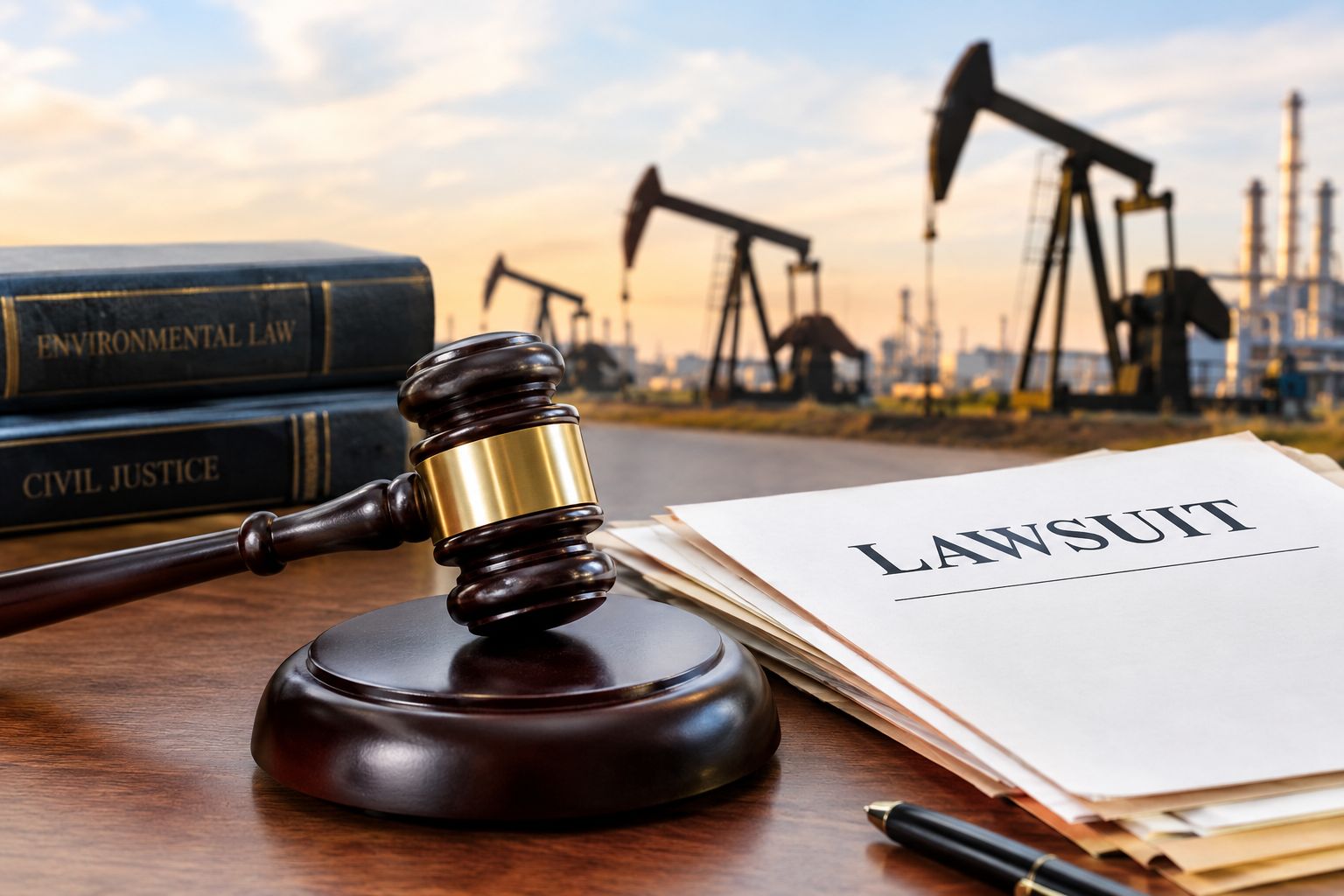
WASHINGTON, D.C. – America’s Supreme Court will start its new term with one of the most consequential environmental cases in years. On Monday, October 5, the justices will hear arguments in Suncor Energy (U.S.A.) Inc. v. County Commissioners of Boulder County. The ruling could decide whether oil companies can be forced to pay for local damage linked to climate change.
It is the first case of the fall 2026 term, and arguments are scheduled to begin at 10 a.m. Eastern (8 a.m. Mountain Time).
Track the Fallout in Real Time
A ruling against the oil majors here could ripple straight into energy markets and pump prices nationwide. Don’t wait for the decision, watch the numbers move now:
Live Oil Price Tracker →
Brent and WTI, updated in real time, so you can see if the market is already pricing in the risk.
Live Trump Tariff Tracker →
Every tariff shift as it happens, because energy, trade, and politics rarely move in isolation.
What the Case Is About
Boulder County and the City of Boulder first sued Suncor entities and ExxonMobil in April 2018. The local governments argue the oil companies misled consumers about the harms of burning fossil fuels and should share the cost of adapting to worsening climate disasters such as floods and wildfires.
ExxonMobil is the country’s largest oil company, and Suncor Energy runs two refineries in Colorado.
The U.S. Supreme Court is not deciding whether climate change is real or whether oil companies caused it. As SCOTUSblog noted, that question is not before the Court. Instead, the justices will decide who gets to hear these claims and under which law.
The Two Legal Questions
The Court is weighing two questions: whether federal law preempts Boulder’s claims, and whether it is too early to hear the case at all.
1. Federal preemption. The companies say climate claims tied to emissions across the country and the world belong under federal law, not state law. They argue the Clean Air Act and the Constitution prevent Boulder’s claims from moving forward under state law.
2. Jurisdiction. Boulder also challenges the Supreme Court’s authority to hear the case, arguing there is no final state-court judgment to review. If the justices agree, they could dismiss the appeal without ever reaching the preemption question.
How the Case Got Here
The path to the Supreme Court took eight years. After the federal district court sent the case back to Colorado state court, the U.S. The Supreme Court declined to review it on April 24, 2023.
The case then returned to Colorado. A 5–2 majority of the Colorado Supreme Court rejected Suncor’s preemption arguments and sent the case back to the trial court. Suncor and ExxonMobil petitioned the U.S. Supreme Court on August 8, 2025, and the Court agreed to hear it on February 23, 2026.
That reversal is notable. Between 2023 and 2025, the Court turned away oil company petitions in nine cases raising essentially the same issue.
The federal government will also have a voice at the podium. The Court granted the Solicitor General’s motion to take part in oral argument as an amicus and divide argument time.
Alito Steps Aside: Why It Matters
The biggest twist in Supreme Court news today, in October, came just one week before arguments. Justice Samuel Alito recused himself on September 28, leaving eight justices to decide the dispute.
The Court gave no explanation, and its rules leave recusal decisions to individual justices without requiring them to explain. However, CBS News reported the likely reason is his stock holdings in oil and gas companies, based on his 2025 financial disclosure.
Alito doesn’t own shares in ExxonMobil or Suncor, but he does own stock in companies facing lawsuits that will turn directly on this decision.
An eight-justice bench creates a real chance of a tie. Yale Law professor Harold Hongju Koh noted the possibility of a 4–4 split, which would leave the 2025 Colorado Supreme Court ruling in place. That outcome would let Boulder’s case proceed but would set no national precedent.
Dozens of Lawsuits Are Waiting
This case reaches far beyond Colorado. More than two dozen states, cities, and local governments have filed similar lawsuits seeking compensation for climate costs, according to Reuters.
State judges have paused 11 such cases in recent months while waiting for the Suncor ruling. These include suits brought by California, New Jersey, Delaware, Hoboken, and eight California cities and counties.
Exxon and Suncor told the Court they face lawsuits seeking billions of dollars in damages and urged review to stop dozens of climate cases from moving ahead in state courts.
The Case by the Numbers
| Metric | Figure |
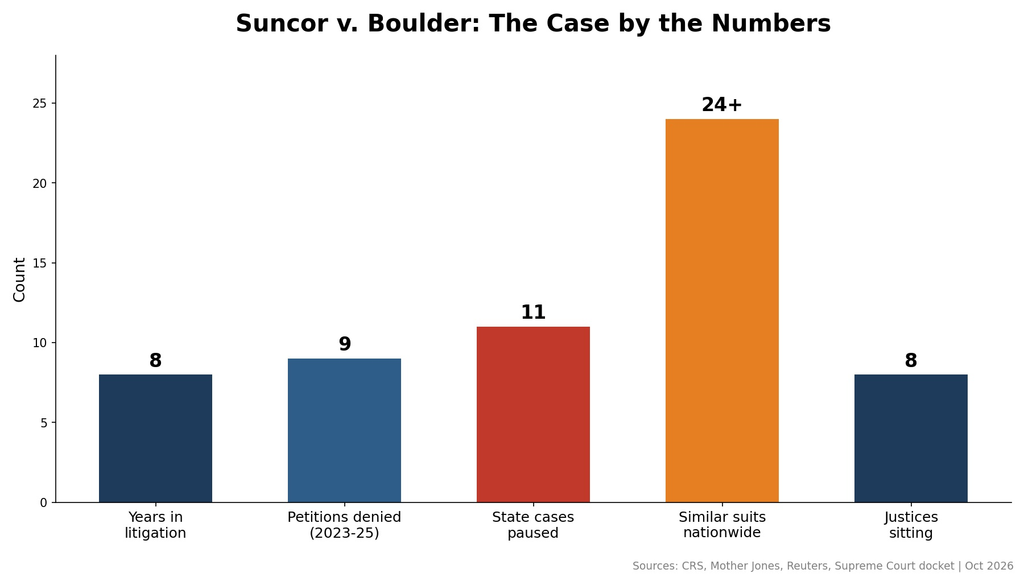
| Years since Boulder filed suit (2018–2026) | 8 |
| Colorado Supreme Court vote for Boulder | 5–2 |
| Oil company petitions denied by SCOTUS (2023–2025) | 9 |
| State cases paused pending this ruling | 11 |
| Similar climate suits nationwide | 24+ |
| Justices hearing the case | 8 |
Suncor v. Boulder: The Case by the Numbers
Count
Use the arrow keys to move between data points
Case timeline (for a timeline graphic):
| Date | Milestone |
| April 2018 | Boulder sues Suncor and ExxonMobil in state court |
| April 24, 2023 | SCOTUS denies first review petition |
| May 2025 | Colorado Supreme Court rules 5–2 for Boulder |
| Aug 8, 2025 | Companies file new cert petition |
| Feb 23, 2026 | SCOTUS grants review |
| Sept 28, 2026 | Justice Alito recuses |
| Oct 5, 2026 | Oral argument opens the term |
| By mid-2027 | Decision expected |
More Top Stories
- PM Modi’s Sweden visit yields six SITAC outcomes for India
- Rupee at historic low of 96.17 vs. dollar: what’s driving it
- India’s GDP grew 7.8%, so why is the rupee at a record low?
- G20 Milwaukee trade talks: what India actually got
What Happens Next
Arguments are only the first step. A decision is expected by mid-2027.
Possible outcomes:
- Companies win on preemption: Most state-law climate suits nationwide could collapse.
- Boulder wins: The case returns to Colorado for trial, and paused suits restart.
- Dismissed on jurisdiction: The case proceeds in Colorado, but the core question remains open.
- 4–4 tie: The Colorado ruling stands, with no nationwide precedent.
For the oil industry, cities, and states, Monday’s argument opens a fight that could reshape climate accountability across the United States.
For more coverage on the legal, political, and economic stories shaping the country right now, visit DonaldTrump.Coach.
FAQs
What is America’s Supreme Court climate case this October?
It is Suncor Energy v. Boulder County, the first case of the October Term 2026. It asks whether local governments can sue oil companies under state law for climate-related damage.
When is the U.S. Supreme Court hearing Suncor v. Boulder?
Monday, October 5, 2026, at 10 a.m. Eastern. The audio is live-streamed on the Supreme Court website.
What is the top Supreme Court news today in October 2026?
The new term opens with this climate case, and Justice Alito’s last-minute recusal means only eight justices will decide it.
Why did Justice Alito recuse himself?
The Court did not say. Reports point to his stock holdings in oil and gas companies that face related lawsuits.
What happens if the Supreme Court ties 4–4?
The Colorado Supreme Court’s ruling would stand, and Boulder’s case would continue, but no national precedent would be set.
Is the Supreme Court deciding whether oil companies caused climate change?
No. It is deciding whether federal law blocks state-law claims and whether the Court has jurisdiction to hear the case now.
References & Sources
- City of Boulder, U.S. Supreme Court to Hear Boulder Climate Case Monday
- Congressional Research Service, State-Law Climate Tort Suits and Suncor v. Boulder County: A Primer for Congress (R49419)
- Climate Litigation Database (Sabin Center)
- Harvard Environmental & Energy Law Program
- CBS News, “Alito recuses from major climate change case