
Global Trends
Bombs Are Falling Near Hormuz and Wall Street Just Hit Another Record High
Why the S&P 500 keeps shrugging off the US-Iran war, and why the “TACO trade” may be running on borrowed time NEW YORK, Oct. 3, 2026 A tanker caught fire in the Strait of Hormuz this week after being hit by an unknown projectile. The Pentagon is sending a third carrier strike group to the…
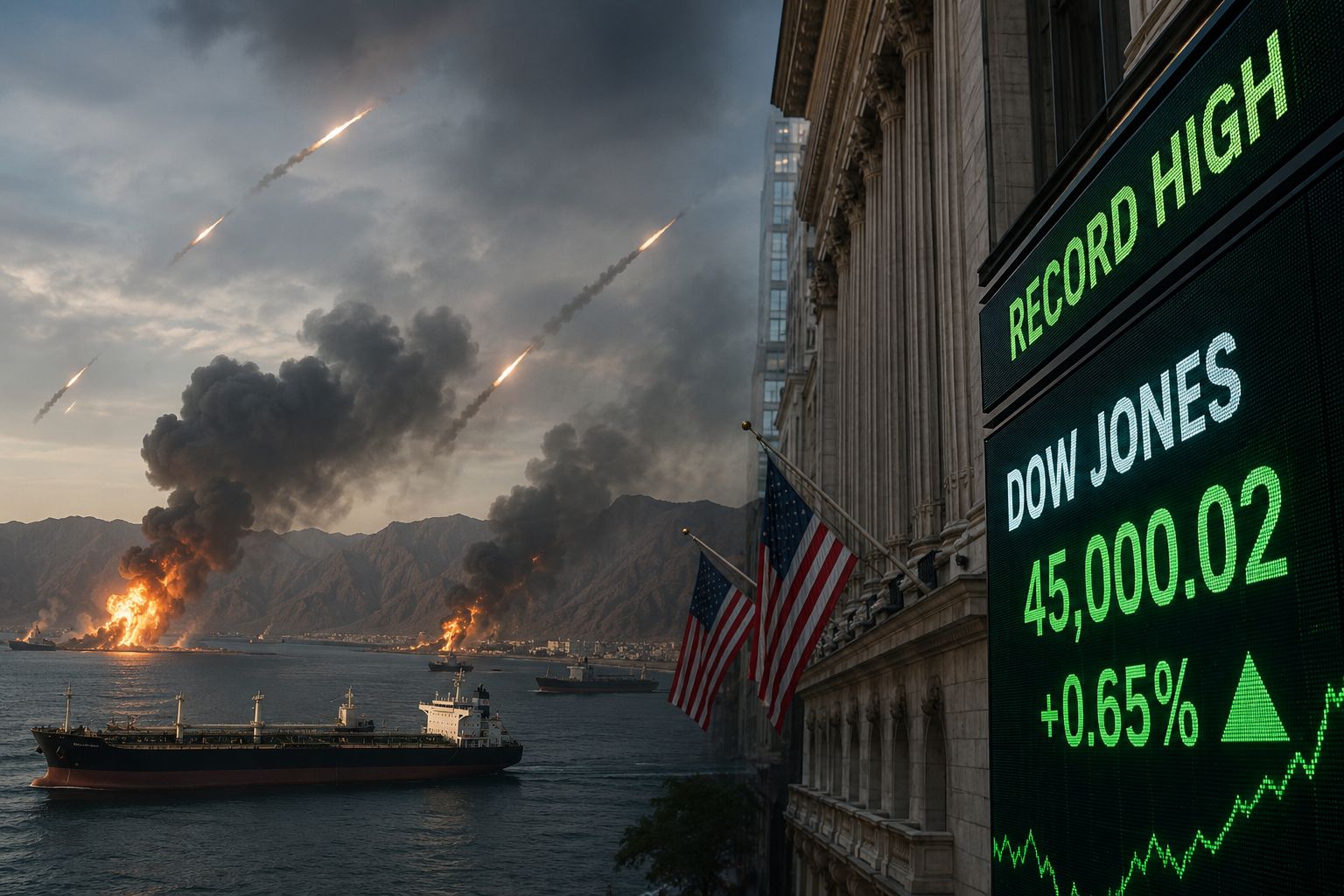
Why the S&P 500 keeps shrugging off the US-Iran war, and why the “TACO trade” may be running on borrowed time
NEW YORK, Oct. 3, 2026
A tanker caught fire in the Strait of Hormuz this week after being hit by an unknown projectile. The Pentagon is sending a third carrier strike group to the Middle East. President Donald Trump rejected Tehran’s latest seven-day proposal to reopen talks and said renewed strikes after the November midterms are “possible.”
And the stock market? The S&P 500 closed Friday at 7,722.72, up 0.73% on the day and about 1% below its all-time closing high of 7,798.99 set in mid-August.
That gap between the headlines and the ticker is the biggest puzzle in US Iran war markets coverage this year. By late August, the S&P 500 had closed at a record 27 times in 2026, according to a Motley Fool tally, even as the war produced what analysts describe as the largest oil-supply disruption in history.
On trading desks, the explanation has a name: the TACO trade.
Track the Fallout in Real Time
The next few weeks will test whether this rally can survive renewed fighting. Don’t wait for the headlines, watch the numbers move now:
Live Oil Price Tracker →
Brent and WTI, updated in real time, directly tied to every Hormuz escalation covered above.
Live Trump Tariff Tracker →
The same TACO instinct driving Iran-war markets started with tariffs, track where that policy stands now.
S&P 500 record closes in 2026
| As of | Record closes |
| July 1 | 24 |
| Late August | 27 |
What Is the TACO Trade?
TACO stands for “Trump Always Chickens Out.” The phrase was born in April 2025, when Trump announced sweeping “Liberation Day” tariffs, stocks dropped more than 12%, and he then announced a 90-day pause within days. Stocks posted one of their biggest single-day rallies in history. That same tariff instinct has carried into 2026, visible most recently in the back-and-forth over the India-US trade deal at the G20 Milwaukee talks, where Washington has leaned on tariff leverage as a negotiating tool rather than a fixed policy.
The lesson investors took away was simple: when markets fall hard enough, the White House blinks. The Trump TACO trade means buying the dip on the bet that the president will reverse course before the economic pain gets too high.
In 2026, Wall Street applied that playbook to a shooting war.
The Mechanism, in Three Steps
Step 1: The Shock. Bombs Fall, Oil Spikes, Stocks Slide
The United States and Israel launched strikes on Iran on Feb. 28. Iran responded by choking off tanker traffic through the Strait of Hormuz, the route for roughly 20% of the world’s oil and natural gas.
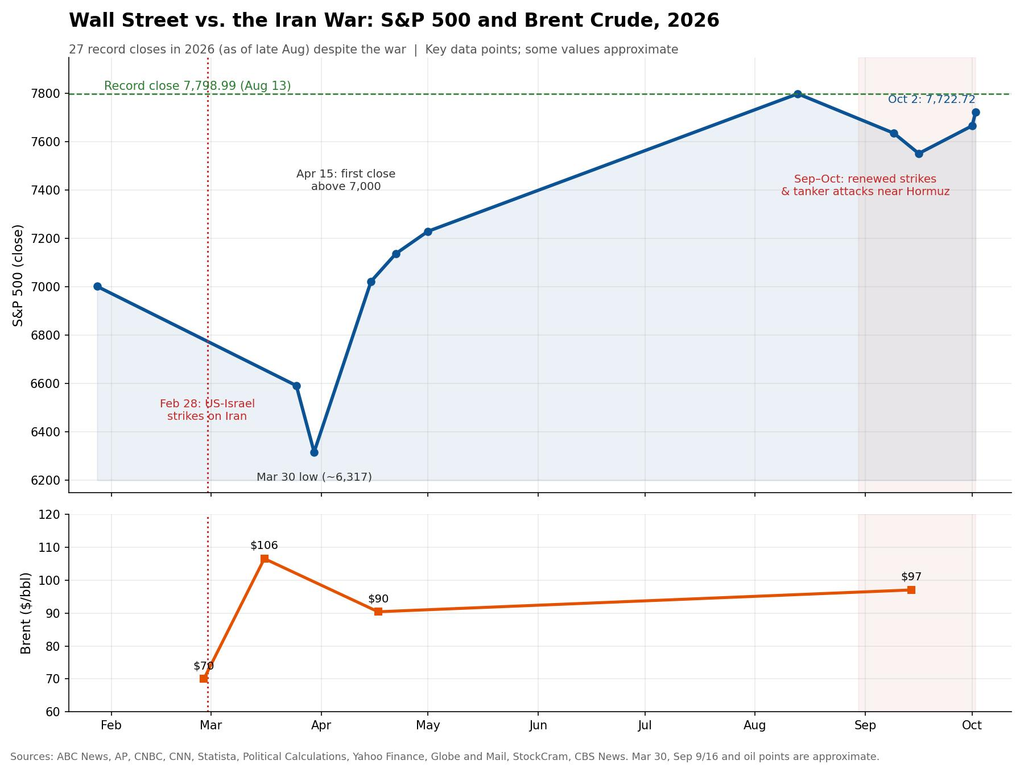
Brent crude, which traded near $70 before the war, jumped above $100. Between Feb. 28 and March 30, the S&P 500 fell almost 8%, briefly flirting with correction territory.
Brent crude during the Iran war ($/barrel)
| Date | Price | What happened |
| Late Feb (pre-war) | ~$70 | Before US-Israel strikes |
| Mid-March | ~$106.50 | Peak of Hormuz shutdown fears |
| Apr 17 | $90.38 | Iran declares Hormuz open during ceasefire |
| Mid-September | ~$97 | After US strikes on IRGC tankers |
This is the part of the cycle that looks like a “normal” war-time market. The same oil spike has hit far beyond Wall Street too. It’s a central reason the Indian rupee has sunk to a historic low against the dollar, since India imports most of its crude and pays for it in dollars.
Step 2: The Off-Ramp. Trump Signals, Markets Snap Back
Then the signals started. On March 23, Trump said the US and Iran had held “very good and productive conversations.” According to Fortune, stocks added roughly $1.7 trillion in minutes and oil fell about 15%, even though Iranian state media denied any talks had taken place.
By March 31, reports emerged that both sides were looking for a quick exit. A ceasefire followed on April 8. On April 15, the S&P 500 closed above 7,000 for the first time, at 7,022.95, wiping out every point of its war losses.
Economists told CNBC that investors had been conditioned to believe Trump will back off if the economic pain becomes too intense. That belief is the engine of the TACO trade: every escalation is treated as temporary, so every dip becomes a buying opportunity.
Step 3: The Fuel. AI Earnings Do the Heavy Lifting
The TACO trade explains why investors are willing to look past the war. Artificial intelligence explains why the index kept climbing once they did.
Tech stocks make up almost half of the S&P 500’s market value, Moody’s Analytics chief economist Mark Zandi has noted. First-quarter S&P 500 profits were tracking roughly 28% growth from a year earlier, more than double what analysts expected in early April, according to LSEG data cited by Reuters.
On Friday, Nvidia hit a new intraday high of $237.88, pushing its market value past $5.7 trillion. When a handful of AI giants rise that fast, they can lift the entire index, even while energy costs squeeze the rest of the economy.
That is how the S&P 500 set a closing record of 7,798.99 in August, on the same day Defense Secretary Pete Hegseth said the US could maintain its blockade of Iranian ports indefinitely.
S&P 500 key closing levels, 2026
| Date | S&P 500 close | Event |
| Jan 28 | 7,002.28 | Pre-war record |
| Feb 28 | n/a | US-Israel strikes on Iran begin |
| Mar 25 | 6,591.90 | US sends pause plan; Iran rejects |
| Mar 30 | ~6,317 | War low (~8% drawdown) |
| Apr 15 | 7,022.95 | First close above 7,000; new record |
| Apr 22 | 7,137.90 | Rally extends after Apr 8 ceasefire |
| May 1 | 7,230.12 | Weekly record close |
| Aug 13 | 7,798.99 | All-time closing record |
| Sep 9 | ~7,636 | Pullback as hostilities intensify |
| Sep 16 | ~7,552 | September low |
| Oct 1 | 7,666.45 | Tanker hit in Hormuz |
| Oct 2 | 7,722.72 | Rally after weak jobs report |
The Bombs Have Not Stopped
The calm on Wall Street sits next to a war that has heated up again.
On Sept. 1, US Central Command struck Islamic Revolutionary Guard Corps targets around the Strait of Hormuz after attempted Iranian attacks on commercial shipping. Iran said it retaliated with missiles and drones. Later in September, US forces destroyed five IRGC-linked oil tankers, and Brent climbed back toward $97 a barrel.
Tankers were reported hit in the strait on Sept. 29 and Oct. 1. The US Treasury added new sanctions on Iran’s auto and rail sectors, which Tehran has been using to move petroleum around the blockade.
The S&P 500 did wobble, sliding to roughly 7,552 by mid-September before recovering. But it never came close to the March lows.
It isn’t just geopolitics putting pressure on oil companies right now, either. The Supreme Court opened its new term this month with a major climate liability case that could determine whether oil majors can be sued for climate-related damages, a separate but parallel risk sitting alongside the war-driven volatility in energy markets.
Why Some Investors Are Getting Nervous
Not everyone on Wall Street is comfortable with the rally. Here are the main warning signs:
- The NACHO trade – State Street Global Advisors says a second trade, “Not a Chance Hormuz Opens,” is running alongside TACO. Oil and shipping-insurance markets are pricing a long disruption, even as stocks price a quick ending.
- Weak breadth – According to Schwab, only 21% of S&P 500 stocks traded above their 50-day moving average this week, and just 40% sat above their 200-day. The index looks strong; the average stock does not.
- Rising yields – Long-term Treasury yields touched their highest levels in about 24 years this week, and talk of further Fed rate hikes has grown.
- A softening job market – The US added just 29,000 jobs in September, and unemployment rose to 4.2%.
- A trade that has never been tested in war – JPMorgan warned back in March that betting on TACO in Iran carries more complex risks than the tariff fight, since Washington does not control the other side’s decisions.
History also offers a caution. RBC Wealth Management found the S&P 500 fell an average of 6% across 20 major post-World War II US military interventions. This time, it fell about 8% and fully recovered within about seven weeks.
What It Means for Your 401(k)
For most American investors, the takeaway is not to bet everything on TACO or NACHO. The market is forward-looking, and right now it is betting on a negotiated end to the war and continued AI-driven profit growth.
If either of those bets breaks, whether from a post-midterm escalation or an earnings miss from a major tech name, the index has a long way to fall from near-record levels. Diversification, a long time horizon, and avoiding panic moves on single headlines remain the standard advice from financial planners.
The Bottom Line
Bombs are falling near Hormuz, oil is near $100, and the S&P 500 sits within about 1% of an all-time high. The mechanism comes down to three steps: a war shock, a presidential off-ramp, and an AI earnings engine.
The TACO trade has paid off repeatedly in 2026. With Trump now openly floating renewed strikes after Nov. 3, the next few weeks will test whether Wall Street’s favorite bet still holds.
For more coverage on how this war is moving markets, trade policy, and global economies, visit DonaldTrump.Coach.
Frequently Asked Questions
What is the TACO trade meaning?
TACO stands for “Trump Always Chickens Out.” It describes the investor strategy of buying stocks during sell-offs triggered by Trump’s policy threats, on the bet that he will reverse course once markets fall far enough. The term started with the April 2025 tariff pause.
What is the Trump TACO trade in the Iran war?
In 2026, traders applied the TACO playbook to the US-Iran war. They bought the March dip on the expectation that Trump would seek a ceasefire or deal rather than tolerate a prolonged oil shock. The April 8 ceasefire and later peace talks rewarded that bet.
Why is the stock market at an all-time high during a war?
Three reasons: investors expect the war to end through negotiation (the TACO trade), the market prices future conditions rather than today’s headlines, and AI-driven earnings from mega-cap tech companies have pushed the index higher.
How many record highs has the S&P 500 hit in 2026?
The S&P 500 had closed at a record 27 times in 2026 as of late August, according to The Motley Fool. Its highest close so far is 7,798.99, set in mid-August.
How did the S&P 500 react when the US Iran war started?
The index fell almost 8% between Feb. 28 and March 30, then recovered all of its losses by mid-April and set a new record on April 15.
What is the latest Iran war news affecting markets?
As of early October, tankers have been struck in the Strait of Hormuz, the US is sending a third carrier strike group, and Trump has rejected Iran’s latest proposal while saying strikes after the midterms are possible.
What is the NACHO trade?
NACHO stands for “Not a Chance Hormuz Opens.” It refers to bets in oil, shipping-insurance and rates markets that the Strait of Hormuz disruption will last a long time, the opposite of the optimism priced into stocks.
Is the TACO trade risky?
Yes. It depends on Trump changing course, and in a war the other side also gets a vote. Weak market breadth, rising Treasury yields, and renewed fighting are all risks to the rally.
References & Sources
- ABC News. “S&P 500 closes at record high as US-Iran ceasefire enters second week” April 15, 2026.
- ABC News. “Iran live updates: Trump says war will be over ‘very soon‘” Oct. 1, 2026
- CNBC. “U.S. strikes Iran as Tehran retaliates, raising risk of wider war” Sept. 1, 2026
- Fortune. “Trump has TACO-d again, this time in Iran” March 23, 2026
- Fortune. “Analysts warn the TACO trade won’t last forever” April 8, 2026
- Statista. “S&P 500 Hits Record High as Investors Shrug Off Iran War” April 23, 2026
- Yahoo Finance / The Motley Fool. “The S&P 500 Has Hit 27 Record Highs in 2026“
- Yahoo Finance. “Stock market today: Dow, S&P 500, Nasdaq rally as Fed rate-hike expectations fade” Oct. 2, 2026
- TheStreet. “Stock Market Today (Oct. 2, 2026).”
- The Globe and Mail. “Stock Market News for Oct 2, 2026.”
- Charles Schwab. “Lower Yields Boost Stocks Early on Soft Jobs Data” Oct. 2, 2026.
- CNN. “The S&P 500 is up almost 10% this year, despite war, inflation and AI nerves.” July 1, 2026
- Investing.com. “S&P 500, Nasdaq close at record highs as U.S.-Iran tensions cool“
- CBS News. “U.S. forces hit IRGC-linked oil tankers as oil nears $100 a barrel.”
- Times of Israel live blog. Oct. 1, 2026.