
Economy
India Said This Trade Deal Was Basically Done. Milwaukee Had Other Plans.
MILWAUKEE, Wis – A week ago, India’s top trade official called the US-India trade deal “done and dusted.” Two days of G20 talks in Milwaukee later, it is still not signed. Commerce and Industry Minister Piyush Goyal met US Trade Representative Jamieson Greer on the sidelines of the G20 Trade Ministerial, which ran September 30…
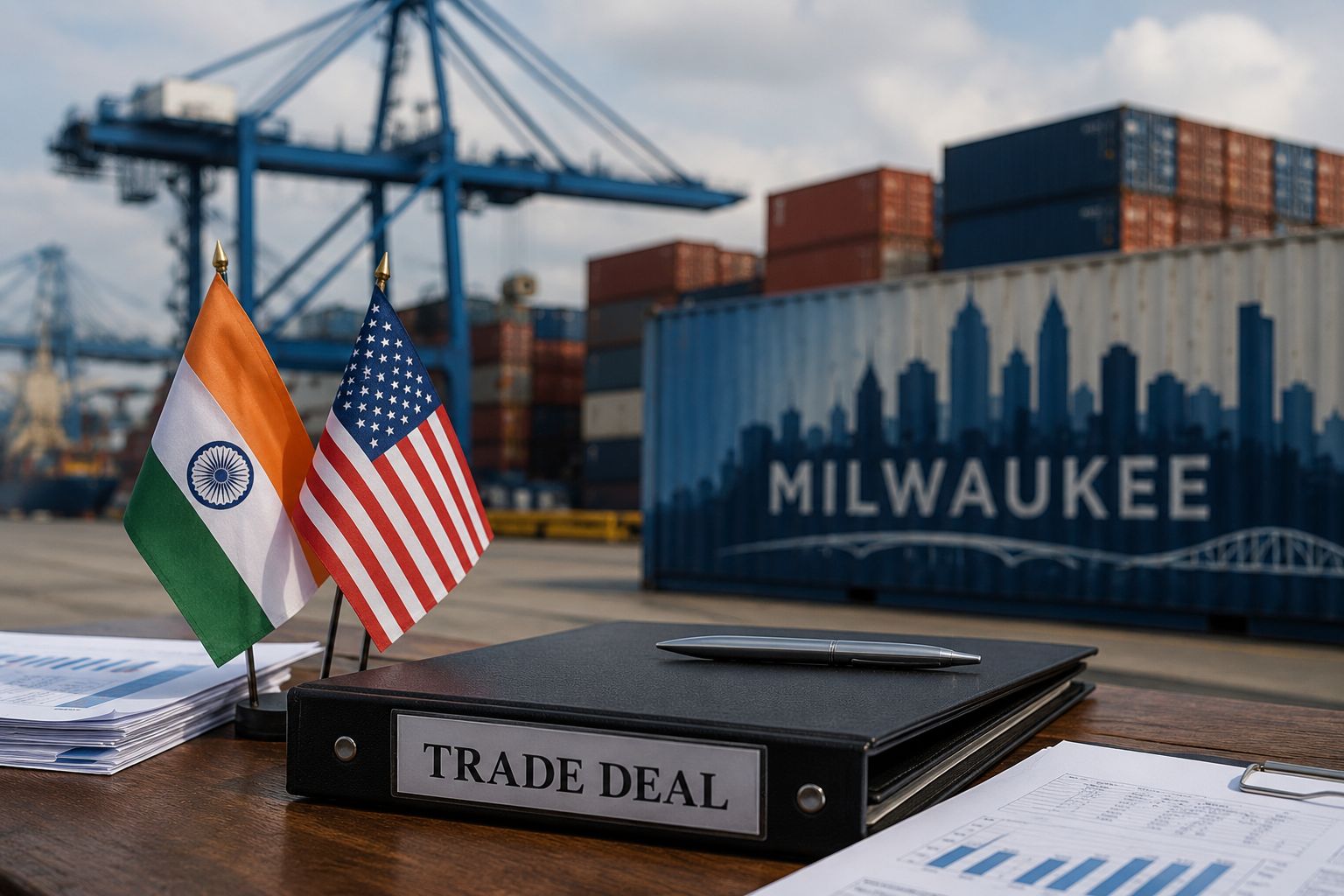
MILWAUKEE, Wis – A week ago, India’s top trade official called the US-India trade deal “done and dusted.” Two days of G20 talks in Milwaukee later, it is still not signed.
Commerce and Industry Minister Piyush Goyal met US Trade Representative Jamieson Greer on the sidelines of the G20 Trade Ministerial, which ran September 30 to October 1. Afterward, Goyal posted on X that the two had a “productive discussion” toward an “early conclusion” of an interim agreement.
That is diplomatic language for: not yet. No signed text, no new tariff rate and no announced date came out of Milwaukee for India.
What the city did deliver was a very American agenda. The US holds the 2026 G20 presidency, and the Trump administration used the meeting to push its own rules for global trade. This is just the latest stop in a busy stretch of international diplomacy for New Delhi, following closely on the heels of PM Modi’s visit to Sweden, which yielded six SITAC outcomes for India.
What the G20 Trade Ministerial actually agreed
The headline outcome was about steel, not India. On September 30, members of the Global Forum on Steel Excess Capacity adopted the “Milwaukee Framework.”
The framework calls for coordinated action against cheap, subsidized steel, largely aimed at China. It covers more anti-dumping and anti-subsidy cases, steel supply-chain monitoring and tighter checks on transshipment. Asked whether countries agreed to raise tariffs on Chinese steel, Greer said every country would do what it thinks is appropriate.
The scale of the problem is large. The forum’s statement projects global steel overcapacity rising from 601 million tons in 2024 to 745 million tons by 2028.
| Year | Excess steel capacity (million tons) |
| 2024 | 601 |
| 2028 (projected) | 745 |
Beyond steel, Greer set four US workstreams for the year:
- Ending the weaponization of trade in food
- Tackling structural excess capacity and production
- Rethinking the Most-Favored-Nation (MFN) principle
- Removing forced labor from global supply chains
The MFN point matters for a country like India. Greer argued that applying MFN unconditionally limits how countries respond to distortive policies. In plain English, Washington wants freedom to charge different countries different tariffs the exact lever India is now negotiating over.
The venue was a message too. Ministers toured a Rockwell Automation plant, and Greer said the point was to show them American factories and what the US is trying to protect. Analysts warned beforehand not to expect breakthroughs, given the administration’s preference for one-on-one deals over multilateral ones.
Why “Done and Dusted” Still Isn’t Done
In February, the two governments announced a framework for an interim deal. Washington said it would cut the reciprocal tariff on Indian goods to 18% and drop a 25% penalty tied to India’s purchases of Russian oil.
Then the ground moved. On February 20, the US Supreme Court struck down the IEEPA tariffs the deal was built on. The administration rebuilt its tariff wall under other laws, and since July 24 most Indian goods pay a 10% Section 301 duty tied to a forced-labor investigation.
| Date | US tariff on Indian goods (%) | Status | What changed |
| Apr 2025 | 10 | In force | 10% baseline reciprocal tariff |
| Early Aug 2025 | 25 | In force | 15% country-specific rate added |
| Late Aug 2025 | 50 | In force | 25% Russia-oil penalty added |
| Feb 2026 | 18 | Announced | Interim framework rate |
| Feb 20, 2026 | 10 | In force | Supreme Court strikes IEEPA tariffs; 10% Section 122 |
| Jul 24, 2026 | 10 | In force | 10% Section 301 forced-labor tariff |
The catch is that Bangladesh, Canada, Indonesia, Malaysia, Mexico, Pakistan, Sri Lanka and the UK sit at that same 10% rate. India’s old 18% “win” no longer means anything, so Goyal wants a mechanism that guarantees an edge over rivals such as ASEAN economies, China and Bangladesh before he signs.
A second Section 301 probe, opened in March into manufacturing overcapacity across 16 economies including India, could add more duties. External Affairs Minister S. Jaishankar called the talks “very, very far advanced” but said that process still clouds the timing.
This tariff uncertainty lands at a complicated moment for India’s broader economy. The same dollar pressures tied to trade and oil costs have pushed the rupee to a historic low against the dollar, even as India’s GDP grew 7.8% last quarter, a split that makes a stable, favorable trade deal with Washington even more valuable for New Delhi right now.
So What Did India Actually Get?
Scored honestly, India’s Milwaukee haul is short:
- A face-to-face with Greer and a shared goal. Both sides restated the aim of an early interim agreement under the larger Bilateral Trade Agreement (BTA). No text or timeline was published.
- Goodwill with US industry. Goyal met CEOs at a National Association of Manufacturers roundtable and urged US firms to invest in India and partner with Indian small manufacturers.
- A seat at the table on the new rules. India took part in the talks on MFN, overcapacity and forced labor that will feed into the G20 leaders’ summit the US hosts later this year.
What India did not get is the thing it came for: a guaranteed tariff edge over its rivals. Greer even joked from the podium that Goyal was “trade minister for life” a warm moment, but not a concession.
The G20 impact on India’s foreign trade, for now, is indirect. The steel framework could tighten global steel markets India also sells into, and an MFN rewrite could reshape how Washington prices access for every exporter.
Why It Matters for Americans, and What Comes Next
India is not a side market. Indian goods exports to the US were about $87.3 billion in 2025, and two-way goods trade was close to $141 billion. Generic medicines, smartphones, apparel and gems are all in that flow, which means tariff swings show up on US store shelves and pharmacy bills.
| Flow | USD billions (2025) |
| India exports to US | 87.3 |
| US exports to India (derived) | 53.7 |
| Total two-way goods trade | 141.0 |
For US exporters, the February framework is the prize. India agreed in principle to cut or eliminate tariffs on US industrial goods and a wide range of farm products, with a stated five-year, $500 billion purchase ambition. None of that is locked in until the interim deal is signed.
Three things to watch:
- The Section 301 overcapacity ruling – Any new duty here decides whether India keeps an edge. Greer has said tariff caps already negotiated in trade deals will be considered.
- A signed interim text – Until it appears in the Federal Register or a CBP notice, treat any India-specific rate as unsettled.
- The G20 leaders’ summit – It is a natural deadline for both capitals to show a win.
Milwaukee kept the India-US trade deal alive, but did not close it. “Done and dusted” will stay a promise until Washington puts India’s competitive advantage in writing.
For more coverage on trade, tariffs, and the global economic stories shaping these negotiations, visit DonaldTrump.Coach.
Frequently Asked Questions
What happened at the G20 Trade Ministerial in Milwaukee?
Trade ministers met September 30 to October 1, 2026, under the US G20 presidency. The main outcome was the “Milwaukee Framework” on steel overcapacity, plus talks on MFN rules, forced labor and food trade.
Did India get a trade deal with the US at the G20?
No. Piyush Goyal and USTR Jamieson Greer discussed an early interim agreement, but no deal was signed and no new tariff rate was announced.
What is the latest India US trade deal news?
Both sides say the deal is close. India wants a guaranteed tariff edge over rivals before signing, while a US Section 301 overcapacity probe is still open.
What did Piyush Goyal do at the G20 2026 meeting?
He met Greer, joined the ministerial sessions and pitched US manufacturers on investing in India at a National Association of Manufacturers roundtable.
What is the G20 impact on India’s foreign trade?
Mostly indirect for now. The steel framework and a possible MFN rewrite could change how India’s exports are priced in the US and other markets.
What tariff do Indian goods pay in the US today?
Most Indian goods pay their normal duty plus a 10% Section 301 tariff in force since July 24, 2026. Steel, aluminum and some auto parts face separate Section 232 duties.
Why does g20 trade matter to US consumers?
India supplies large volumes of generic drugs, apparel and electronics to the US, so tariff changes can affect prices Americans pay.
References & sources
- Ambassador Greer’s Opening Remarks at the G20 Trade Ministerial – USTR, Sep 30, 2026
- USTR to Host G20 Trade Ministerial in Milwaukee – USTR, May 19, 2026
- Piyush Goyal, US trade chief meet in Milwaukee to push India-US trade deal – ANI / The Tribune, Oct 1, 2026
- US trade chief Greer says ‘Milwaukee Framework’ to combat global excess steel capacity – Reuters via Investing.com, Sep 30, 2026
- US leads global steel forum members to new agreement on excess capacity – MLex, Sep 30, 2026
- US unveils ‘Milwaukee Framework’ to tackle global steel overcapacity – overcapacity figures
- Greer jokes Goyal is “trade minister for life” – ANI, Oct 1, 2026
- G20 trade meet exposes fault lines over global rules – The Hans India
- Trump’s tariffs strain G20 talks in Milwaukee – AFP roundup
- India-US trade deal ‘done and dusted’, says Piyush Goyal – PTI / Upstox, Sep 2026 (trade figures, Section 301 rate)