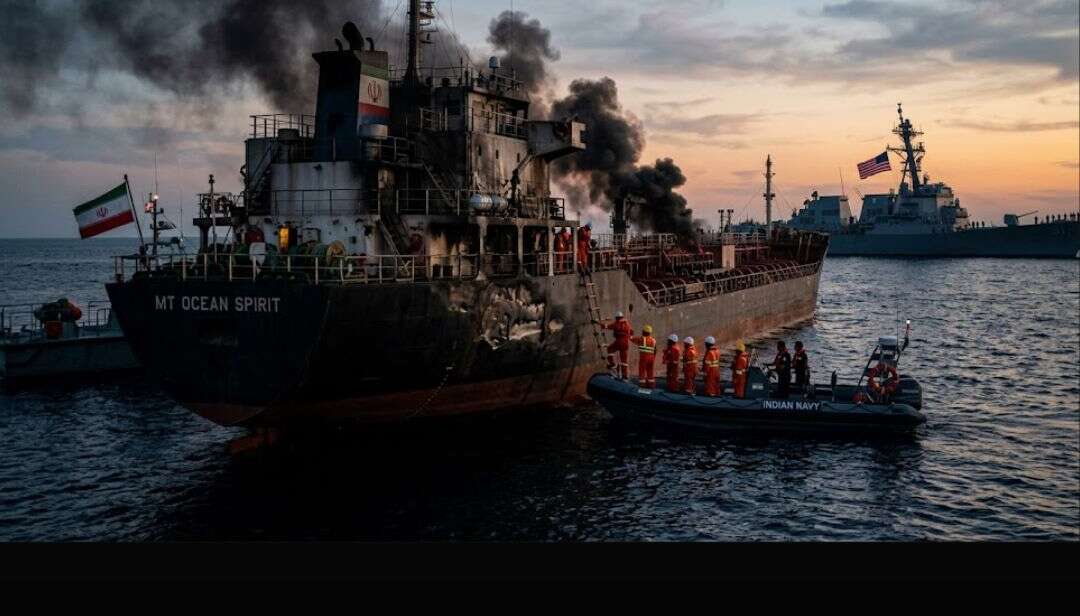
As the Israel Iran US war continues to escalate across the Persian Gulf region, a new flashpoint has emerged involving civilian shipping and Indian nationals. In the latest act of maritime aggression tied to the deepening Strait of Hormuz crisis, Iran’s forces attacked the MT Siron — a Togo-flagged chemical tanker — near the outer port limits of Shinas, Oman, with 12 Indian crew members on board. All crew members have been confirmed safe, but the incident has sent fresh shockwaves through international maritime and diplomatic channels.
The Attack: What We Know About the MT Siron Incident
The MT Siron was navigating near the Omani coastline when it was intercepted by Iranian Coast Guard vessels. Iranian forces fired warning shots at the tanker as part of a broader pattern of maritime aggression that Iran has deployed since the conflict began on February 28, 2026. The vessel, registered under the Togo flag and crewed entirely by Indian nationals, was targeted near the outer port limits of Shinas — a coastal area in Oman that has seen heightened maritime tension in recent weeks.
India’s Ministry of Ports, Shipping and Waterways confirmed the incident and said it is in constant coordination with the Ministry of External Affairs (MEA), Indian diplomatic missions in the region, and maritime stakeholders to monitor the evolving situation. Mandeep Singh Randhawa, Director at the Ministry, confirmed the details of the attack and emphasized that all 12 Indian crew members remain unharmed.
India has lodged a strong protest over the attack — the latest in a string of Iran attack incidents targeting vessels with Indian crew members transiting through or near the Strait of Hormuz.
The Broader Context: How the Israel Iran US War Reached This Point
To understand why a chemical tanker near Oman now makes global headlines, it is essential to revisit the origins of the 2026 Iran conflict. On February 28, 2026, the United States and Israel launched a coordinated air campaign against Iran, which also resulted in the assassination of Supreme Leader Ali Khamenei. In swift retaliation, Iran closed the Strait of Hormuz — the critical chokepoint through which roughly 20% of the world’s oil supply passes — triggering the world’s most severe oil supply disruption since the 1970s energy crisis.
What followed has been described as a “dual blockade”: the US Navy blockading Iran from the outside while Iran blockades the Persian Gulf from within. Strait of Hormuz traffic has collapsed by approximately 95%, with only a handful of vessels daring to transit the waterway. Those that do risk becoming targets in a conflict that has drawn in Israel, the United States, Iran, and now, inadvertently, neutral nations like India.
Trump Orders Aggressive Action Against Iran at Sea
In a dramatic escalation that reframed the iran attack us dynamic, President Donald Trump ordered the US military to “shoot and kill” Iranian small boats operating in and around the Strait of Hormuz. His directive followed failed diplomatic negotiations — on April 12, Vice President JD Vance announced that US-Iran talks had collapsed entirely. Trump subsequently declared a formal US naval blockade of the strait, instructing the Navy to intercept any vessels that have paid tolls to Iran.
When pressed on a timeline for ending hostilities, Trump told reporters bluntly: “Don’t rush me.“
Meanwhile, Iran’s Foreign Minister has been conducting an urgent diplomatic circuit, traveling to Pakistan and Russia in a bid to secure international support and apply pressure on Washington. Pakistani Prime Minister Shehbaz Sharif confirmed a fifty-minute phone call with Iranian President Masoud Pezeshkian, signaling that back-channel efforts remain active even as frontline tensions surge.
India Caught in the Crossfire
For India, the Iran attack on the MT Siron represents a particularly uncomfortable development. New Delhi has historically maintained cordial ties with Tehran while simultaneously deepening its strategic partnership with Washington. The repeated targeting of vessels carrying Indian crew members — this is not the first such incident during the 2026 Strait of Hormuz crisis — has put India in the difficult position of having to protest Iranian aggression even as it tries to preserve diplomatic neutrality.
The South China Morning Post raised the pointed question now circulating in maritime security circles: can Iran protect friendly shipping at all? The answer, at least near the Omani coast, appears to be no — and with Strait of Hormuz traffic paralyzed, thousands of seafarers from India and across Asia face mounting danger.
What Comes Next
With a fragile conditional ceasefire still technically in place, and Iran’s foreign minister on an international tour, diplomacy has not yet been entirely abandoned. But on the water, the reality is starkly different. The MT Siron attack is a reminder that in the Israel Iran US war news cycle, it is often ordinary sailors — thousands of miles from the political decisions that shaped this conflict — who bear the most immediate cost.
India has called for the safety of its nationals to be guaranteed and is closely monitoring all vessels with Indian crew operating in the Persian Gulf region. As the crisis enters its third month, the world watches the Strait of Hormuz — and waits.