Share This Article
The gunfire outside the White House Correspondents’ Dinner had barely faded when the administration chose its target: not the suspect in custody, but the political opposition.
Within 24 hours of the April 25, 2026, shooting that sent President Trump sprinting for cover at the Washington Hilton, White House press secretary Karoline Leavitt stood at the briefing room podium and delivered a carefully curated list of inflammatory remarks by Democratic elected officials. The message was deliberate: the left’s aggressive rhetoric created the conditions for the attack, and Democrats bore moral responsibility for what had nearly transpired.
What went unmentioned conspicuously, critics argued was the catalog of violent, dehumanizing, and escalatory language that the president himself has deployed consistently across nearly a decade in public life, language whose volume and intensity, according to political scientists, has never been higher than right now.
The Double Standard on Display
Leavitt’s statement was precise in its framing. “Those who constantly, falsely label and slander the president as a fascist and a threat to democracy and compare him to Hitler to score political points are fueling this kind of violence,” she told reporters, casting Democratic rhetoric as the proximate cause of political violence.
The rebuttal came immediately, and it came with receipts.
Just weeks before the WHCD shooting, Trump had posted on Truth Social comparing the Democratic Party to Iran describing both as “the greatest enemy America has.” In prior months, he had publicly stated that certain Democratic members of Congress were committing “seditious behavior” that was “punishable by death” a call for execution directed at political rivals that triggered documented real-world threats against nearly two dozen elected officials. He had described political opponents as “the enemy within,” a phrase political scientists have characterized as “the terminology of dictators.”
Following the death of former Special Counsel Robert Mueller, Trump posted on Truth Social: “Good, I’m glad he’s dead.”
House Democratic Leader Hakeem Jeffries was among the first to name the contradiction publicly. Leavitt, he said, had constructed an argument that required ignoring an entire library of evidence.
A Decade of Escalating Language
The accusations of hypocrisy are not just political counterpunching they are, at this point, documented by academic research.
A multi-year analysis of Trump’s political speeches found that violent vocabulary in his addresses rose from 0.6 percent in 2016 to 1.6 percent in 2024 a near-tripling that, the researchers noted, “surpassed nearly all other democratic politicians and approached the levels seen in authoritarian regimes.” The pattern was not rhetorical noise. It was a strategic evolution: as Trump’s political career matured, the language of menace became more central, not peripheral, to his political identity.
The mechanism is not mysterious. Experts in political psychology have long established that when politicians use dehumanizing or demonizing language casting opponents not as misguided rivals but as enemies, threats, traitors they lower the psychological threshold for violence in their audiences. “It can make it seem like someone feels like they have to take action,” one political scientist told PBS, “they’re compelled to take what they think is heroic or patriotic action.”
The Numbers Behind the Fracture
The political climate this language has helped produce is measurable. According to data from PRRI, the gap between Republicans and Democrats on the basic question of the country’s direction has reached an all-time high of 68 points. The share of Americans who believe there is even “some common ground” between the two parties has declined by an average of 12 percentage points since 2023 a collapse in shared civic perception with no precedent in modern American polling.
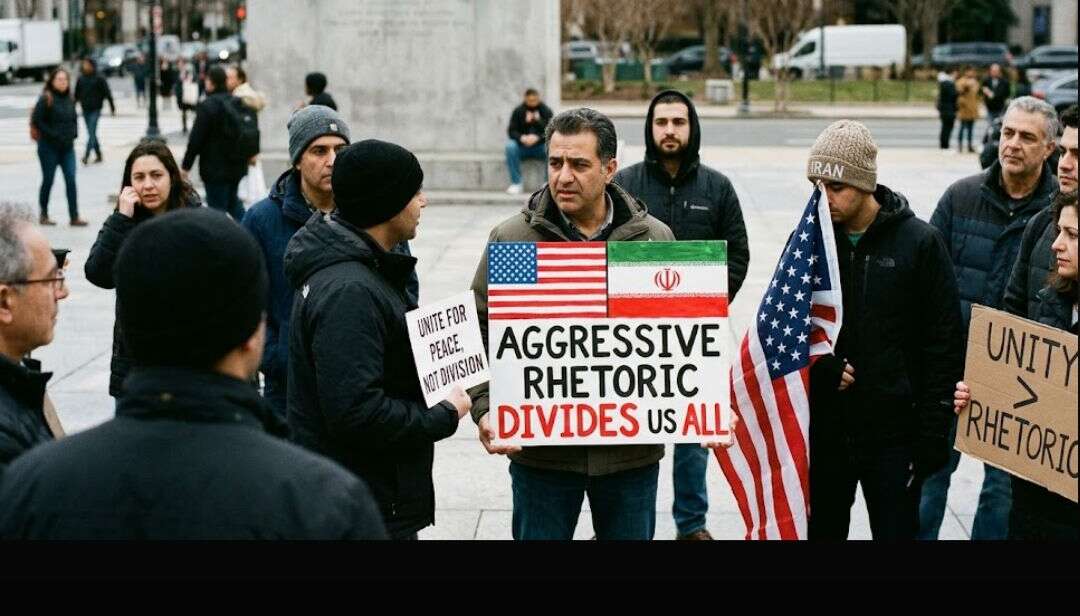
These are not abstractions. They are the statistical signature of a nation that has stopped seeing itself as one people navigating disagreements, and has begun to see itself as two populations in existential conflict. Aggressive rhetoric the constant naming of enemies, the escalation of ordinary policy disagreements into matters of civilizational survival is a primary driver of that transformation.
Here are Some Related Blogs to Read
- NATO chief calls US strikes on Iran “absolutely necessary”
- Will gold rally as US-Iran tensions escalate
- Oil jumped but the market stayed calm
- 5 takeaways from Tuesday’s 2026 primaries
- US tariff system reset across 60 economies
- Trump tariffs Section 122 surcharge expires
- Trump had deliberately paused Hormuz operations to force Iran into a deal.
- JD Vance claims Hegseth has been misleading Trump on the Iran war.
- Iran has been digging out hidden missile stockpiles after rejecting Trump’s peace offer.
The Split Reality
What makes the current moment particularly difficult to navigate is the competing and mutually exclusive frameworks through which Americans now interpret the same events.
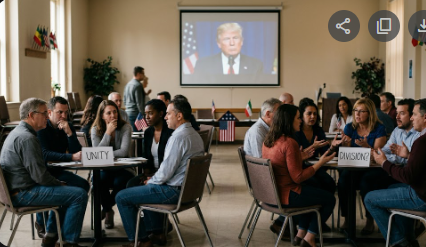
To Trump’s supporters and the White House, the WHCD shooting is proof of leftist radicalization enabled by irresponsible Democratic rhetoric. To Trump’s critics, it is inseparable from a political culture the president himself has spent years cultivating one in which opponents are not just wrong but dangerous, not just mistaken but evil, not just rival partisans but enemies of civilization deserving punishment up to and including death.
CNN’s analysis of the post-shooting week captured the dynamic precisely, describing “a country’s emerging split reality” in which both sides have genuine grievances, genuine fears, and almost no common interpretive language with which to process them together.
The hypocrisy at the center of the White House’s post-shooting messaging is, in this sense, less a calculated lie than a symptom. In a political environment where aggressive rhetoric has become the operating mode of governance itself, selective outrage is not the exception it is the architecture.

Oil & Energy Markets
A look at crude price swings, OPEC supply moves, and how energy markets react to geopolitical shocks.

Geopolitics & Conflict
Breaking down how wars, ceasefires, and diplomatic deals ripple through global trade and security.
US Foreign Policy
Coverage of Trump administration negotiations, sanctions, and strategic decisions shaping world events.
Economy & Inflation
Tracking how commodity prices, gas costs, and supply chains affect everyday consumers.