Share This Article
Iran has publicly attacked a coming round of U.S. sanctions as an exercise in “extraterritorial sovereignty” Tehran’s phrase for Washington’s power to punish companies in third countries that have no American presence at all. At the same moment, CNN reports that the United States and its Middle East allies have effectively flipped the oil script on Iran: the oil Strait of Hormuz threat that Tehran has relied on for decades no longer produces the market panic a comparable threat once would have even though prices did spike sharply when the war began.
The connection is direct. Iran is objecting loudly to sanctions partly because its traditional counter-threat is producing less pressure than it used to.
Iran’s Response: ‘Extraterritorial Sovereignty’
Iran’s objection is not only that the U.S. sanctions hurt its economy. Tehran is making a legal and political argument aimed at the rest of the world. Foreign Ministry spokesman Esmaeil Baghaei called the announcement an assertion of “extraterritorial sovereignty” over every member state of the United Nations, arguing that no country can lawfully force foreign banks, businesses or airports under another state’s jurisdiction to cut legal trade with Iran.
Iran’s case rests on principles it says are established in international law: sovereign equality under the UN Charter and the prohibition on one state intervening in another’s affairs. Officials warned that combining economic pressure with any naval blockade would, in their words, push the world toward a return to colonialism. Iran’s foreign minister dismissed the measures as familiar and destined to fail, noting that the country has lived under U.S. sanctions for decades.
None of this is neutral ground. Washington’s position is that secondary sanctions are a legitimate tool to enforce its policy; Iran’s is that they are unlawful coercion of third countries. Readers should understand this section as Iran’s argument, not a settled legal finding.
Here are Some Related Blogs to Read
- Get the full picture on where this war is headed – more Trump-era geopolitical coverage at DonaldTrump.Coach.
- Tuesday’s missiles didn’t come out of nowhere, Iran has been digging out hidden missile stockpiles after rejecting Trump’s peace offer
- Not everyone in Trump’s own camp agrees on strategy, JD Vance claims Hegseth has been misleading Trump on the Iran war
- This isn’t the only recent flashpoint at sea, a US Navy destroyer just fired on and seized an Iranian cargo ship
- The strikes haven’t ended Iran’s nuclear ambitions either, US intel says recent strikes did only limited damage to Iran’s nuclear program
- That brief pause before Tuesday’s attack wasn’t random, Trump had deliberately paused Hormuz operations to force Iran into a deal
- The missiles are only half the story, Iran and Israel’s spy war is heating up amid claims of stolen F-15 secrets
- Trump’s fights aren’t confined to Tehran, he’s now clashing with his own SCOTUS picks back home
- Global supply chains are already bracing for impact, Goyal’s courting 50 US leaders in New York over exactly that.
- Stay ahead of the story track it live or get the full background on how the US-Iran war escalated to this point.
How the U.S. and Middle East Allies Flipped the Oil Script
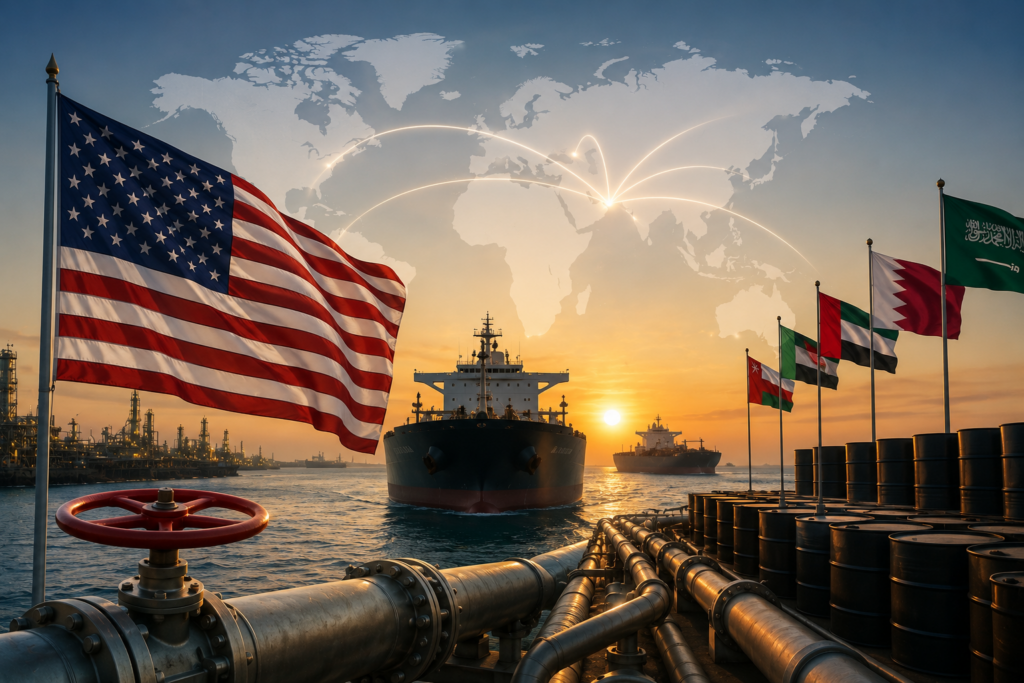
This is the part that genuinely changed, and it explains why Iran’s leverage has eroded.
For decades the logic ran one way: pressure Iran too hard and Iran threatens the Strait of Hormuz, oil spikes, Western economies suffer, pressure eases. The threat did not need to be executed to work, it only needed to be credible.
Several developments dismantled that arithmetic.
U.S. production transformed the buyer: The United States shifted from a major net importer of crude to a net exporter of petroleum. A Hormuz disruption still raises global prices, but it no longer threatens American supply the way it did in the 1970s or even the 2000s.
Gulf allies built and used bypass infrastructure: Saudi Arabia’s East-West pipeline to the Red Sea and the UAE’s pipeline to the port of Fujairah both route crude around the Strait. During this conflict Saudi Arabia rerouted a large volume of crude reported at around five million barrels a day through its East-West line to the Red Sea port of Yanbu, and other Gulf producers moved further barrels around the chokepoint. This does not fully replace normal transit, but it removes the scenario of total cutoff and blunts the psychological force of the threat.
Higher output elsewhere filled the gap: Producers outside the Gulf raised output to compensate. Brazil, Guyana and Venezuela together added more than a million barrels a day, and the United States added hundreds of thousands more.
Spare capacity acts as a shock absorber: Saudi Arabia and the UAE hold meaningful spare production capacity that can be brought online, giving markets a visible buffer.
Strategic reserves and coordination: The IEA framework allows member states to release reserves in a coordinated way, another signal to traders that a supply gap would be filled.
Naval pressure and rerouting, not smooth transit, kept crude moving: It would be wrong to suggest ordinary traffic simply continued under escort. In practice, transit through the Strait fell dramatically: Iran fired on non-compliant tankers, the U.S. imposed a naval blockade on Iran’s ports, and Washington’s push for allied naval escorts drew a mixed response, with some partners declining to commit ships. What kept the wider oil market supplied was the rerouting and added production above uninterrupted convoys through Hormuz.
And the decisive asymmetry: Iran’s own oil exports transit the same water. Closing the Strait would cut Iran’s principal revenue source and infuriate China, its largest customer. The threat has always been partly self-destructive; the difference now is that markets have partly priced that in.
Strait of Hormuz Global Oil Trade: The Numbers That Matter
The Strait is a narrow passage between Iran and Oman linking the Persian Gulf to the Arabian Sea. At its tightest it is about 21 miles wide, with shipping lanes just two miles wide in each direction. Its importance follows entirely from that geometry.
| Factor | Detail |
| Daily transit (normal times) | ~20 million barrels per day of crude and condensate |
| Share of global consumption | Roughly one-fifth |
| LNG | A significant share of global liquefied natural gas trade |
| Narrowest width | ~21 miles; lanes ~2 miles each direction |
| Main destinations | China, India, Japan, South Korea |
| Bypass capacity | Saudi East-West and UAE Fujairah pipelines partial only |
| Wartime status (2026) | Transit far below normal; open vs. closed is contested |
The destination list is the strategically important line. The Strait of Hormuz global oil trade flows overwhelmingly east. A closure would be an Asian energy crisis first, a global price event second, and an American supply problem a distant third. That reordering is the single biggest change in the geopolitics of this waterway in fifty years.
What it means for U.S.-sanctioned countries and the market
Two questions will decide how far this goes. The first is whether Washington enforces the secondary sanctions against Iran’s largest partners. Analysts note that Iran is already among the most sanctioned countries in the world, and that the real test is whether the U.S. sanctions are willing to penalize major economies such as China and Russia for continuing to buy Iranian oil. Going after them would be a far larger escalation than adding smaller entities to a list.
The second is patience. One veteran commodity strategist has observed that Tehran appears to believe it can outlast the pressure, having endured sanctions for decades. If that reading is correct, the near-term effect may be continued disruption and price volatility rather than a quick change in Iran’s behavior. For oil markets, the rerouting has taken some heat out of prices compared with the war’s peak, but the balance remains fragile and sensitive to any renewed threat to shipping.
What to Watch Next
Watch for three things: whether the sanctions move from announcement to published designations and which countries are named; whether either side breaks the current pause in direct attacks; and whether any deal emerges to reopen the Strait of Hormuz on agreed terms. The state of Middle East and U.S. relations over the coming weeks will turn on those three signals more than on any single statement.
FAQs
What are the new U.S. sanctions on Iran?
A tougher round of sanctions has been announced and is expected to take effect, which Iran has criticised in advance. Iran’s core objection is to the secondary sanctions component that penalises non-American companies in third countries for dealing with Iran.
What does ‘extraterritorial sovereignty’ mean?
It is Iran’s term for the United States applying its laws beyond its own borders specifically, penalising foreign companies with no U.S. presence for conduct that is legal where they operate. Washington’s counter is that it is only setting conditions for access to its own financial system.
Why is the U.S. imposing new sanctions on Iran right now?
The new sanctions, expected to be formally announced Monday, follow President Trump’s pledge to launch what he called the “most crushing economic operation” against Iran, aimed at pressuring Tehran economically as the broader U.S.-Iran war continues without a negotiated ceasefire.
How has the Strait of Hormuz affected global oil trade in 2026?
Since Iran effectively restricted passage through the strait following the February 2026 war, shipping traffic has fallen to a small fraction of pre-war levels, disrupting roughly a fifth of global oil flow and contributing to higher gas and diesel prices worldwide.
Which countries have helped offset Iran’s closure of the Strait of Hormuz?
Saudi Arabia has rerouted several million barrels per day via pipeline to the Red Sea, other Gulf states have redirected additional volumes around the strait, and non-Middle East producers like Brazil, Guyana, Venezuela, and the U.S. have increased output to help stabilize global supply.
Does Iran still have leverage in the standoff despite the sanctions and oil rerouting?
Yes. Iran reportedly holds around 80 million barrels of oil on the water outside the U.S. blockade, largely destined for China, generating significant monthly revenue even as its overall economic and export position weakens.
References & Sources
- CNBC – Iran criticizes U.S. sanctions, “extraterritorial sovereignty” (22 Aug 2026)
- CNN Business – How the US and Middle East allies flipped the oil script on Iran (22 Aug 2026)
- Al Jazeera – Iran says new US sanctions violate sovereignty of other states (22 Aug 2026)
- Congressional Research Service – The Strait of Hormuz: Security Developments and Impacts on Oil, Gas, and Other Commodities
- CNN Business – How much oil is actually leaving the Persian Gulf? (17 Aug 2026)
- U.S. News / Reuters – US, Iran keep up hostile rhetoric ahead of new sanctions (21 Aug 2026)

Oil & Energy Markets
A look at crude price swings, OPEC supply moves, and how energy markets react to geopolitical shocks.

Geopolitics & Conflict
Breaking down how wars, ceasefires, and diplomatic deals ripple through global trade and security.
US Foreign Policy
Coverage of Trump administration negotiations, sanctions, and strategic decisions shaping world events.
Economy & Inflation
Tracking how commodity prices, gas costs, and supply chains affect everyday consumers.