Share This Article
May 4, 2026 | World & Defense
What was supposed to be the crown jewel of Donald Trump’s Middle East legacy is quietly being folded up and handed off and America’s adversaries are paying close attention.
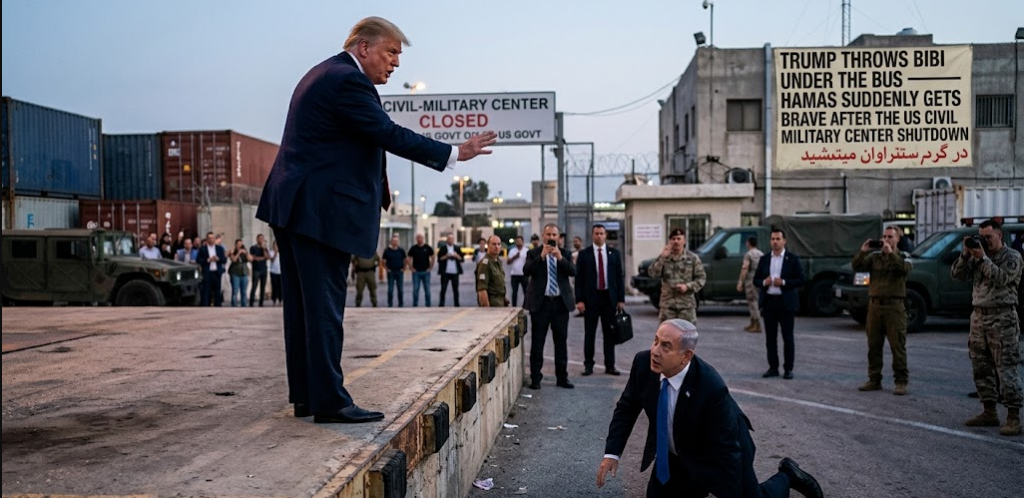
The United States is shutting down the Civil-Military Coordination Center (CMCC) in Israel, the flagship institution of Trump’s 20-point Gaza peace plan, established after the October 2025 ceasefire between Israel and Hamas. With 200 US troops initially deployed to monitor the truce and coordinate humanitarian aid into Gaza, the CMCC was the most tangible symbol of American commitment to a post-war order. Now, those troops are being drawn down to 40, the mission is being rebranded as the “International Gaza Support Center,” and civilian staff from allied nations are being asked to fill roles vacated by US military personnel.
The message, whether intended or not, is unmistakable: Washington is stepping back. And Hamas noticed immediately.
The Trump-Netanyahu Rupture Nobody Wanted to Name
For months, senior Trump officials have been at war quietl with Israeli Prime Minister Benjamin Netanyahu over the pace and terms of Gaza’s transition. White House officials have voiced growing frustration over IDF operations they believe directly violate ceasefire terms. Trump himself forced Netanyahu to call Qatar and apologize after a botched Israeli strike in Doha targeted Hamas leadership. When Israel lobbied hard to block Turkey and Qatar from the Gaza Executive Board, Secretary of State Marco Rubio told Netanyahu the decision was irrevocable.
These are not the gestures of unconditional allies.
Here are Some Related Blogs to Read
- NATO chief calls US strikes on Iran “absolutely necessary”
- Will gold rally as US-Iran tensions escalate
- Oil jumped but the market stayed calm
- 5 takeaways from Tuesday’s 2026 primaries
- US tariff system reset across 60 economies
- Trump tariffs Section 122 surcharge expires
- Trump had deliberately paused Hormuz operations to force Iran into a deal.
- JD Vance claims Hegseth has been misleading Trump on the Iran war.
- Iran has been digging out hidden missile stockpiles after rejecting Trump’s peace offer.
Multiple reports confirm Trump aides have “run out of patience” with the Israeli prime minister. The CMCC shutdown, sources tell Reuters and Al-Monitor, is the direct consequence of an impasse Israel keeps striking inside Gaza, Hamas keeps refusing to disarm, and the ceasefire framework is functionally collapsing in slow motion. The US civil-military relations architecture built around the CMCC carefully assembled to give Trump a geopolitical win has stalled because Israel will not let it succeed.
Netanyahu, for his part, is playing his own game: dragging out the process, keeping military pressure on Hamas, and hoping Trump eventually adopts a more hawkish posture. One Israeli minister even publicly called for the CMCC to be closed. That is how broken the coordination has become.
Hamas Smells Blood
Into this vacuum, Hamas is moving with new confidence. The group’s armed wing has flatly declared disarmament “not acceptable.” Political leader Khaled Meshaal has framed the demand as a colonial attempt to make Palestinians “an easy victim to be eliminated.” A unified bloc of Palestinian factions Hamas, Palestinian Islamic Jihad, and the Popular Front for the Liberation of Palestine has collectively rejected every disarmament proposal on the table.
More critically, Hamas has continued launching attacks against IDF forces inside Gaza even during the nominal ceasefire period. The UN has described the truce as “increasingly fragile.” Israel is now openly threatening to resume full-scale war unless Hamas disarms a threat that, without the CMCC and robust US civil-military relations infrastructure backing it, carries less weight than it once did.
This is precisely what the CMCC was designed to prevent: a monitoring and accountability vacuum that allows both sides to escalate without consequence. When the US military civil-war in strategy between those pushing diplomatic stabilization and those backing Israel’s military maximalism produces institutional paralysis, Hamas fills the space.
What Comes Next
The CMCC’s successor, the International Stabilization Force, is meant to deploy into Gaza but has no firm timeline and no enforcement mandate. Seven diplomats familiar with CMCC operations told Al-Monitor the handover is, in effect, a quiet closure dressed up as a transition.
For US allies who committed personnel and funds to Trump’s Gaza rebuilding plan on Washington’s encouragement, the move adds deep unease. For adversaries watching US resolve in the region, the optics are far worse.
Trump came into 2026 promising he would deliver Middle East peace faster than any president before him. Instead, he finds himself squeezed between a defiant Netanyahu who won’t follow the plan and a resurgent Hamas that has concluded the Americans are leaving the table.
The CMCC’s shuttered doors do not just signal a policy setback. They signal to every actor in the region who holds leverage and who does not and right now, it isn’t Washington.

Oil & Energy Markets
A look at crude price swings, OPEC supply moves, and how energy markets react to geopolitical shocks.

Geopolitics & Conflict
Breaking down how wars, ceasefires, and diplomatic deals ripple through global trade and security.
US Foreign Policy
Coverage of Trump administration negotiations, sanctions, and strategic decisions shaping world events.
Economy & Inflation
Tracking how commodity prices, gas costs, and supply chains affect everyday consumers.