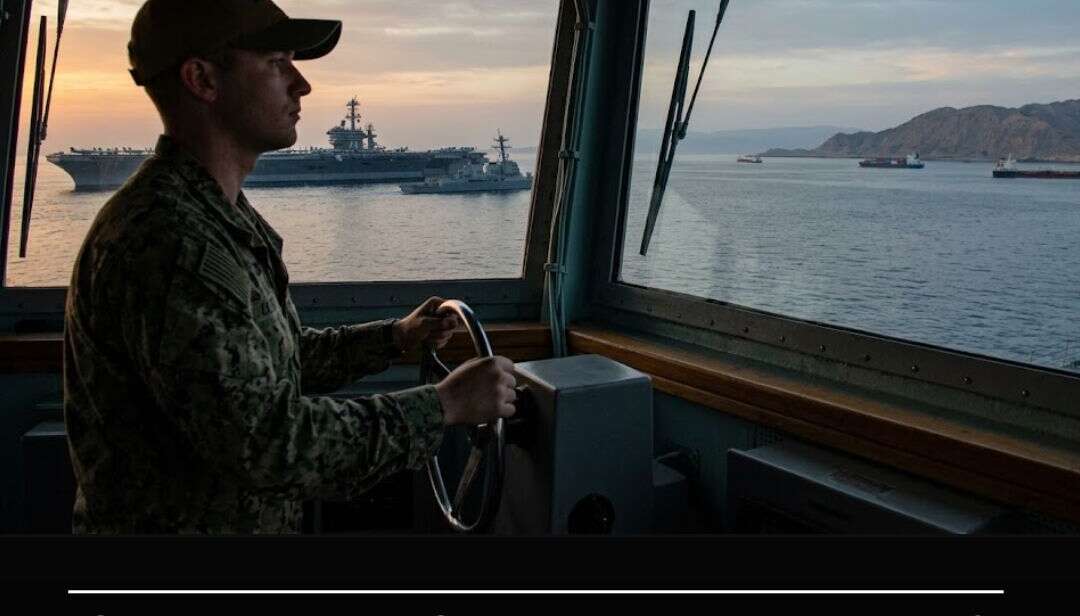
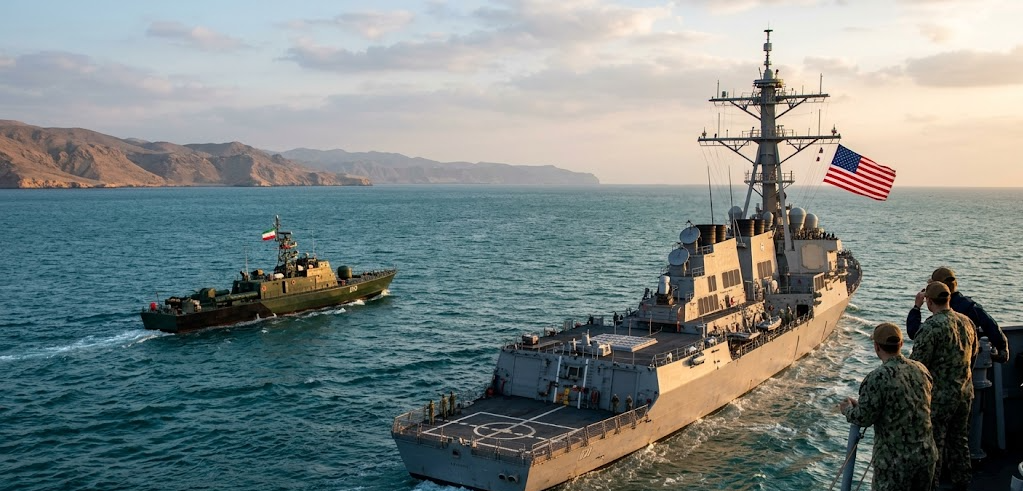
In an unprecedented naval command decision, the United States Navy has assumed direct control of commercial maritime traffic through the Strait of Hormuz — deploying destroyers, aircraft, and 15,000 service members to personally guide stranded ships out of one of the world’s most dangerous waterways. The operation, launched Monday under the banner of “Project Freedom,”
In an unprecedented naval command decision, the United States Navy has assumed direct control of commercial maritime traffic through the Strait of Hormuz — deploying destroyers, aircraft, and 15,000 service members to personally guide stranded ships out of one of the world’s most dangerous waterways.
The operation, launched Monday under the banner of “Project Freedom,” marks the first time in modern history that the US Navy has taken on active navigation direction for foreign commercial fleets through a hostile chokepoint — a move that immediately drew both global attention and sharp warnings from Iran.
US Navy News: A Mission Unlike Any Other
United States Navy news rarely involves directing civilian cargo ships through mined waters under threat of enemy fire. But that is precisely what US Central Command (CENTCOM) announced it would begin doing on May 4, 2026.
Rather than forming traditional close-in convoy escorts, the US Navy will position guided-missile destroyers within striking range of the strait, while a Joint Maritime Information Center actively tells ships which routes to take — specifically steering them away from lanes mined by Iranian forces during weeks of conflict.
On day one of operations, the Joint Maritime Information Center established what officials described as an “enhanced security area” south of typical shipping routes, urging mariners to coordinate closely with Omani authorities due to anticipated high traffic volume. The message to commercial captains was direct: follow the Navy’s guidance or risk your vessel.
What the Strait of Hormuz Crisis Looks Like on the Water
The Strait of Hormuz — a narrow, 21-mile-wide channel between Iran and Oman connecting the Persian Gulf to the Arabian Sea — is the world’s most critical oil transit chokepoint. In normal conditions, roughly 20 million barrels of crude oil and petroleum products pass through daily, representing approximately a quarter of all seaborne oil trade and 20% of global liquefied natural gas (LNG) supplies.
Since Iran’s closure of the strait following US-Israeli military operations in late February 2026, that flow has effectively stopped. The International Energy Agency has classified the resulting disruption as the biggest energy supply shock in recorded history, with Goldman Sachs estimating a reduction of 14.5 million barrels per day in global output.
Approximately 800 commercial vessels remain trapped in the Persian Gulf, with an estimated 20,000 seafarers stranded aboard — many rationing food, water, and medical supplies. The humanitarian toll has proven as significant as the economic one, lending weight to the Navy’s new operational mandate.
The Naval Firepower Behind the Operation
United States Navy news of this scale commands attention. CENTCOM confirmed that US military support for Project Freedom includes:
Guided-missile destroyers — including USS Frank E. Petersen (DDG-121) and USS Michael Murphy (DDG-112), which first transited the strait on April 11 to scout and verify mine-free corridors
More than 100 land- and sea-based aircraft
Multi-domain unmanned platforms for surveillance and threat detection
Approximately 15,000 service members across the operational theatre
12 destroyers pre-positioned in the Middle East as of late April
The US Navy’s approach does not guarantee physical escorts for every vessel but ensures a protective umbrella: warships remain in the vicinity, ready to respond to any Iranian interdiction attempt with force.
Iran’s Response and the Risk of Miscalculation
Tehran’s reaction was swift. Ebrahim Azizi, head of Iran’s parliamentary National Security Commission, warned that any US interference in the Straits of Hormuz would be considered a violation of the ceasefire agreement in effect since April 8. Iran’s military separately threatened direct strikes on US forces approaching the strait.
The standoff puts both sides on a razor’s edge. The US has framed the entire operation as humanitarian in nature — pointing to the 20,000 stranded crew members and dwindling food supplies aboard trapped vessels. Iran views the same operation as a military provocation dressed in civilian clothing.
Why This Moment Matters for Global Shipping
The Strait of Hormuz has been a flashpoint before — most notably during the 1980s Tanker War, when the US Navy last mounted a major Gulf escort mission under Operation Earnest Will. That operation, launched in 1987, saw the Navy escort Kuwaiti oil tankers reflagged under the American flag through Iranian-mined waters. Project Freedom echoes that precedent, but the scale, complexity, and stakes are substantially higher.
With US Navy assets now directing traffic through the straits of Hormuz in real time, the world’s most important oil corridor has effectively become an American naval command zone — at least for now. Whether Iran chooses to test that authority in the coming days will define not just the fate of 20,000 stranded seafarers, but the trajectory of a conflict already reshaping global energy markets.
Market Analysis
A quick snapshot of market trends, customer behavior, and competitor movements.