Washington / Havana — Even as President Donald Trump has ratcheted up his rhetoric against the Cuban government — issuing warnings sharp enough to set off alarm bells in Havana, Miami, and capitals across Latin America — senior U.S. military and national security officials are quietly but firmly pushing back against the suggestion that kinetic
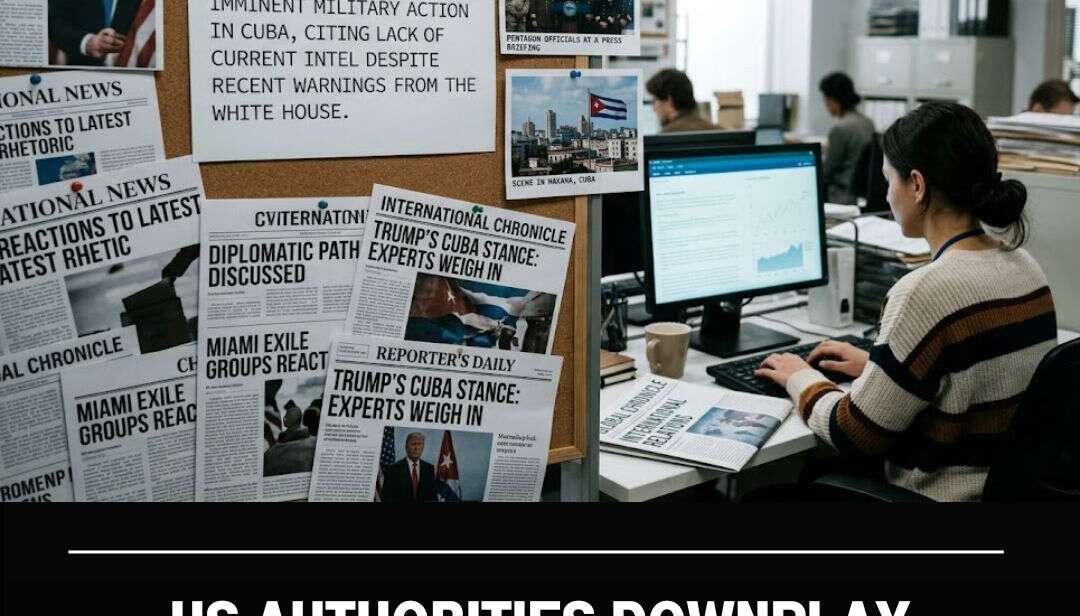
Washington / Havana — Even as President Donald Trump has ratcheted up his rhetoric against the Cuban government — issuing warnings sharp enough to set off alarm bells in Havana, Miami, and capitals across Latin America — senior U.S. military and national security officials are quietly but firmly pushing back against the suggestion that kinetic action against Cuba is imminent. The message from the Pentagon, the State Department, and the intelligence community is consistent: the warnings are real, the pressure is intensifying, but a military operation against Cuba is not on the immediate table.
Understanding the gap between Trump’s public posture and his administration’s operational reality requires looking carefully at what Washington actually wants from Havana — and what it is willing to do to get it.
Trump’s Warnings: What He Said and Why It Matters
Trump’s recent statements on Cuba have been characteristically blunt. In a series of remarks spanning press availabilities and social media posts, the President accused the Cuban government of “exporting repression across the hemisphere,” providing safe harbor to wanted criminals and narcotraffickers, and sustaining what he described as “an open wound of communism ninety miles from Florida that we’ve tolerated for too long.”
He pointedly refused to rule out military options when pressed by reporters, stating: “I never take anything off the table. Cuba’s leadership should know that.”
That framing — the deliberate ambiguity of “all options” — is a staple of Trump’s coercive diplomacy toolkit, deployed previously against Iran, North Korea, and Venezuela. In each case, the rhetorical escalation was designed to generate maximum psychological pressure on the target government while preserving Washington’s flexibility to pursue diplomatic or economic outcomes without committing to military action.
What US Authorities Are Actually Saying
Behind the presidential rhetoric, however, a different picture is emerging from the institutions responsible for actually executing military policy. Senior Pentagon officials, speaking on background to multiple outlets, have confirmed that no operational orders related to Cuba have been issued, no significant military asset repositioning toward the Caribbean theater has occurred, and no formal contingency planning escalation beyond standard standing protocols is underway.
A senior State Department official was more direct: “The President uses strong language. That’s his style and it serves a purpose. But there is no military operation being planned against Cuba. Full stop.”
The intelligence community’s assessment, according to sources familiar with recent briefings, is that Cuba does not currently present the kind of acute, time-sensitive threat that would trigger serious consideration of military intervention — and that the costs and complications of any such action would far outweigh achievable strategic gains.
The Real Pressure Campaign: Economic and Diplomatic
What the administration is actively pursuing against Havana is an intensified version of the maximum pressure economic model it has applied to Iran, Venezuela, and Nicaragua. Treasury Department sanctions targeting Cuban military-linked enterprises have been expanded. Remittance flows — a critical economic lifeline for ordinary Cubans — face tightened restrictions. And the State Department has intensified its support for Cuban civil society organizations and independent media operating both inside and outside the island.
The administration has also moved to deepen coordination with regional partners — particularly Colombia, Ecuador, and the Dominican Republic — on interdicting narcotrafficking networks that U.S. officials allege operate with Cuban state tolerance if not active facilitation.
The pressure campaign is calibrated to achieve two things simultaneously: destabilize the Cuban government’s economic position without triggering the kind of humanitarian catastrophe that would generate international backlash, and signal to Havana that the cost of continued defiance will compound steadily over time.
Why Cuba Is on Trump’s Radar Now
The timing of Trump’s elevated Cuba focus is not arbitrary. Several converging factors have pushed Havana up Washington’s priority list.
The Cuban government’s deepening relationship with Russia and China has drawn renewed attention from U.S. intelligence agencies monitoring foreign military and intelligence infrastructure in the Western Hemisphere. Reports of expanded Russian signals intelligence facilities on Cuban soil — first surfaced publicly in 2023 — have not gone away and remain a live concern within the national security establishment.
Cuba’s role in sustaining the Maduro government in Venezuela — through the deployment of intelligence and security personnel that effectively function as regime protection infrastructure — has also kept Havana in Washington’s strategic crosshairs. Any serious effort to change the political trajectory in Venezuela runs directly through the Cuban security services embedded there.
Additionally, Florida’s political arithmetic remains a constant gravitational force on any Republican administration’s Cuba policy. The Cuban-American community in South Florida represents one of the most reliable and mobilized voting blocs in the country’s most critical swing state — and its expectations of a tough Trump Cuba posture are not ones his political team can afford to disappoint.
The Risk of Rhetoric Outrunning Reality
There is, however, a genuine strategic risk embedded in the gap between Trump’s warnings and his administration’s actual operational posture. When presidential rhetoric consistently outpaces policy reality, it generates credibility costs that compound over time — adversaries learn to discount the warnings, allies grow uncertain about Washington’s actual commitments, and domestic audiences grow cynical about the distance between words and action.
Cuba’s government, with seven decades of experience managing American pressure and threats of every variety, is well-practiced at reading that gap. Havana is unlikely to make significant concessions in response to rhetoric it calculates will not be backed by force — particularly when it has Russian and Chinese relationships providing alternative lifelines against economic pressure.
Whether Washington’s maximum pressure economic campaign eventually generates enough internal strain to shift Cuban government behavior remains genuinely uncertain. What U.S. authorities are clear about, at least for now, is that military action is not the mechanism through which that outcome will be pursued.
The warnings are real. The military action, for now, is not.
Market Analysis
A quick snapshot of market trends, customer behavior, and competitor movements.