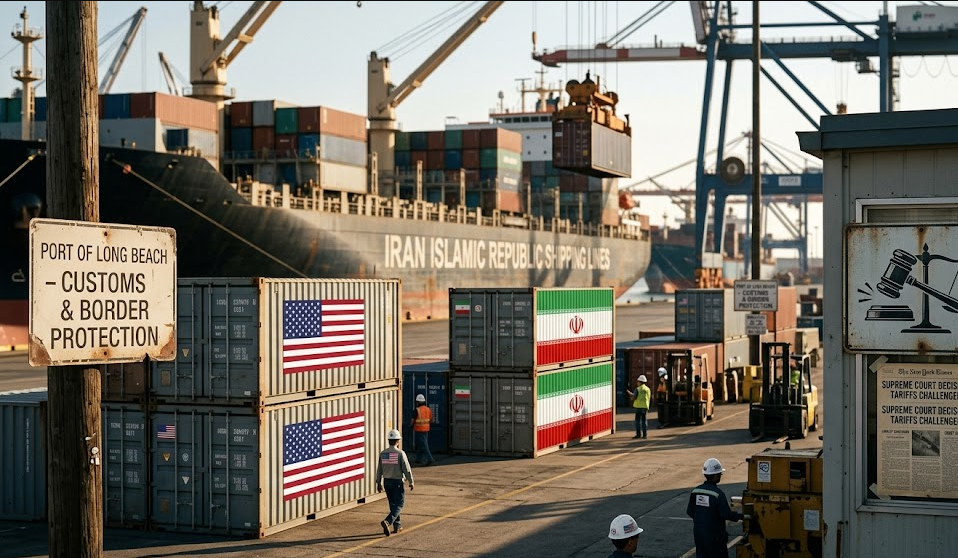
After months of legal battles, Supreme Court rulings, and bureaucratic scrambling, hundreds of thousands of American importers are finally approaching the moment they have been waiting for: the first refund payments from Trump’s tariffs are expected to begin flowing around May 11, 2026. The repayment operation — one of the largest in US customs history
After months of legal battles, Supreme Court rulings, and bureaucratic scrambling, hundreds of thousands of American importers are finally approaching the moment they have been waiting for: the first refund payments from Trump’s tariffs are expected to begin flowing around May 11, 2026. The repayment operation — one of the largest in US customs history — will distribute approximately $166 billion to more than 330,000 businesses across roughly 53 million import entries.
Are Trump’s Tariffs Legal? The Supreme Court Said No.
The refunds exist because the Supreme Court of the United States answered that question decisively on February 20, 2026. In a landmark 6-3 ruling in Learning Resources, Inc. v. Trump, the Court held that the International Emergency Economic Powers Act (IEEPA) does not authorise the President to impose tariffs. Chief Justice John Roberts, writing for the majority and joined by Justices Sotomayor, Kagan, Gorsuch, Barrett, and Jackson, concluded that IEEPA’s use of the words “regulate” and “importation” did not grant the executive branch the sweeping power to tax imports.
Roberts invoked the “major questions” doctrine — the judicial principle that if Congress wants to delegate authority over decisions of vast economic or political significance, it must do so explicitly and clearly. Trump’s IEEPA tariffs, which had been generating billions of dollars in monthly revenue, cleared no such bar. Justices Thomas, Kavanaugh, and Alito dissented.
President Trump responded by calling the ruling “terrible” and “totally defective,” and moved swiftly to impose a new 10% global tariff through separate legal authority. But for the tariffs already collected under IEEPA — more than $160 billion worth — the refund clock had started.
How the Refund System Works
The US Customs and Border Protection (CBP) launched a new online portal on April 20, 2026, called the Consolidated Administration and Processing of Entries — CAPE — specifically designed to process the unprecedented volume of refund claims.
The scale of the task is staggering. Customs officials estimate 330,000 importers paid Trump’s tariffs across 53 million entries. As of April 26, more than 75,000 refund requests had already been submitted through the portal. Approximately 21% of import entries subject to the tariffs have been accepted for duty removal through CAPE, and roughly 3% have already been fully liquidated and entered the active repayment phase — meaning US Treasury payments are now being processed.
CBP has stated it aims to issue refunds within 60 to 90 days of each approved claim, though processing complexities could extend that timeline. A court order filed in the US Court of International Trade set the expectation for the first batch of payments to go out around May 11, giving businesses their first concrete repayment date.
Not all claims have sailed through, however. CBP has rejected approximately 15% of refund requests submitted to date — a figure that has alarmed small business advocates who describe the application process as needlessly complex for entrepreneurs without dedicated customs brokers.
Are Trump’s Tariffs Working? The Economic Verdict Is Harsh.
Beyond the legal question, the economic record of Trump’s tariffs is one that even their proponents find difficult to defend. According to the Tax Foundation, Trump’s tariffs represented the largest US tax increase as a share of GDP since 1993 — amounting to an average additional cost of $1,500 per American household in 2026 alone.
Far from delivering the manufacturing renaissance Trump promised, the tariffs left manufacturing in a prolonged slump for most of 2025. Paradoxically, Americans actually imported slightly more goods in 2025 — $3.4 trillion worth, up 4% from 2024 — than the year before Trump’s tariff regime fully kicked in, suggesting the levies did not meaningfully reshape trade flows in the short term.
Inflation told a clearer story. Federal Reserve Chair Jerome Powell noted that elevated goods inflation readings directly reflected the tariff impact. Goldman Sachs estimated Trump’s tariffs raised inflation by half a percentage point in 2025 and projected they would add a further three-tenths of a percentage point in just the first six months of 2026. Business sentiment deteriorated sharply as tariff policy changed more than 50 times between Liberation Day and the Supreme Court ruling, leaving companies unable to plan.
What Happens Next: A Refund Race and a New Tariff Regime
For the 330,000 importers owed money, May 11 cannot come soon enough. Many small businesses that absorbed the cost of Trump’s tariffs — sometimes paying duties of 25% or more on goods from China, Canada, and Mexico — have been financially strained for over a year. The CAPE portal refund process, while imperfect, represents their first real path to financial relief.
Meanwhile, Trump’s new 10% global tariff, imposed in direct response to the Supreme Court’s February ruling, remains in force and faces its own wave of legal challenges. Whether that levy survives judicial scrutiny will determine whether the cycle of imposition, litigation, and refund begins all over again — with American businesses once more caught in the middle.
Market Analysis
A quick snapshot of market trends, customer behavior, and competitor movements.