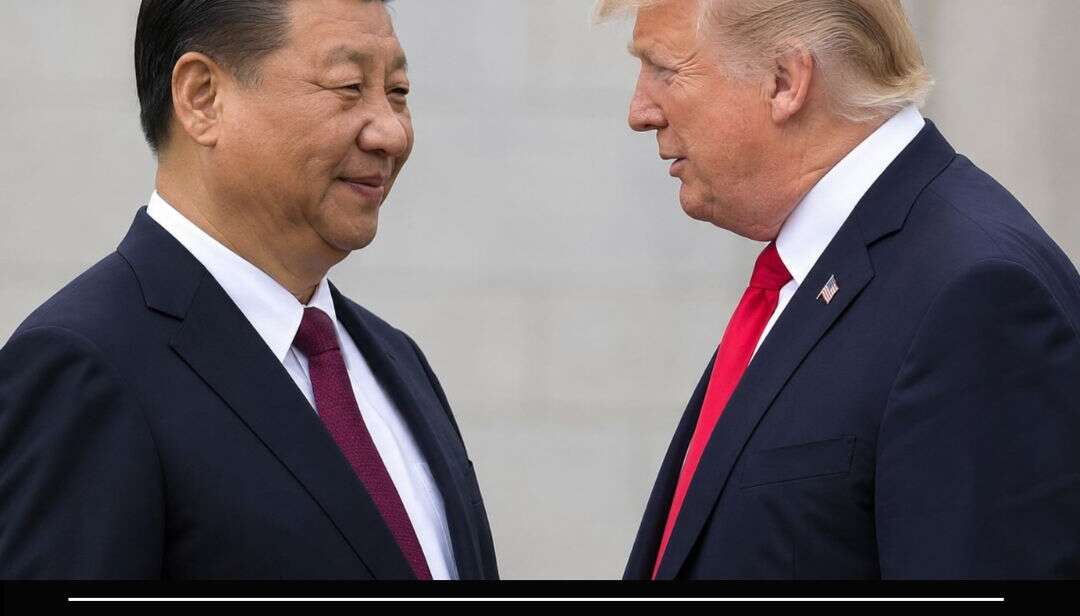
In a moment that will echo far beyond the walls of Beijing’s Great Hall of the People, the two most powerful men on earth sat down on May 14, 2026 — and the entire planet leaned in to listen.
Donald Trump and Xi Jinping opened their long-anticipated two-day summit in Beijing, a meeting that arrived weighted with more geopolitical freight than any US-China encounter in decades. The US Iran war, a global energy crisis, surging inflation at home, a fragile ceasefire in the Middle East, and the ever-present spectre of Taiwan all converged in one room — as governments from Singapore to Brussels, from Tokyo to Taipei, watched every handshake, every communiqué, and every carefully parsed sentence for signs of what comes next for them.
The Opening: A Question About History
Xi’s opening framing was deliberate and philosophically loaded. The Chinese president asked Trump directly whether the United States and China could avoid the “Thucydides Trap” — the ancient Greek concept describing how a rising power and a ruling power inevitably slide toward conflict. It was the kind of question that sounds academic until you remember both nations have nuclear weapons, competing claims over critical waterways, and troops stationed within striking distance of each other across multiple theatres.
Xi then proposed that the two countries work toward a “constructive China-US relationship of strategic stability” — a framework Beijing intends to treat as the guiding architecture for the relationship for the next three years and beyond. Trump, flanked by Secretary of State Marco Rubio and a delegation that included Elon Musk (Tesla), Tim Cook (Apple), Jensen Huang (Nvidia), and Larry Fink (BlackRock), agreed.
The symbolism was unmistakable: America’s corporate giants came to Beijing. The world’s factory floor received them.
Iran and the Strait: The Most Urgent Issue
The Iran war was the gravitational centre of the summit — the issue that made the meeting necessary and the one that most urgently requires resolution.
Both sides reached an agreement on a critical principle: the Strait of Hormuz must remain open to support the free flow of global energy. That statement — while not yet a ceasefire or a nuclear deal — represents a meaningful public alignment between Washington and Beijing on the most consequential shipping lane on earth. Xi also signalled that China was interested in purchasing more American oil, a development that would reduce Beijing’s dependence on Iranian crude flowing through the strait and give both nations a commercial incentive aligned with reopening.
But Xi also made clear China’s opposition to the militarisation of the Strait and any effort to impose tolls or access conditions — a reference to the US naval blockade that Washington has maintained since April 13. The line was carefully drawn: China wants the energy flowing, but not under American military management.
The Israel-Iran war dynamic was never far from the surface. Trump needs China to pressure Tehran into accepting the 14-point memorandum of understanding currently stalled in review. Xi has the leverage — Beijing buys over 80% of Iran’s oil — but the price of that leverage was the central unresolved question heading into day two.
Taiwan: Xi’s Sharpest Words
If Iran was the most urgent issue, Taiwan was the most dangerous. Xi reserved his sharpest language for the island Beijing claims as its own territory, telling Trump that Taiwan is “the most important issue in US-China relations” and warning that if not handled properly, it could push the bilateral relationship to a “dangerous” place — language that fell just short of a direct threat but left no ambiguity about intent.
Taiwan’s government watched from Taipei with undisguised anxiety. So did Japan and South Korea, whose security architecture is built on the assumption that Washington’s commitment to the region’s democratic allies is non-negotiable. In Seoul and Tokyo, the question being asked was not what Trump and Xi agreed on Taiwan — it was what Trump may have privately conceded.
The World Watching From Afar
CNBC reported that from Singapore to Brussels, world leaders have been eyeing the Trump-Xi summit from afar — and what they have seen so far has provoked a mixture of cautious relief and deep unease.
The prospect of an emerging “G2” — a US-China bilateral framework that effectively manages the world’s most important relationship in ways that exclude everyone else — has alarmed European capitals and Indo-Pacific allies alike. If Washington and Beijing cut deals on trade, technology, Taiwan, and Iran without consulting their respective allies, the rules-based international order that those allies depend on for security and prosperity becomes secondary to whatever Trump and Xi decide works for them.
European officials have been particularly vocal about being cut out of an arrangement that could accelerate their declining leverage on the global stage. Japan and South Korea face the more immediate fear: that Trump’s transactional instincts, combined with Xi’s disciplined long-game strategy, could produce a security architecture in which Taiwan’s future is quietly bargained away.
A Summit That Will Define the Decade
The US stock market has already priced in optimism. The S&P 500 edged toward 7,400, with investors betting that a Beijing breakthrough — even a partial one — would bring oil prices down, ease inflation, and restore the conditions for Federal Reserve rate cuts.
But the stakes are far larger than the next quarterly earnings cycle. What Trump and Xi decide in Beijing — on Iran, on Taiwan, on trade, on technology — will set the terms of the world’s most consequential relationship for years to come. Every government on earth knows it. Every market is watching.
The Thucydides Trap Xi invoked is not just a rhetorical device. It is the organizing question of this era: can two superpowers navigate their rivalry without catastrophic collision? In Beijing this week, two men are attempting to answer it — while the world, for once, holds its breath together.