May 5, 2026 | Maritime & Global Trade The waters off Dubai have become one of the most crowded anchorages on earth — and that tells you everything about who currently controls the Strait of Hormuz. According to Bloomberg tracking data, at least 363 vessels were anchored in waters near Dubai as of Tuesday, against
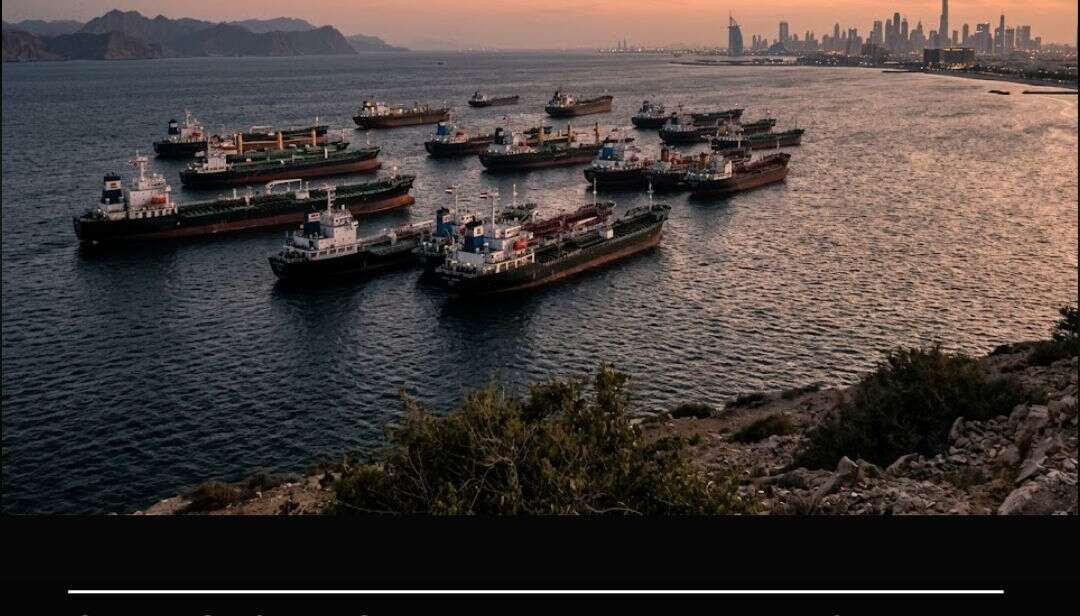
The waters off Dubai have become one of the most crowded anchorages on earth — and that tells you everything about who currently controls the Strait of Hormuz.
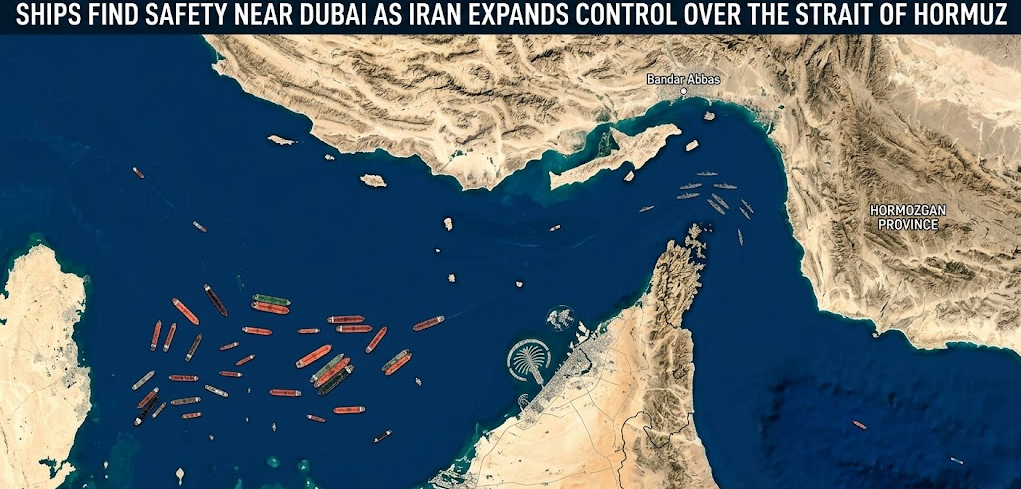
According to Bloomberg tracking data, at least 363 vessels were anchored in waters near Dubai as of Tuesday, against an average of 294 for the seven days prior. Nearly 60 additional ships sailed into the area in a single day — an extraordinary surge even for waters that have seen carriers clustering since the war began in late February. Crew members aboard vessels in the region report hearing a steady stream of radio broadcasts from Iran’s Islamic Revolutionary Guard Corps, warning of new maritime boundaries now enforced by IRGC naval units.
The message is clear. Dubai is far enough. Go no closer.
Iran’s New Control Zone — Defined and Enforced
On Monday, the IRGC announced a formally defined maritime control zone in the Strait of Hormuz, published with a map and explicit coordinates. The zone’s western boundary runs from the westernmost tip of Iran’s Qeshm Island to the UAE emirate of Umm al-Quwain. Its southern boundary extends from Iran’s Mount Mobarak to the Fujairah coast.
Dubai sits just outside that boundary — which is precisely why hundreds of captains are anchoring there rather than pressing further east. IRGC Spokesperson Gen. Hossein Mohebbi stated that vessels operating within the zone must comply with “transit protocols issued by the IRGC Navy” and proceed along designated routes under coordination with Iranian authorities. Ships that do not comply, he warned, will be stopped by force.
The IRGC has also published an alternative routing map, channeling ships willing to pay a toll through Iranian territorial waters past Larak Island, where naval checks can be conducted. Tolls have ranged between one and two million dollars per vessel — a figure that has effectively made the strait a toll road operated by Tehran.
A Waterway Reduced to a Trickle
The scale of the collapse in Strait of Hormuz traffic is staggering. Before the US-Israel war against Iran began on February 28, roughly 135 ships transited the strait every day — around 3,000 per month. In all of April, just 191 vessels crossed. Traffic currently runs at approximately five percent of its pre-war average, according to Kpler data tracked by CNN and multiple maritime intelligence firms.
Approximately 2,000 ships and 20,000 seafarers remain stranded across the Persian Gulf, according to the International Chamber of Shipping. Some have been waiting for weeks. For those with cargo already inside the Gulf, the options are grim: pay Iran’s toll, wait indefinitely, or attempt a passage under US military escort — an offer that, as Project Freedom showed, leaves shipowners guessing about exactly what protection they will receive and under what rules.
Iran has maintained a selective approach to passage. Ships flagged to China, Russia, India, Iraq, Pakistan, the Philippines, Malaysia, and Thailand have been granted transit rights — a geopolitical sorting mechanism that rewards non-Western alignment and punishes everyone else.
The Economic Damage Is Compounding
The Strait of Hormuz is not just about oil. Before the crisis, the waterway carried approximately 15 million barrels per day of crude and oil products — roughly one-fifth of global supply. Brent crude is currently trading above $112 per barrel, more than 50 percent above pre-conflict levels. But the damage extends well beyond energy markets.
The Persian Gulf accounts for 30 to 35 percent of global urea exports and up to 30 percent of internationally traded fertilizers. Ammonia, grain, manufactured goods, and liquefied natural gas bound for Asia have all stalled. Shortages of refined fuel products are already being reported across parts of Asia. Insurance premiums for vessels willing to transit the region have reached levels that make many cargo runs economically unviable regardless of the military situation.
The Maersk vessel Alliance Fairfax became one of the rare success stories this week — exiting the Persian Gulf with US Navy coordination under Project Freedom. But one ship is a data point, not a solution.
Dubai as Sanctuary — for Now
The clustering near Dubai reflects a pragmatic calculation by shipping operators: stay close enough to resume operations quickly if conditions change, but far enough to avoid IRGC interdiction. It is a floating holding pattern, measured in billions of dollars of stranded cargo and tens of thousands of seafarers in limbo.
Iran’s expanding control zone is not static. Each new map published by the IRGC represents a test of how far Tehran can push its maritime perimeter before facing a credible response. With Project Freedom’s operational details still undefined and the ceasefire under strain, the boundary between Dubai’s safe waters and Iran’s controlled zone may not hold where it is today.
The ships anchored off Dubai are not just waiting out a crisis. They are watching to see who, ultimately, controls the world’s most critical chokepoint.
Market Analysis
A quick snapshot of market trends, customer behavior, and competitor movements.