
US Politics
Oil Rises as Markets Stay Skeptical of US-Iran Peace Talks
NEW YORK, Oil prices pushed higher this week even as the United States and Iran signaled they were back at the negotiating table, a sign that energy markets no longer take a diplomatic breakthrough at face value. After months of false starts, traders are treating the newest US-Iran peace talks as a headline to hedge…
NEW YORK, Oil prices pushed higher this week even as the United States and Iran signaled they were back at the negotiating table, a sign that energy markets no longer take a diplomatic breakthrough at face value. After months of false starts, traders are treating the newest US-Iran peace talks as a headline to hedge against, not a reason to sell.
According to benchmark data, US West Texas Intermediate was trading between $92 and $93 a barrel late in the week, while Brent crude, the international benchmark, was trading between $104 and $105. Throughout 2026, prices have fluctuated on every escalation and every olive branch; the present increase is indicative of a market that has come to distrust the trend.
What Happened
The immediate driver is a mix of cautious diplomacy and hard bargaining. On the sidelines of the United Nations General Assembly in New York, US and Iranian negotiators, with Qatar mediating, have been exploring a phased arrangement that could reopen the Strait of Hormuz and lift the US naval blockade of Iranian ports. The UK’s recent deployment of a mine hunter to Hormuz underscores just how seriously allied nations are still treating the risk in that corridor, deal talks or not.
President Donald Trump described the discussions as productive and said there was momentum toward a deal. But a White House official also stressed that Washington felt little pressure to negotiate, arguing that its sanctions campaign and blockade had left the US in a strong position. Iran, for its part, has said it will not accept any deal unless the US eases military pressure, removes the blockade and unfreezes Iranian assets, and it has insisted on retaining control over Hormuz.
Earlier in the week, oil snapped a five-day losing streak after Iranian President Masoud Pezeshkian told the UN that Iran would not surrender, a reminder that the two sides remain far apart even as they talk. That gap has also spilled into domestic politics, fueling the clash between Trump and congressional Republicans over Iran war powers, including the Senate’s own resolution attempting to force an end to the conflict.
Why Markets Are Skeptical
The skepticism is earned. This is not the first time a US-Iran deal has looked close. A memorandum of understanding reached in mid-June led to a fragile ceasefire that collapsed within weeks over disputes about shipping through the strait. Negotiations have repeatedly appeared to be near a breakthrough, only to break down.
We now have to pay for that history. Traders are asking for a risk premium and an extra buffer in the price of petroleum due to the cost of being caught on optimism. If the negotiations don’t work out, Hormuz will probably face another threat. Until the strait is actually reopened by a documented, verified agreement, the market is probably going to keep that premium.
The 2026 Price Roller Coaster
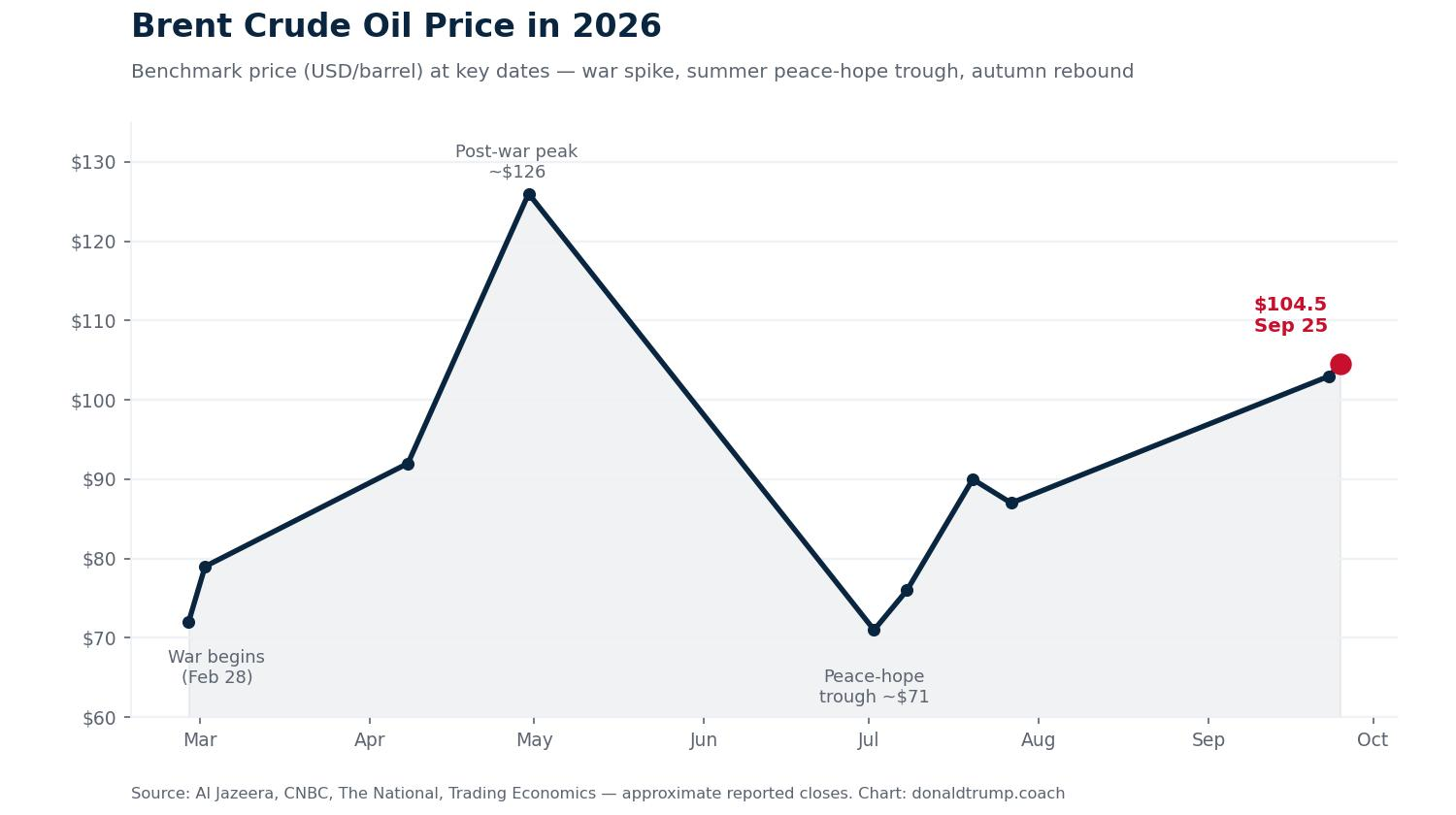
The chart below shows why this year has been so punishing for anyone trying to guess where oil is headed. Brent started 2026 near $72 before the war, spiked to a post-war peak above $126 in the spring, slid back to pre-war levels near $71 in early July on peace hopes, then rebounded again as those hopes faded.
What Could Bring Prices Down
Analysts point to two developments that could ease oil prices today if they hold. The first is a credible agreement to reopen the Strait of Hormuz, which would remove the single biggest supply risk hanging over the market. The second is a continued recovery in Middle East supply, including the partial restart of Saudi Arabia’s East-West pipeline after earlier drone attacks. There are also signs of longer-term regional realignment, including reports that Saudi Arabia is weighing a non-aggression treaty with Iran, which could ease tensions well beyond the current talks. Some market analysts have said that if both trends continue, Brent could drift back toward the low $90s as a more normal supply picture returns.
Working against that, Houthi forces have seized strategic Red Sea positions and imposed a maritime embargo on Saudi-linked ships, keeping a second chokepoint, the Bab el-Mandeb Strait, in play alongside Hormuz.
What It Means for Your Wallet
For American households, oil prices today translate to pump prices in a matter of days. Elevated crude has kept gasoline well above where it sat before the war, and diesel, which moves freight and farm equipment, has stayed higher still, feeding into grocery and shipping costs on a lag. The administration has tried to soften some of that pressure elsewhere, including recent cuts to tariffs on farm and industrial equipment, though fuel costs remain the more direct hit to household budgets. If the peace talks produce a durable deal, drivers could see relief within weeks. If they collapse, the risk premium and the pump price climb together.
The disruption is also reshaping global trade relationships in real time. India’s rupee recently hit a historic low against the dollar, and Commerce Minister Piyush Goyal has been actively courting 50 US business leaders in New York to shore up supply chains against exactly this kind of volatility. Meanwhile, Washington has been working to turn the Quad into a more active strategic hub partly in response to these shifting energy and security dynamics, and India’s own diplomatic maneuvering was on display during PM Modi’s recent visit to Sweden.
What to Watch Next
The single most important signal remains the Strait of Hormuz. As long as it stays contested, the oil market will keep pricing in disruption. Watch for a concrete, verifiable outcome from the US-Iran peace talks rather than another optimistic announcement, the market has heard those before, and this week it voted with higher prices.
FAQs
Why are oil prices rising during the US-Iran peace talks?
Oil prices are rising because markets are skeptical the US-Iran peace talks will produce a lasting deal. A similar agreement collapsed over the summer, so traders are keeping a risk premium in crude prices until the Strait of Hormuz is verifiably reopened.
What is the oil price today?
As of late September 2026, Brent crude oil price traded around 104–105 a barrel and WTI crude price near 92–93. These figures move daily; check the live tracker linked below for the current oil price today.
How do the US-Iran peace talks affect the Strait of Hormuz?
The talks center partly on reopening the Strait of Hormuz, the shipping lane that carries a large share of the world’s seaborne oil. Iran wants the US blockade lifted and control of the strait retained; the US wants guaranteed passage. Until that is resolved, oil prices stay elevated.
Why does the Iran war move gas prices in the US?
When conflict threatens the Strait of Hormuz, traders price in the risk of a supply cut, pushing global crude higher. US gasoline tracks crude within days, which is why the oil prices Iran war story shows up at the pump.
Could a US-Iran deal bring oil prices down?
Yes. Analysts say a credible agreement to reopen the Strait of Hormuz, combined with recovering Saudi supply, could push the Brent crude oil price back toward the low $90s. But a deal has to be held. Previous ones did not.
Where can I track oil prices today?
See our live oil price tracker, updated regularly, for the current Brent crude oil price, WTI crude price and the latest on the US-Iran peace talks.
References & sources
- CNBC – Oil rises, snaps five-day losing streak as Iran vows it will not surrender (Sept. 23, 2026)
- The National – Oil at $100 a barrel as focus remains on Iran peace talks and Saudi supply recovery (Sept. 23, 2026)
- Trading Economics – Brent crude oil price, historical data and news
- Trading Economics – Crude oil (WTI) price and news
- U.S. Energy Information Administration – petroleum and crude oil data
- AAA – national gas price average