
Share This Article
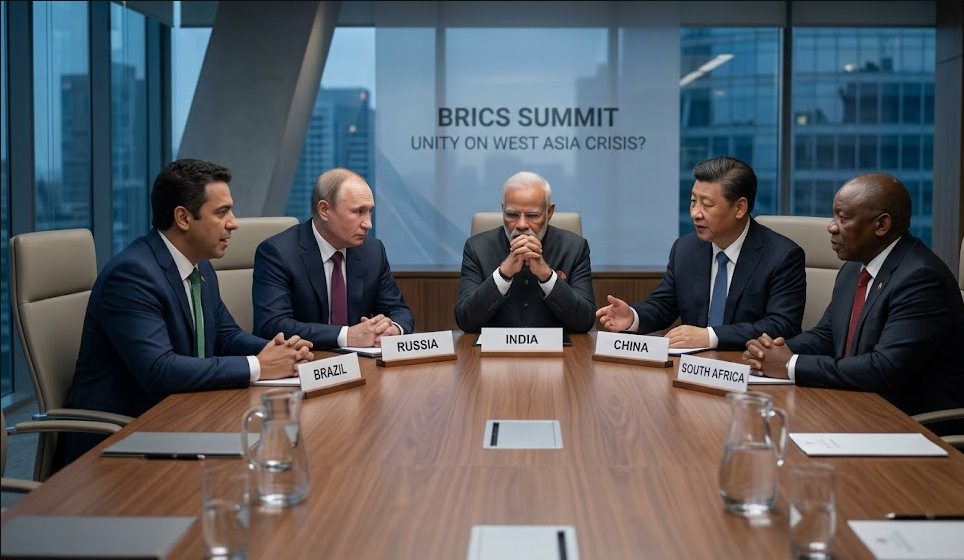
New Delhi, May 15, 2026 – The optics were supposed to project solidarity. Eleven foreign ministers gathered in the Indian capital under India’s 2026 BRICS presidency, with the West Asia Crisis the US-Iran War in its 77th day, the Strait of Hormuz closed, oil markets in turmoil as the central item on the agenda. Instead, what the world witnessed was a bloc at war with itself.
BRICS ended its Foreign Ministers’ Meeting without a joint statement. In its place, India issued a procedurally careful “Chair’s Statement and Outcome Document” 63 points of diplomatic language held together by deliberate ambiguity and, in two critical paragraphs, frank footnotes acknowledging that “a member had reservations on some aspects.” The members who could not agree were Iran and the UAE. Both now sit inside the same bloc. Both are on opposite sides of the most consequential regional war in a generation.
The Clash That Broke the Communiqué
The confrontation was not kept behind closed doors. Iranian Foreign Minister Abbas Araghchi arrived in New Delhi demanding that BRICS formally condemn what he called US and Israeli “unlawful aggression” and “violations of international law.” His Deputy FM Kazem Gharibabadi was blunter still: “One country is insisting on condemning Iran. We want India’s BRICS chairship to be successful. It is not a good approach to send a signal to the world that BRICS is divided.”
That country was the UAE.
Here are Some Related Blogs to Read
- NATO chief calls US strikes on Iran “absolutely necessary”
- Will gold rally as US-Iran tensions escalate
- Oil jumped but the market stayed calm
- 5 takeaways from Tuesday’s 2026 primaries
- US tariff system reset across 60 economies
- Trump tariffs Section 122 surcharge expires
- Trump had deliberately paused Hormuz operations to force Iran into a deal
- JD Vance claims Hegseth has been misleading Trump on the Iran war
- Iran has been digging out hidden missile stockpiles after rejecting Trump’s peace offer
- US Navy destroyer just fired on and seized an Iranian cargo ship
- Iran and Israel’s spy war is heating up amid claims of stolen F-15 secrets
- he’s now clashing with his own SCOTUS picks back home
- see what the UK’s mine-hunter deployment really signals.
- Stay ahead of the story track it live or get the full background on how the US-Iran war escalated to this point.
UAE Minister of State Khalifa Shaheen Al Marar rejected Araghchi’s framing with equal force, accusing Iran of attempting to justify what he called “terrorist attacks” referencing approximately 3,000 Iranian strikes on UAE territory using ballistic missiles, cruise missiles, and drones targeting civilian infrastructure since the US-Iran War began. Araghchi shot back, accusing the UAE of being “an active partner in this aggression” by providing bases, airspace, territory, intelligence, and facilities to the United States and Israel.
Russian FM Sergey Lavrov who had made headlines earlier at the same event with his viral phone-and-gun quip was forced to physically intervene to soothe frayed tempers between the two delegations.
As Al Jazeera reported, the scenes in New Delhi exposed something structural: “Why the Iran conflict is becoming a problem for BRICS.”
India’s Impossible Chairmanship
No country felt the weight of the failure more acutely than India, which holds the 2026 BRICS presidency and had invested significant diplomatic capital in projecting the bloc’s relevance during the West Asia Crisis.
External Affairs Minister S. Jaishankar chose his words with surgical precision. “Peace cannot be piecemeal,” he told the assembled ministers. “Stability cannot be selective.” He called for “unimpeded maritime flows” through the Strait of Hormuz as vital for global economic well-being language calibrated to avoid naming either the US naval blockade or Iranian provocation as the cause. He described unilateral sanctions as “unjustifiable measures” that “cannot substitute dialogue” language that satisfied neither Washington nor Tehran, which was precisely the point.
As News Laundry’s analysis assessed India’s strategy: “Agreeing to disagree India is using calibrated ambiguity to keep BRICS together.” That ambiguity produced footnotes instead of consensus on the two most sensitive paragraphs: Paragraph 21 on the West Asia Crisis and Paragraph 29 on Yemen, Red Sea navigation, and the Strait of Bab Al-Mandab. Iran dissented on both.
The Expansion Problem Nobody Wanted to Name
The deeper issue is one that BRICS architects did not fully anticipate when the bloc began its rapid expansion in 2024 and 2025. Iran joined in 2024. The UAE joined in 2024. Saudi Arabia followed in July 2025. Egypt and Ethiopia joined alongside Iran. The bloc that was once a loose coordination forum for large emerging economies has absorbed, simultaneously, a nation under US-Israeli military assault and the nation that provided bases for that assault. It has absorbed Iran and the UAE bilateral adversaries engaged in an active proxy and direct military conflict.
As the Council on Foreign Relations has noted, BRICS expansion was designed to amplify the Global South’s voice in international institutions. What it has also done is import the Global South’s deepest conflict directly into the bloc’s decision-making architecture.
The Carnegie Endowment’s analysis of BRICS expansion warned precisely of this dynamic: that a larger bloc would find it harder, not easier, to forge unified positions as member interests diverged. New Delhi is now living that analysis in real time.
Where BRICS Can and Cannot Hold
The honest accounting of the New Delhi meeting is not entirely bleak. On the issues where BRICS members share genuine common ground criticism of unilateral Western sanctions, reform of UN governance structures, support for development finance, digital infrastructure cooperation the outcome document achieved solid consensus across all 63 points. China, despite sending an ambassador rather than FM Wang Yi (occupied with the Beijing bingo Trump-Xi summit), backed the multilateral reform language fully. Brazil, South Africa, Russia, and India found common ground on economic architecture.
The Diplomat’s assessment framed the limits clearly: “Iran War Tests BRICS And Reveals Its Limits.” The bloc functions as an economic and governance reform platform. It does not function and may never function as a unified geopolitical actor when its own members are shooting at each other.
Foreign Policy noted that this is not uniquely a BRICS problem: “NATO and the G-7 are just as divided as BRICS” on the US-Iran War. The difference is that NATO’s divisions are between allied democracies disagreeing on policy. BRICS’ divisions are between nations whose territory has been bombed and nations that provided the airbases for the bombers.
That is not a footnote problem. That is a structural one.

Oil & Energy Markets
A look at crude price swings, OPEC supply moves, and how energy markets react to geopolitical shocks.

Geopolitics & Conflict
Breaking down how wars, ceasefires, and diplomatic deals ripple through global trade and security.
US Foreign Policy
Coverage of Trump administration negotiations, sanctions, and strategic decisions shaping world events.
Economy & Inflation
Tracking how commodity prices, gas costs, and supply chains affect everyday consumers.