Beijing, May 15, 2026 — When Air Force One touched down in Beijing this week, flanked by a delegation of Silicon Valley billionaires and Wall Street titans, the optics alone told a story. Donald Trump — the man who launched a trade war against China, threatened tariffs at every turn, and spent years casting Beijing as America’s greatest rival — had arrived on Chinese soil seeking something. And Xi Jinping knew exactly how to play it.
Three days later, as Trump wrapped up his state visit touting “fantastic trade deals,” analysts and foreign policy observers were quietly tallying a different scorecard. Not Trump’s wins. Xi’s.
Victory One: The US-Iran War — China Gets the Credit
The most consequential outcome of the Beijing summit was not economic. It was strategic. Both leaders agreed in principle that the Strait of Hormuz must remain open and free of tolls — a direct reference to the ongoing US-Iran War, now in its 75th day following the February 28 U.S.-Israeli strikes that killed Supreme Leader Ayatollah Ali Khamenei.
With a ceasefire described by Trump himself as being on “massive life support,” and negotiations stalled over Iran’s refusal to immediately surrender an estimated 440 kilograms of highly enriched uranium, Beijing stepped into the vacuum. Xi signalled that China would purchase more American oil — a strategic sweetener designed to reduce U.S. dependence on Hormuz — while simultaneously positioning China as the adult in the room: the power capable of de-escalating a conflict that has already cost Washington $29 billion and drained its Strategic Petroleum Reserve at record pace.
For Xi, this is pure diplomatic gold. China emerges not as a bystander to the US-Iran War, but as its potential peacemaker. The optics gift Beijing enormous credibility across the Middle East and the Global South.
Victory Two: Taiwan Warning Goes Unchallenged
Buried beneath the trade headlines was a moment of equal importance. According to CNBC’s reporting from inside the summit, Xi formally warned Trump on Taiwan — demanding Washington handle the issue with care. Trump, who arrived hoping to lock in economic concessions, did not push back publicly.
This is Xi’s second win: a sitting U.S. president, on Chinese soil, absorbing a red-line lecture on Taiwan without visible objection. The image — Trump flanked by Elon Musk and Jensen Huang, nodding through geopolitical guardrails set by Beijing — is one that will resonate far longer than any tariff announcement.
Victory Three: The Soft Power Dividend — and a Viral Trump of Their Own
The third victory is subtler, but culturally significant. While the two leaders met behind closed doors, a very different Trump was going viral on the internet — a Chinese one.
Ryan Chen (陈瑞), a 42-year-old entertainer from southwest China performing under the name “瑞哥英语,” has become a global phenomenon for his uncanny impersonation of Donald Trump. CNN called it “pitch-perfect.” The New York Times ran a feature. Millions follow him across TikTok and Instagram.
Crucially, Chen avoids political satire — too risky in China’s media environment — and instead uses his Trump persona to promote Chinese cities, food, and tourism. The result is a form of soft power that Beijing could never have manufactured through official channels: an internationally beloved, algorithmically amplified Chinese creator using Trump’s own image to make China look warm, funny, and worth visiting.
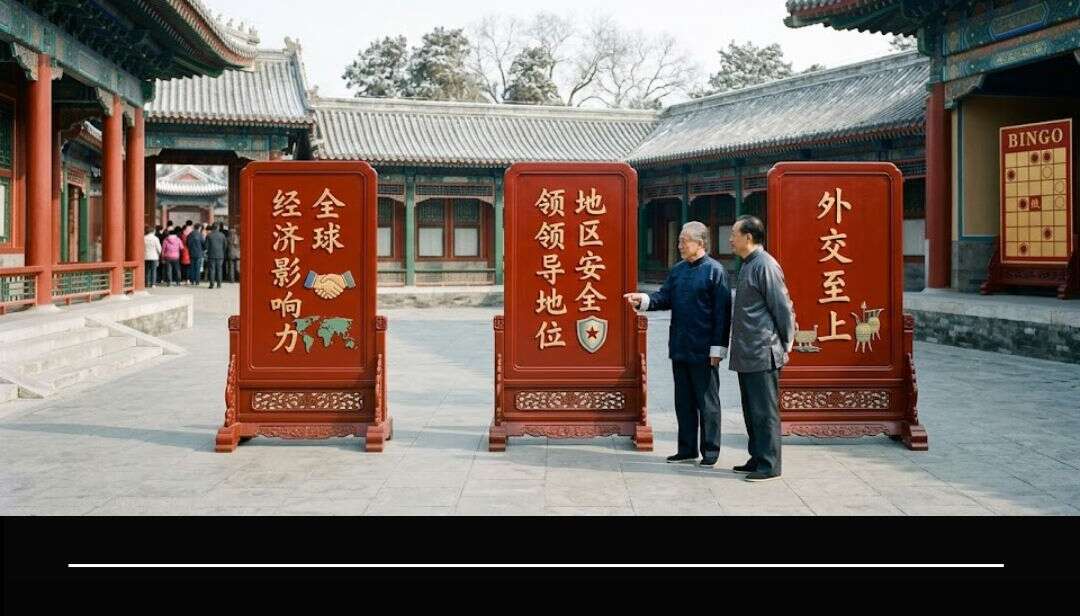
Beijing bingo, some observers might say.
The Bigger Picture
Trump returned home with trade commitments and a photo-op narrative. But the structural outcomes of the Beijing summit favour China on nearly every front. The US-Iran War gave Xi the leverage of indispensability. Taiwan gave Xi a moment of public deference. And china’s viral Donald Trump impersonator — an accidental ambassador — reminded the world that Beijing’s cultural reach now extends into the very caricature of its chief rival.
None of this means the U.S.-China relationship has been reset. Xi’s warnings on Taiwan were not gestures of goodwill. They were conditions. And with a fragile ceasefire in the Middle East, a depleted Strategic Petroleum Reserve, and inflation biting at home, Trump needs Beijing far more than he can afford to publicly admit.
In the game of Beijing bingo, Xi just marked three squares.