With the ceasefire expiring in days, three nations are racing to narrow the gaps on uranium enrichment and Hormuz tolls — who has leverage and what a last-minute deal would require. Seven days. That is what separates the world from the expiration of the only thing currently standing between the United States and a resumed
With the ceasefire expiring in days, three nations are racing to narrow the gaps on uranium enrichment and Hormuz tolls — who has leverage and what a last-minute deal would require.
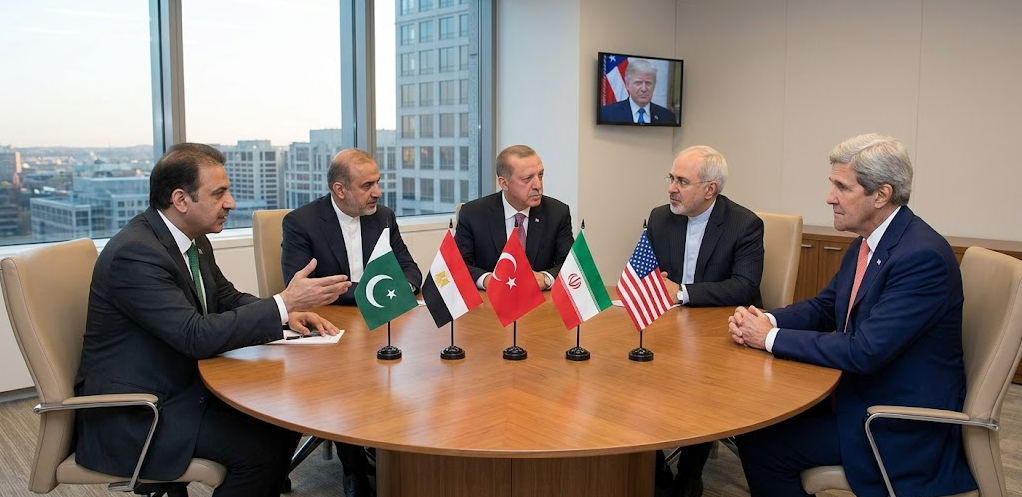
Seven days. That is what separates the world from the expiration of the only thing currently standing between the United States and a resumed war with Iran. The two-week ceasefire, brokered by Pakistan and agreed on April 8, runs out on April 21. The Islamabad talks failed. The U.S. naval blockade is active. And now the diplomatic weight of preventing a second round of bombing has fallen on three countries that were not party to the original conflict: Pakistan, Egypt, and Turkey.
They are racing. Whether they have enough runway to land anything is the question every foreign ministry in the region is asking this week.
What Pakistan Built — and Is Now Trying to Save
Pakistan’s role in this crisis has been extraordinary. Prime Minister Shehbaz Sharif and Army Chief Field Marshal Asim Munir spent weeks in back-channel contact with both Washington and Tehran before the original ceasefire, reportedly making personal calls to senior officials on both sides to establish the trust that made Islamabad viable as a meeting venue.
When the 21-hour talks ended without a deal last weekend, both Trump and Iranian officials pointedly praised Pakistan’s mediation — a deliberate diplomatic signal that Islamabad’s channel remains open. Pakistani Foreign Minister Ishaq Dar moved quickly, announcing that Islamabad would “try to set up a new round of dialogue in the coming days.”
CNN and Bloomberg reported Monday that U.S. officials are already internally discussing potential dates and locations for a second in-person meeting — and that a ceasefire extension is on the table if talks advance fast enough. Pakistan is the natural venue for that second round, and Islamabad knows its leverage is at its peak right now, before the clock expires.
Egypt and Turkey: The Parallel Tracks
While Pakistan holds the primary channel, Egypt and Turkey have been running quieter but significant parallel tracks. According to The Levant Files and the Atlantic Council, Egyptian and Turkish diplomats have been physically carrying messages between Washington and Tehran — serving as trusted intermediaries in a relationship where direct communication has historically broken down.
Turkey’s involvement is layered with strategic self-interest. Ankara, as a NATO member with deep economic ties to both the West and the Islamic world, sits in a uniquely awkward position. The Atlantic Council analysis noted that Turkey’s usefulness is measured not just by military power but by its value as a coordination hub — and Foreign Policy’s Erdogan government has worked deliberately to position itself as indispensable to any resolution.
Egypt’s stake is more straightforwardly economic. Suez Canal revenues have cratered under the Hormuz blockade’s disruption of global shipping patterns. Cairo’s interest in a deal is not abstract — it is measured in lost toll income and a regional security environment that Egyptian President el-Sisi cannot afford to see deteriorate further.
The Two Gaps That Need Closing
CNN and Al Jazeera have both mapped the precise contours of what broke down in Islamabad — and what mediators are now working to bridge.
Gap One: Uranium enrichment. Both sides have privately floated the concept of a moratorium — a temporary freeze on Iranian enrichment rather than a permanent dismantlement. The problem is the timeframe. The U.S. wants a freeze that functionally eliminates Iran’s breakout capacity. Iran wants a short-horizon freeze that preserves its future right to resume. Mediators are reportedly exploring whether a 10-to-15 year moratorium with phased sanctions relief could thread that needle — something structurally similar to what the JCPOA attempted, but without Obama’s sunset clauses.
Gap Two: Hormuz tolls. Iran has been collecting passage fees from commercial shipping through the strait — a policy Trump has called an “illegal toll” and a red line for any deal. Iran views the tolls as sovereign revenue and a symbol of territorial control. The compromise being explored, according to diplomatic sources cited by Bloomberg, would have Iran suspend toll collection as part of a broader economic package that includes partial unfreezing of Iranian assets — essentially paying Iran not to charge the toll, using its own money.
What a Last-Minute Deal Would Actually Look Like
Analysts at the Carnegie Endowment and Foreign Policy have sketched the minimum viable framework: an enrichment moratorium of sufficient length to satisfy Trump’s base politically, an immediate Hormuz reopening in exchange for a first tranche of asset release, a phased sanctions-relief calendar tied to Iranian compliance benchmarks, and a Pakistani-hosted monitoring mechanism to verify the early stages.
The UN Secretary-General António Guterres called this week for “continued talks and an end to ceasefire violations” — lending international institutional weight to the mediation effort and signaling that the UN is prepared to provide observer infrastructure if both sides reach a framework.
The Window Is Narrow — But It Exists
The blockade complicates everything. Iran cannot be seen domestically accepting a deal while its ports are being blockaded — any agreement reached under those conditions would be politically toxic for Tehran’s leadership. The sequencing question — does the blockade pause before talks, or do talks produce a deal that ends the blockade — is itself a negotiation.
But Bloomberg’s most recent reporting, published Monday, captures the key signal: both the U.S. and Iran are weighing further truce talks even with the blockade underway. Neither side has slammed a final door. Pakistan’s phone lines are open. Egypt and Turkey are in motion.
Seven days is not much time. It is, however, enough — if the gaps are as narrow as Iran’s Foreign Minister claimed they were when he said the Islamabad MOU was “inches away.”
Market Analysis
A quick snapshot of market trends, customer behavior, and competitor movements.