New Delhi / Washington, May 22, 2026 — Nineteen years. That is how long it took the European Union to finalise a trade agreement with India. US envoy Sergio Gor, America’s 27th Ambassador to India and Special Envoy for South and Central Asian Affairs, is not prepared to wait that long — and has said so publicly.
“Negotiations have been ongoing for a year and a half, but to put it in perspective, the European Union took almost 19 years,” Gor stated on May 22. “We are confident that in the coming weeks and months, this trade deal will be finalised.”
The target: $500 billion in US-India bilateral trade by 2030 — more than doubling the current combined goods and services trade of approximately $212 billion. For a relationship reshaped by the US-Iran agreement impasse, the closed Strait of Hormuz, and a geopolitical realignment that has made India’s energy dependency newly urgent, the trade deal is not merely commercial. It is strategic architecture for a post-Hormuz world.
Who Is Sergio Gor — and Why Does He Matter?
Born in Tashkent in 1986, Sergio Gor arrived in Washington via George Washington University, Senator Rand Paul’s office, and the Trump Victory Finance Committee. When Trump returned to power, he named Gor Director of the Presidential Personnel Office — described in Washington circles as “the most powerful man you’ve never heard of” — before appointing him Ambassador to India and Special Envoy for South and Central Asia in August 2025.
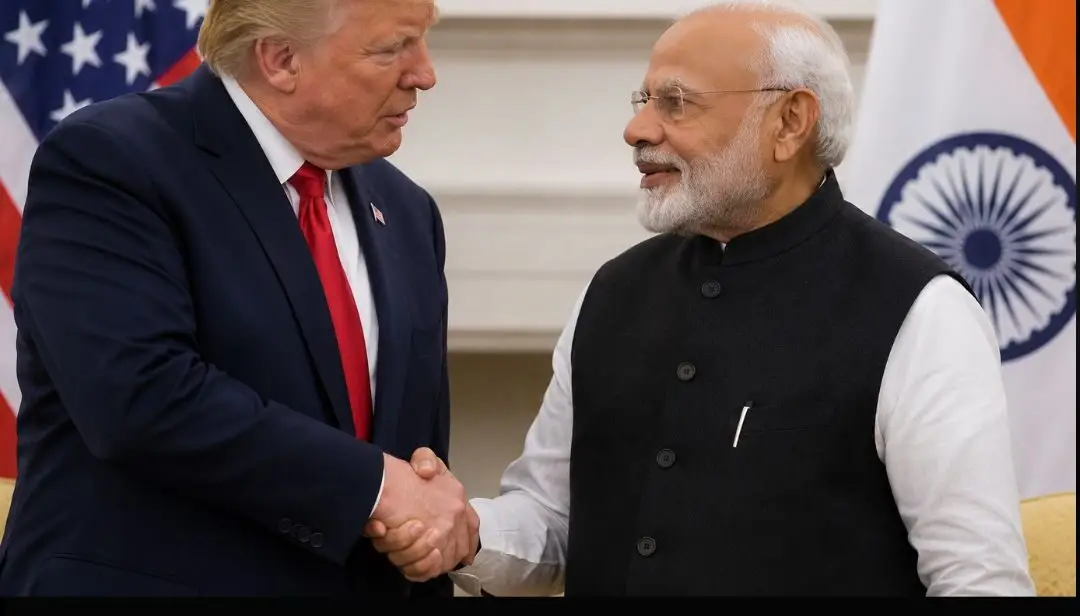
Gor presented his credentials to President Droupadi Murmu on January 14, 2026, and has since become the most active American diplomatic voice in India since the relationship’s post-nuclear deal renaissance. His operating theory is explicit and personal: at the India Today Conclave in March, he stated that “the only two people who got this deal done were President Trump and PM Modi” and that “one of the reasons this deal got done was because of their deep, personal friendship.” As DD News confirmed, Gor has framed the entire relationship as a function of that bond — which survived Trump’s first term, Biden’s interlude, and has now been institutionalised into a trade framework.
The February Framework: What Was Already Agreed
The foundation beneath Gor’s $500 billion forecast was laid on February 6, 2026, when the US and India announced a framework for an interim Bilateral Trade Agreement — formally launched by Trump and Modi on February 13, 2025, and now moving toward finalisation. As CNBC confirmed, the framework is substantial.
India secured elimination or reduction of US tariffs on pharmaceuticals, gems and diamonds, textiles, apparel, leather, organic chemicals, and aircraft parts. The US reciprocal tariff on India was cut from 25 percent to 18 percent, with the additional 25 percent punitive tariff related to Indian purchases of Russian oil completely removed. In return, India agreed to reduce barriers on US agricultural products — from dried distillers’ grains to tree nuts, sorghum, and wine — while explicitly protecting sensitive domestic dairy and staple crops.
The $500 billion figure, clarified by Commerce Minister Piyush Goyal on February 9, is not a binding obligation but a statement of commercial intent. “We don’t have to. We intend to,” Goyal told reporters, breaking down the number: coking coal purchases rising from $17 billion to $30–35 billion as Indian steel capacity doubles; civil aviation at $80–100 billion anchored by $50 billion in Boeing orders already placed; energy products growing at 8–10 percent annually; and technology including Nvidia semiconductors. Goyal called $500 billion “a very conservative number,” projecting India’s total import demand over the period at approximately $2 trillion.
The Strait of Hormuz Dimension: Why Energy Is Central
The US-Iran agreement deadlock — and the closed Strait of Hormuz — has changed the energy calculus of the US-India trade relationship in ways that Gor has acknowledged directly. India’s crude basket price surged from $69 a barrel in February 2026 to $113 in March as the Strait’s closure severed approximately 50 percent of India’s traditional Middle Eastern supply corridor.
Washington has been explicit: the US wants India to diversify crude imports away from Russia and toward American and alternative energy sources, as Business Standard reported. The trade framework’s energy component — India purchasing American oil, LNG, and coking coal — is both a commercial deal and a strategic repositioning, reducing India’s dependence on supply routes that one adversary can close with a mine and a press conference.
On May 20, Gor went further, declaring “big things ahead” in US-India nuclear energy collaboration — responding to Maharashtra Chief Minister Devendra Fadnavis’s meeting with the Nuclear Energy Institute and the US-India Strategic Partnership Forum. With the SHANTI Act having opened India’s nuclear market to foreign investment, a 20-member US nuclear industry delegation visited India from May 18–21 to map Westinghouse and GE-Hitachi’s post-SHANTI engagement, as Organiser confirmed. Nuclear is now part of the $500 billion architecture, not separate from it.
Rubio Arrives — and the Stakes Clarify
Secretary of State Marco Rubio’s India visit, scheduled for May 23–26, provides the highest-level confirmation yet that the trade deal is approaching its final phase. As Republic World reported, the agenda spans the trade deal, Section 301 investigations, Quad security cooperation, and energy diversification — a sequence that maps precisely onto the US-India relationship’s convergence of commercial ambition and Strait of Hormuz strategic necessity.
Gor framed the moment precisely in his May 22 statement: “President Trump’s goal is to facilitate bilateral trade in a way that creates lucrative opportunities for American businesses and workers.” In the language of the relationship — built on personal friendship, strategic convergence, and the shared pressure of a world reshaped by Iran strikes and a closed strait — that statement is as close to a closing argument as a trade deal gets.
The EU took 19 years. Gor is promising weeks.