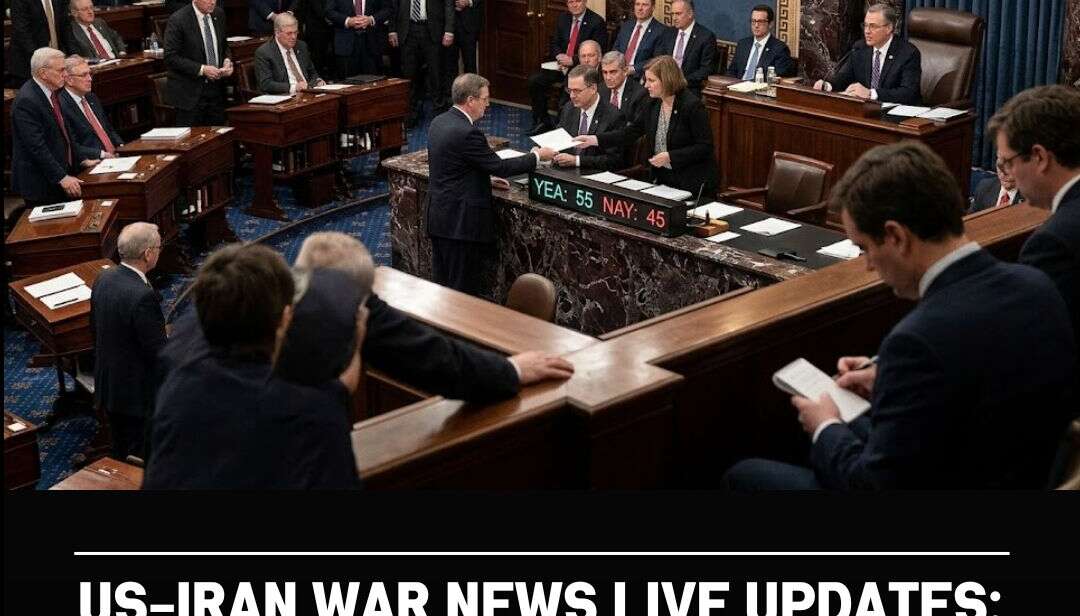
Washington / Tehran / Global Markets, May 20, 2026 — In a historic rebuke that cuts to the constitutional heart of America’s role in the iran crisis, the US Senate voted 50-47 on May 19 to advance a war powers resolution requiring congressional approval before President Trump can launch any further Iran strikes. Four Republicans broke with their party. The White House immediately signalled a veto. And the global market absorbed the news with cautious relief — Brent crude easing 45 cents to $110.83 — while the deeper question hanging over Washington hardened into something unavoidable: who, in a constitutional democracy, actually has the authority to take a nation to war?
What the Senate Actually Voted On
The resolution was introduced by Senator Tim Kaine of Virginia and has been the subject of seven previous failed procedural attempts since the US-Iran War began on February 28. The text directs “the President to remove the United States Armed Forces from hostilities within or against US and Israel joint operations against Iran, unless explicitly authorised by a declaration of war or a specific authorisation for use of military force” — a direct invocation of the 1973 War Powers Resolution, which limits unauthorised presidential military action to 60 days.
That 60-day clock expired on May 1. The Trump administration’s response, delivered by Defense Secretary Pete Hegseth to senators, was that the ceasefire of April 7 meant “the hostilities that began on Saturday, February 28 have terminated” — pausing or stopping the clock entirely. “We are in a ceasefire right now, which our understanding means the 60-day clock pauses or stops,” Hegseth stated.
Kaine called it an illegal argument built on a fiction. “This is, in my view, an illegal war because the president started it without coming to Congress,” he told reporters after the vote. “My Republican colleagues are hearing in their phone calls from their constituents that this is a stupid war.” He added a commitment that has rattled the White House: “We’re going to force a war powers vote every week until this war is over.”
The Four Republicans Who Defected
The 50-47 margin was made possible by four Republican senators crossing the aisle — a defection that Senate Majority Leader John Thune of South Dakota had publicly tried to prevent, signalling that “it would be best if everybody hung together and supported the president.”
Rand Paul of Kentucky, the Senate’s most consistent libertarian voice on executive war powers, was the least surprising of the four. Susan Collins of Maine issued a measured statement: “Further military action against Iran must have a clear mission, achievable goals, and a defined strategy for bringing the conflict to a close.” Lisa Murkowski of Alaska joined quietly. Most significantly, Bill Cassidy of Louisiana — a first-time supporter of the resolution — cited a lack of clarity from the Pentagon on Operation Epic Fury’s objectives, giving the defection a credibility that rattled Republican leadership.
The sole Democratic defector: Senator John Fetterman of Pennsylvania voted against advancement, separating himself from his party on the question of US and Israel war authority.
As Al Jazeera reported, the vote marks the first time the Senate has successfully advanced a war powers measure against Trump’s Iran campaign — after four previous failures and a procedural landscape designed to keep the resolution buried in committee.
US-Iran War News Live Updates: The Battlefield Backdrop
The Senate vote did not occur in a vacuum. It came one day after Trump announced the postponement of a scheduled Iran strikes package on May 19, following direct requests from Saudi Arabia, Qatar, and UAE leaders for “serious negotiations” — the latest in a pattern of strike-pause-diplomacy cycles that the iran crisis has settled into since the April 8 ceasefire.
Operation Epic Fury — the joint US and Israel campaign codenamed Operation Roaring Lion in Israel — formally concluded on May 5 after 66 days of coordinated strikes. But the war has not ended. Israel launched new strikes in southern Lebanon on May 19. The USS Alaska nuclear submarine was deployed to Gibraltar in mid-May to maintain pressure on Tehran. A secret Israeli military base was reported by the Wall Street Journal to have been constructed in western Iraq specifically to support the Iran air campaign.
Iranian Foreign Minister Abbas Araghchi, speaking from New Delhi’s BRICS meeting last week, captured Tehran’s assessment of the diplomatic track with precision: “Iran cannot trust the Americans at all.” A Pakistani mediator source noted both sides “keep changing their goalposts.” Trump, meanwhile, predicted the war would end “very quickly” and that oil prices would “plummet” once it does.
Can Congress Actually Stop Him?
The constitutional architecture is clear in theory and murky in practice. The War Powers Resolution of 1973 requires presidential notification to Congress within 48 hours of introducing forces into hostilities and mandates withdrawal within 60 days without congressional authorisation. But as CNN’s legal analysis documented, “the law sets a 60-day limit on unauthorised wars — the US is blowing past it in Iran.”
The resolution’s path to becoming law requires passage of the full Senate, then the House — where a previous war powers vote failed by a single vote at 212-212 — and then a two-thirds majority in both chambers to override an expected presidential veto. As the Washington Post’s War Powers Act analysis noted: Congress has never successfully overridden a presidential veto of a war powers resolution in American history.
The resolution is, therefore, more political document than operational constraint. But politics shape wars as surely as weapons do. Four Republican senators have now publicly declared that Trump’s Iran strikes lack sufficient congressional legitimacy — and Kaine has promised to repeat the exercise every week until the answer changes.
The Global Market Reads the Room
For oil traders watching the iran crisis through the lens of a $110 Brent crude and a Strait of Hormuz that has been closed for 80 days, the Senate vote registered as a de-escalation signal. Brent eased. WTI eased. The market’s interpretation was straightforward: congressional constraint on presidential war-making reduces the probability of a new escalation cycle in the near term.
That interpretation may be optimistic. The resolution has not passed. The veto stands ready. And the iran crisis — with its US-Iran war news live updates cycle of strikes, pauses, leaks, and failed diplomacy — has defied every prediction of swift resolution since it began.
But for the first time since February 28, the US Senate has formally told a sitting president: not without us.