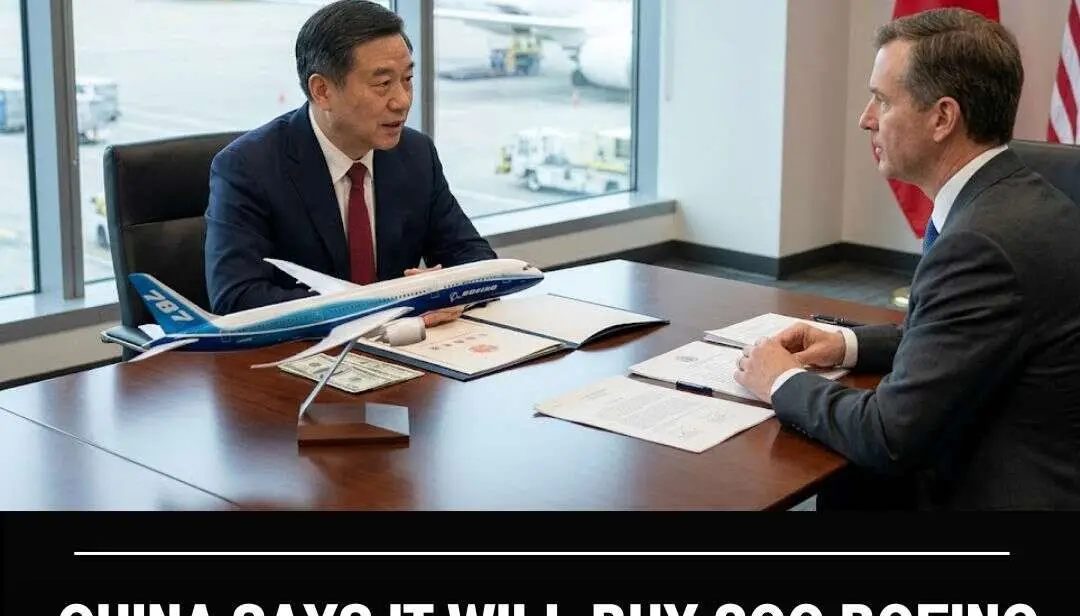
In the most concrete commercial outcome to emerge from the high-stakes Trump-Xi summit in Beijing, China has agreed to purchase 200 Boeing jets worth an estimated $17–19 billion — the largest Chinese aviation order in nearly a decade — while simultaneously pushing Washington to extend their fragile US tariff ceasefire beyond its current November 2026 expiry. The twin moves reflect Beijing’s broader strategy: use trade concessions to stabilize its relationship with Washington at a moment when the US-Iran war has scrambled global supply chains, energy markets, and the geopolitical assumptions underpinning both countries’ economic planning.
The deal, announced on May 15, 2026, following Trump’s first visit to Beijing in nearly a decade, also carries a tantalizing conditional upside: President Trump told reporters China could expand the order to as many as 750 aircraft — potentially the largest single aviation contract in Boeing’s history — “if they do a good job.” General Electric will supply between 400 and 450 engines under the arrangement.
Boeing’s China Comeback — Complicated by Markets
For Boeing, the announcement marked a symbolic return to a market that had been effectively closed for the better part of a decade. In the seven years of restricted Chinese access preceding the deal, Boeing delivered just over 100 aircraft to China in total — roughly equal to what it had delivered in 2018 alone. The 200-jet order signals a potential restoration of what is the world’s second-largest aerospace market.
Wall Street, however, was underwhelmed. Boeing’s stock fell between 3.8% and 7% on the announcement, as markets had priced in expectations of 500 or more aircraft. The selloff underscored a core vulnerability that Boeing CEO Kelly Ortberg acknowledged directly: the deal is, in his words, “100% dependent on US-China negotiations and relations.”
In other words, every Boeing jet in this order is a diplomatic hostage to the durability of the trade relationship — a fact that gives Beijing significant leverage over Washington’s calculus going forward. For more on the market reaction, see CNBC’s analysis of why Boeing’s stock fell despite landing the China order.
The Tariff Ceasefire: Architecture and Fragility
The US tariff ceasefire now in force is the product of a longer diplomatic arc. At the APEC summit in Busan, South Korea on October 30, 2025, Trump and Xi established an initial truce that reduced US tariffs on Chinese goods to 10%. The May 2026 Beijing summit updated those terms: US tariffs on Chinese imports now stand at 30%, while China’s tariffs on US products sit at 10% — an asymmetry Beijing has flagged as a negotiating priority.
The current truce runs through November 10, 2026. China is pressing for an extension and a framework for further reciprocal reductions on approximately $30 billion worth of goods, covering agricultural products, energy, medical devices, and — pointedly — Boeing aircraft. The two sides also established a new institutional architecture: a “Board of Trade” and a “Board of Investment” to manage ongoing commercial negotiations.
Notably, the White House’s official summit summary omitted any reference to “tariff reductions,” and Trump told reporters he and Xi had not discussed tariffs — a discrepancy that left trade analysts parsing the gap between public messaging and negotiating reality.
The Iran Shadow Over Every Deal
No element of the Trump-Xi summit can be understood in isolation from the US-Iran war. The conflict has disrupted the Strait of Hormuz, rattled global energy markets, and injected a layer of urgency into Sino-American trade diplomacy that would otherwise not exist.
At the Beijing summit, President Xi assured Trump that China would not supply military equipment to Iran and offered to help broker a ceasefire — a commitment Trump described publicly as a potential breakthrough. In return, Washington signaled willingness to discuss further tariff relief and accelerate the Boeing jets order. The transaction is explicit: Chinese diplomatic cooperation on Iran, in exchange for US commercial and trade concessions.
Beijing’s leverage is considerable. China remains Iran’s largest trading partner and holds back-channel influence that Washington cannot replicate through direct pressure alone. The US tariff ceasefire extension request is, in this light, not merely a trade ask — it is part of a broader diplomatic package in which commerce and geopolitics are deeply intertwined.
What Comes Next
The Boeing jets deal and tariff truce extension talks represent the optimistic scenario for US-China relations in 2026 — but the foundations remain brittle. Boeing CEO Ortberg’s candid admission that the order depends entirely on the political relationship captures the defining risk. Should the US-Iran war escalate, should tariff negotiations stall, or should Washington conclude that Beijing is not delivering on its Iran mediation promises, the commercial architecture built in Beijing could unravel as quickly as it was assembled.
For now, both sides have chosen trade engagement over confrontation — and 200 Boeing jets are the most tangible proof of that choice.