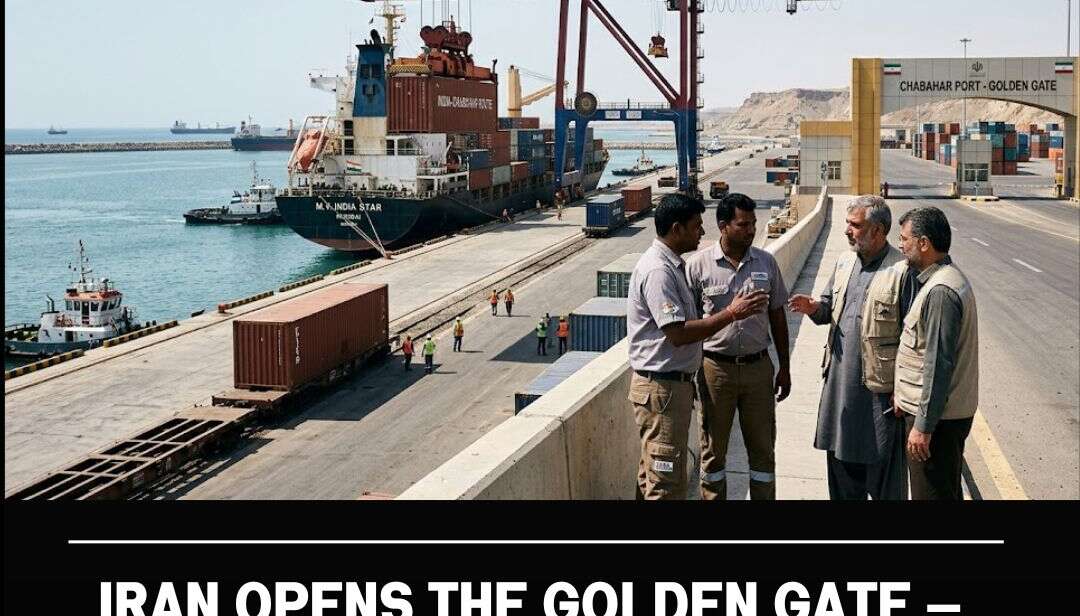
New Delhi / Tehran, May 15, 2026 — The port of Chabahar sits on Iran’s southeastern coastline, 87 miles west of Pakistan’s Chinese-backed Gwadar, just outside the choke of the Strait of Hormuz. For a decade it has been India’s most ambitious strategic infrastructure bet — a sovereign foothold in Iran that bypasses Pakistan, unlocks Central Asia, and counters Beijing’s growing maritime arc across the Indian Ocean.
Today, with the US-Iran War in its 77th day, a US naval blockade intercepting tankers in the Gulf of Oman, and Washington’s sanctions waiver for the project formally expired on April 26, that bet is under its most severe pressure yet.
Tehran’s answer is not retreat. It is persuasion.
The “Golden Gate” Appeal
Iranian Foreign Minister Abbas Araghchi arrived in New Delhi on May 13, 2026, for the BRICS Foreign Ministers’ Meeting — and came bearing a specific message for India. Speaking directly about Chabahar, Araghchi deployed language that was both poetic and deliberate: the port, he declared, is a “golden gate” for India’s access to Central Asia, the Caucasus, and Europe.
“I hope that Indians would continue their work in Chabahar Port so it would be fully developed at the service of the interests of India and other countries around,” he said, as reported by WION News and The Tribune.
Araghchi acknowledged openly that “the pace of investment has slowed down due to the restrictive nature of US sanctions” but framed the project as a major symbol of bilateral cooperation that neither side could afford to abandon. He also arrived with a concrete ask: India must use its diplomatic weight — specifically its BRICS presidency and its perceived neutrality in the US-Iran War — to help secure safe passage for Indian vessels through the Strait of Hormuz, currently subject to the US naval blockade imposed on April 13, 2026.
What the US-Iran War Has Done to Chabahar
The geography of Chabahar was supposed to be its insurance policy. Located outside the Strait of Hormuz, it was marketed for years as India’s war-proof corridor to Iran and Central Asia — a route that would function even when the strait was closed. The US-Iran War has exposed that assumption as partial at best.
On February 28, the opening day of US-Israeli strikes, American and Israeli forces hit the IRGC Navy Imam Ali Base in Chabahar itself. The port took direct military pressure before a single sanctions deadline had passed. Then came the April 13 naval blockade: US destroyers and Boeing P-8 Poseidon patrol aircraft began intercepting tankers departing from Chabahar in the Gulf of Oman. As AGBI reported, “Chabahar is outside the strait geographically, but not outside US blockade logic.”
The port has since been repurposed by maritime intelligence as a node for ship-to-ship transfers of Iranian oil destined for China — a far cry from its intended role as India’s bridge to Afghan iron ore, Uzbek gas, and the International North-South Transport Corridor connecting Mumbai to Saint Petersburg.
India’s Tightrope: Strategic Retreat or Tactical Pause?
India completed its $120 million financial commitment for Chabahar’s Shahid Beheshti terminal in August 2025, just ahead of the Trump administration’s revocation of all Iran-related sanctions exemptions in September. The final payment was transferred in February 2026 under explicit US pressure — a move that drew sharp criticism from Indian opposition parties who accused the Modi government of “buckling under US pressure to abandon a vital strategic project.”
Now, with the sanctions waiver expired and no budget allocation for Chabahar in India’s 2026-27 Union Budget — the first such omission in nearly a decade — New Delhi is exploring a temporary divestment structure: transferring India Ports Global Limited’s stake to a local Iranian entity, with a legal guarantee that control reverts to India once US sanctions are lifted or a new waiver is secured.
The Ministry of External Affairs insists this is not an exit. As Bloomberg reported, the MEA confirmed it “continues to engage with both the United States and Iran to sustain operations at the strategically important facility.” External Affairs Minister S. Jaishankar recently held direct talks with Araghchi, and discussions for a time-bound sanctions waiver remain active according to BW Businessworld.
The Russia Factor and the Gwadar Rivalry
At the same BRICS meeting where Araghchi pressed India on Chabahar, Russian FM Sergey Lavrov added his own layer of diplomatic pressure. Lavrov argued publicly that India’s Chabahar investment gives New Delhi “immense diplomatic leverage” with Tehran and urged India to use its BRICS presidency to convene direct de-escalation talks between Iran and its Gulf adversaries.
The subtext is strategic and unmistakable. Chabahar sits 107 miles from Gwadar — Pakistan’s Chinese-funded deep-water port that is projected to handle 400 million tonnes of cargo annually by 2030. If India exits Chabahar permanently, the entire southwestern flank of Central Asian connectivity falls into Beijing’s orbit. As CSIS has documented, Gwadar is already evolving toward a potential Chinese naval base — a development that makes India’s presence at Chabahar not merely commercial, but existential to its Indo-Pacific posture.
The Calculation New Delhi Cannot Avoid
Tehran’s “golden gate” framing is seductive precisely because it is accurate. Chabahar genuinely unlocks Central Asia for Indian exporters, genuinely anchors the INSTC, and genuinely provides the only land corridor to Afghanistan that bypasses Pakistan. The US-Iran War has made that gateway dangerous and legally fraught — but it has not made it less valuable.
What India faces is a classic strategic dilemma: hold a vital long-term asset at short-term legal and diplomatic cost, or yield to US sanctions pressure and surrender a decade of investment to a geopolitical vacuum that China will fill before the ink dries on any peace agreement.
Iran has made its pitch. As Al Jazeera’s analysis noted starkly: “Is India’s Chabahar dream in Iran dead?” New Delhi’s answer, for now, is neither yes nor no. It is a strategic pause — dressed, carefully, as something that still has a future.
Tehran is betting it does.