
Share This Article
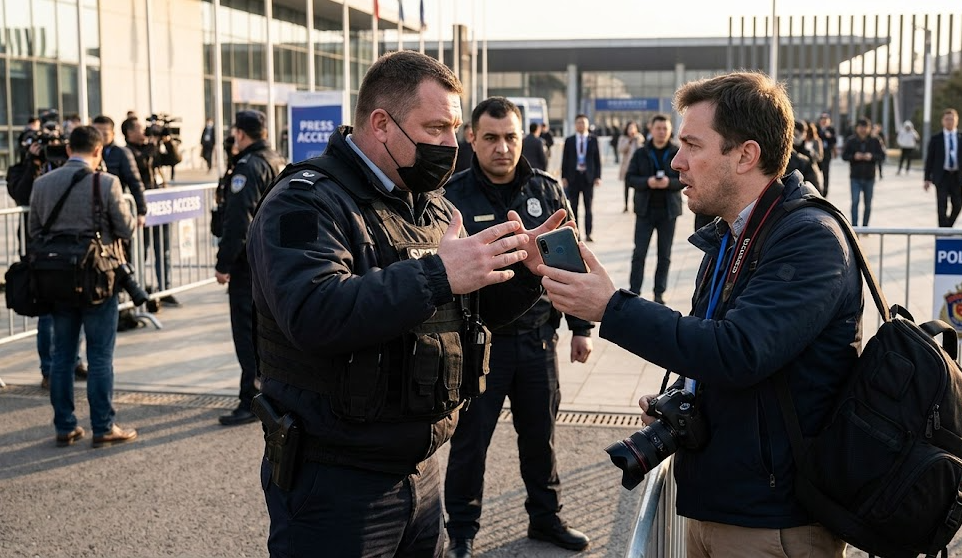
New Delhi, May 15, 2026 – Sergey Lavrov has survived four decades of superpower summits, Cold War brinkmanship, and more hostile press conferences than most diplomats endure in a lifetime. It takes something unusual to make him pause. On Thursday, at the BRICS Foreign Ministers’ Meeting in New Delhi, that something was a journalist who could not stop taking calls.
The journalist interrupted twice. The first time, Lavrov offered a measured request: “It’s either you yourself or your phone.” The second interruption pushed the Russian Foreign Minister into territory that instantly went viral.
“If you don’t surrender your phone, they will take out a gun.”
He was not smiling. The room erupted in laughter anyway. Within hours, the clip had circulated across every major platform dissected, memed, and debated. Was it dry Lavrovian wit? A veiled commentary on surveillance culture? Or something sharper, delivered in the deadpan register that has always been FM Sergey Lavrov’s signature diplomatic weapon?
The Room Where It Happened
The press conference followed a two-day BRICS Foreign Ministers’ Summit in New Delhi a gathering that carried far more geopolitical weight than its routine title suggests. The US-Iran War, now in its 77th day, cast a shadow over every session. The Strait of Hormuz remains functionally closed. Global oil markets are volatile. Ceasefire talks in Islamabad are stalled. And the Beijing bingo Trump-Xi summit, concluded just hours earlier, had reshuffled the geopolitical deck in ways that every BRICS nation was still absorbing.
Into this context walked FM Sergey Lavrov for bilateral meetings with External Affairs Minister S. Jaishankar on May 13, a session with Prime Minister Modi on May 14, and the BRICS ministerial itself on May 15. The phone quip was the moment the world noticed. But the substance beneath it was what mattered.
The Real Agenda: Iran, Oil, and a Pressure-Proof Partnership
According to Sputnik Global and WION News, FM Sergey Lavrov arrived in Delhi with a clear strategic offer: Russia wants India to formally serve as a long-term mediator to resolve the US-Iran War. Moscow publicly backed New Delhi for a diplomatic role in ending the conflict a significant signal, given Russia’s own proximity to Tehran and its interest in any post-war energy architecture that does not favour American dominance of Gulf supply routes.
Here are Some Related Blogs to Read
- Get the full picture on where this war is headed – more Trump-era geopolitical coverage at DonaldTrump.Coach.
- Tuesday’s missiles didn’t come out of nowhere, Iran has been digging out hidden missile stockpiles after rejecting Trump’s peace offer
- Not everyone in Trump’s own camp agrees on strategy, JD Vance claims Hegseth has been misleading Trump on the Iran war
- This isn’t the only recent flashpoint at sea, a US Navy destroyer just fired on and seized an Iranian cargo ship
- The strikes haven’t ended Iran’s nuclear ambitions either, US intel says recent strikes did only limited damage to Iran’s nuclear program
- That brief pause before Tuesday’s attack wasn’t random, Trump had deliberately paused Hormuz operations to force Iran into a deal
- The missiles are only half the story, Iran and Israel’s spy war is heating up amid claims of stolen F-15 secrets
- Trump’s fights aren’t confined to Tehran, he’s now clashing with his own SCOTUS picks back home
- Global supply chains are already bracing for impact, Goyal’s courting 50 US leaders in New York over exactly that.
The two nations agreed to increase supplies of Russian hydrocarbons and fertilisers to India critical at a moment when Indian refiners have ramped Russian crude imports to approximately 2.06 million barrels per day, accounting for roughly one-third of India’s total oil intake. With Brent crude above $106 a barrel and Indian jet fuel costs up nearly 100 percent since February, Moscow’s discounted crude has become a structural lifeline for New Delhi’s economy.
ANI News reported that both sides are now formally pivoting toward what Lavrov called a “pressure-proof economy” bilateral trade insulated from third-country sanctions, Trump’s 25 percent tariff threats, and what Lavrov bluntly characterised as “Western neocolonial interference.” The target: $100 billion in bilateral trade by 2030.
Why the Phone Joke Landed and Why It Resonated
Lavrov’s quip did not land in a vacuum. It landed in a week when device security had become the dominant subtext of global diplomacy. The Trump delegation to Beijing from Elon Musk to Tim Cook had just operated under a total digital lockdown: no personal phones, no cloud sync, stripped-down clean devices, and hardware disposal on return. The world had spent days discussing what it means to be a powerful person in a surveillance state with no device in your pocket.
Lavrov’s remark whether pure comedy or layered commentary fit that conversation perfectly. For a diplomat who once noted that “I always assume there are no secrets in this world, so we never discuss taboo topics in any case,” the phone-and-gun line was entirely consistent with his worldview: in the current era of digital surveillance and intelligence competition, your device is not your property. It is your vulnerability.
As The Federal noted, the clip sparked genuine online debate about tone and intent. Russian state media framed it as trademark dry humour. Western commentators parsed it differently. Indian social media simply enjoyed it.
The BRICS Backdrop: Why Delhi Matters Now
The Al Jazeera analysis of the BRICS meeting put it plainly: with the US-Iran War reshaping every assumption about energy, trade routes, and alliance architecture, the gathering of Brazil, Russia, India, China, and South Africa’s top diplomats in New Delhi was not routine multilateralism. It was a live negotiation over who shapes the post-war order.
Russia needs India’s neutrality to blunt Western sanctions. India needs Russia’s oil to survive the US-Iran War’s energy shock. China fresh from the Beijing bingo summit with Trump needs BRICS coherence to demonstrate that a non-Western diplomatic track remains viable. And Iran, though absent from the room, was present in every sentence.
Lavrov left Delhi with defence cooperation agreements, space partnership commitments, expanded energy deals, and India’s implicit endorsement as a potential US-Iran War mediator. He also left with a viral moment that will outlast every communiqué.
In his world, that is probably the point.

Oil & Energy Markets
A look at crude price swings, OPEC supply moves, and how energy markets react to geopolitical shocks.

Geopolitics & Conflict
Breaking down how wars, ceasefires, and diplomatic deals ripple through global trade and security.
US Foreign Policy
Coverage of Trump administration negotiations, sanctions, and strategic decisions shaping world events.
Economy & Inflation
Tracking how commodity prices, gas costs, and supply chains affect everyday consumers.