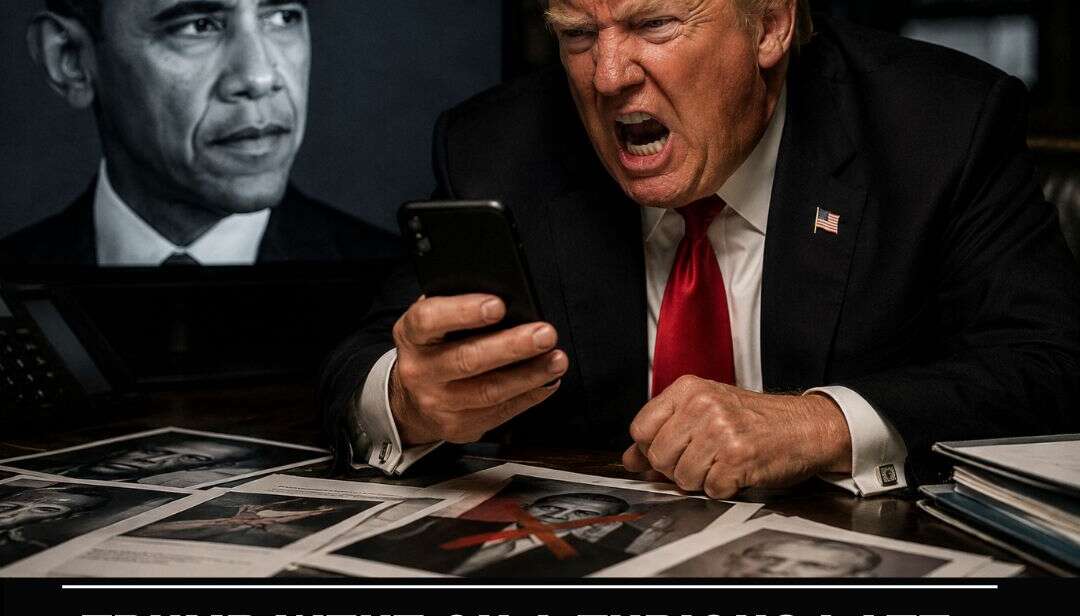
Washington — It began just after midnight. By 2 a.m., the posts had accumulated into something that veteran White House correspondents, opposition researchers, and even some Republican strategists were struggling to characterise with their usual clinical detachment. President Donald Trump, in what observers are calling one of his most sustained and factually untethered late-night social media episodes in recent memory, unleashed a furious multi-post rampage targeting former President Barack Obama — deploying fabricated quotes, long-debunked conspiracy theories, and incendiary accusations that drew immediate condemnation from fact-checkers, former officials, and constitutional scholars while simultaneously energising the online ecosystem that treats Trump’s most unrestrained moments as political gospel.
By morning, the damage assessment was already underway — not just to political norms, but to the specific diplomatic environments that Trump’s own administration has been painstakingly constructing around the US Iran war and the Iran-linked network operations that have consumed American intelligence and military bandwidth for months.
What Trump Actually Posted
The posts, published across Trump’s Truth Social account and subsequently amplified across aligned media ecosystems, centred on a series of accusations against Obama that fact-checkers identified as false, misleading, or entirely fabricated within hours of their publication.
Most inflammatory among them was a quote attributed to Obama regarding Iran — presented by Trump without sourcing, context, or any verifiable origin — that suggested the former president had privately encouraged Iranian leadership to “wait out” American pressure campaigns during nuclear negotiations. The quote does not appear in any documented record of Obama’s public or private statements. Former Obama administration officials contacted by multiple outlets described it as “completely fabricated” and “an invention with no basis in any communication the former President ever made.”
Trump also resurrected a series of conspiracy theories about Obama’s role in the origins of the Iran nuclear deal — specifically the claim that Obama had secretly transferred cash payments to Tehran in exchange for diplomatic concessions, a characterisation of the 2016 sanctions relief payment that has been repeatedly and thoroughly debunked by independent fact-checkers, legal scholars, and even Republican-led congressional investigations that found no evidence of criminal wrongdoing in the transaction’s legal structure.
The late-night posts did not stop at Iran policy. Trump ranged across birther-adjacent territory, unsubstantiated claims about Obama administration surveillance operations, and personal attacks that retired the pretence of policy critique in favour of straightforward personal vilification.
Why Obama — and Why Now
The timing and target of Trump’s late-night rampage did not emerge from a vacuum, and understanding both requires looking at the specific pressures bearing on the Trump administration at the moment the posts were published.
The US Iran war has reached an inflection point that is generating significant internal pressure within the administration. Diplomatic negotiations have stalled amid Iranian deliberation, military operations have continued without producing a decisive strategic outcome, and the Iran-linked network’s demonstrated operational resilience — despite sustained US and UK sanctions pressure — has raised uncomfortable questions about the effectiveness of the maximum pressure framework.
Into that environment of strategic frustration, Obama’s name functions as a politically productive pressure release valve. The Iran nuclear deal that Obama negotiated and Trump withdrew from in 2018 remains the original sin of Trump’s Iran policy framework — the decision that, in Trump’s telling, created the conditions for everything that followed. Attacking Obama on Iran serves the dual purpose of deflecting accountability for the current crisis’s origins and energising a base that has never forgiven the JCPOA as a policy or Obama as its architect.
The fabricated quote attributed to Obama about Iran is particularly revealing in this context. Its specific content — suggesting Obama encouraged Tehran to resist American pressure — directly serves the narrative that the current US Iran war’s difficulties are traceable to Obama-era appeasement rather than to the consequences of Trump’s own 2018 JCPOA withdrawal. If the quote were real, it would be political dynamite. Because it is fabricated, it is something more troubling: evidence of a willingness to construct the evidentiary basis for a preferred narrative when real evidence does not support it.
The Iran-Linked Network Dimension
There is a specific and under-examined connection between Trump’s Obama attack and the Iran-linked network that US and UK sanctions have been targeting across multiple theatres. The network’s financial architecture — built substantially during the Obama-era sanctions relief period that followed the JCPOA — has been a persistent Republican talking point about the consequences of diplomatic engagement with Tehran.
The argument, advanced by Trump allies and some legitimate Iran policy critics, is that the economic normalisation that followed the JCPOA provided the IRGC with the revenue base from which it constructed the Iran-linked network’s current operational reach — the proxy funding streams, the external operations budget, and the financial intermediation infrastructure that US and UK coordinated sanctions are now working to dismantle.
There are elements of this argument that serious analysts take seriously. The JCPOA’s sanctions relief did increase Iranian oil revenues and did coincide with an expansion of IRGC regional activity. The causal relationship between those two facts is contested — many analysts argue the IRGC would have expanded its activities regardless, funded through alternative means — but the correlation is real and politically potent.
Trump’s late-night posts, however, do not engage this legitimate policy debate. They bypass it entirely in favour of fabricated quotes and conspiracy theories that undermine the credibility of the valid criticism by embedding it within demonstrably false claims. The effect is to make the entire critique easier to dismiss — a self-defeating political strategy that benefits Obama more than it harms him.
The Fact-Check Avalanche
By mid-morning, every major American fact-checking organisation had published detailed rebuttals of the posts’ central claims. PolitiFact rated the Obama Iran quote “Pants on Fire.” The Washington Post Fact Checker awarded it four Pinocchios. AP Fact Check traced the quote’s apparent origin to a fringe social media account with no journalistic credibility and no documented access to Obama’s private communications.
Former Obama National Security Adviser Susan Rice called the posts “a new low in presidential dishonesty, even by the standards of a presidency defined by its relationship with invented facts.” Obama’s own office released a brief statement describing the attributed quote as “entirely fabricated” without engaging further — a response calibrated to rebut without elevating.
Republican responses were more measured but notably unenthusiastic. Several GOP senators, asked about the posts during Capitol Hill availability, declined to comment or offered variations of the “I don’t follow social media late at night” deflection that has become the party’s standard response to Trump’s most indefensible moments.
The Strategic Cost: Diplomacy’s Collateral Damage
Beyond the immediate political spectacle, Trump’s late-night rampage carries a specific cost that his administration’s own Iran diplomats are quietly absorbing: it makes the serious business of managing the US Iran war harder.
American negotiating credibility — the quality that allows adversaries and allies alike to treat Washington’s commitments as reliable and its accusations as grounded in evidence — is a finite resource. Every time the President of the United States publishes demonstrably fabricated quotes on social media at 2 a.m., a portion of that credibility is expended. The Iranian negotiators currently deliberating over the American war-ending proposal are not unaware of the gap between the administration’s formal diplomatic communications and its President’s nocturnal social media behaviour. Tehran’s hardliners use exactly that gap to argue that American commitments cannot be trusted — that a government whose leader fabricates quotes about Iran policy at midnight is not a government whose diplomatic proposals deserve serious engagement.
The Iran-linked network’s propagandists are already amplifying the fabricated Obama quote across Persian-language social media — not because they believe it, but because a U.S. President circulating false information about Iran policy is the most effective possible argument for the regime’s domestic audience that American information about Iran cannot be trusted.
Trump went on a rampage. The collateral damage, as always, extends well beyond its immediate target.