Share This Article
How a decades-long campaign by Israel’s prime minister finally found its willing partner and ignited the Middle East
For more than two decades, Benjamin Netanyahu harbored a vision: a joint American-Israeli military campaign that would dismantle Iran’s nuclear program, cripple its military, and trigger the collapse of the Islamic Republic. He pitched it to one American president after another. Each said no. Then came Donald Trump and the map of the Middle East changed forever.
The story of Netanyahu’s war, now unfolding in real time, is not just a tale of geopolitics. It is the story of a single leader’s extraordinary persistence, the presidents who resisted him, and the one who did not.
The Rejected Pitch: Three Presidents, Three Refusals
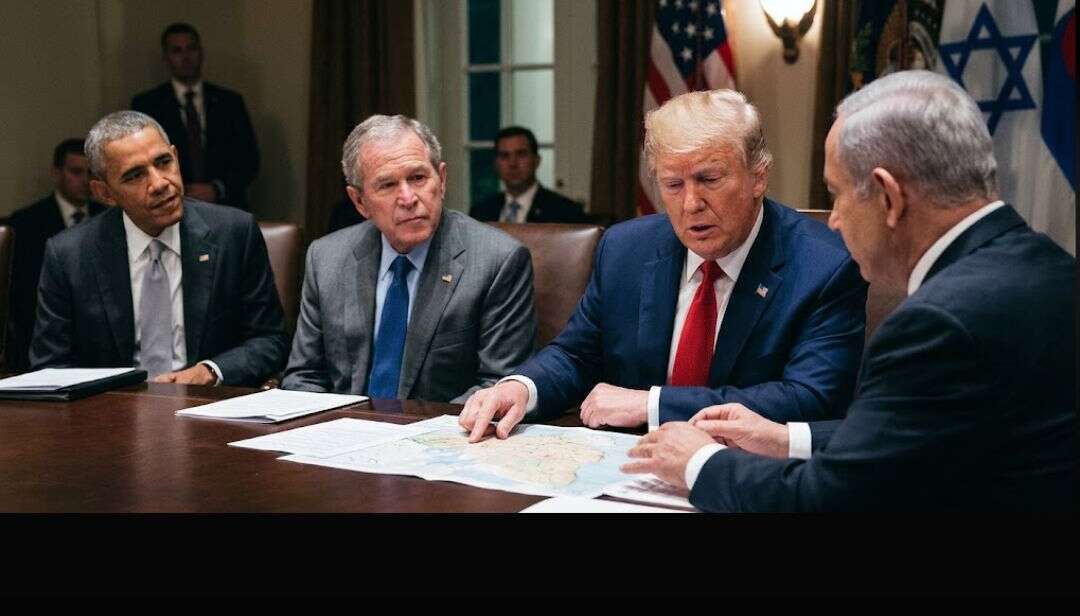
Former US Secretary of State John Kerry pulled back the curtain during an appearance on The Late Show with Stephen Colbert, recalling that Netanyahu had, over the years, urged multiple American administrations to consider military action against Iran and each time, the proposal was turned down. “Obama said no. Bush said no. President Biden said no. I mean, I was part of those conversations,” Kerry said.
Kerry indicated that the refusal from each administration stemmed from a shared view that diplomatic avenues had not been fully explored before considering military options. He also rejected Netanyahu’s projections about political upheaval in Iran, noting that predictions of internal revolt or a shift in power did not come to pass casting doubt on the core assumptions used to justify potential military action. The Statesman
Kerry also cited a New York Times report detailing Netanyahu’s procedure for convincing Trump to strike Iran, describing it as a “basically four-point pitch” killing the leadership, inciting regime change, destroying the military, and more.
The Situation Room: Netanyahu’s Final Sales Pitch

Here are Some Related Blogs to Read
- NATO chief calls US strikes on Iran “absolutely necessary”
- Will gold rally as US-Iran tensions escalate
- Oil jumped but the market stayed calm
- 5 takeaways from Tuesday’s 2026 primaries
- US tariff system reset across 60 economies
- Trump tariffs Section 122 surcharge expires
- Trump had deliberately paused Hormuz operations to force Iran into a deal.
- JD Vance claims Hegseth has been misleading Trump on the Iran war.
- Iran has been digging out hidden missile stockpiles after rejecting Trump’s peace offer.
On February 11, 2026, Netanyahu stood in the White House Situation Room and presented Trump with a video montage and intelligence outlining the plan. His team argued that Iran’s ballistic missile program could be disabled within weeks, that Tehran would be too weakened to close the Strait of Hormuz, and that retaliatory actions against American interests in the region would likely be limited.
American officials broke Netanyahu’s proposal down into four parts: killing Supreme Leader Khamenei, decimating Iran’s ability to threaten its neighbors, triggering a popular uprising in Iran, and ultimately installing a secular leader to govern the country. Trump was most interested in the first two objectives, saying regime change would be “their problem.”
According to the New York Times, Trump’s reported response to the pitch was simply: “Sounds good to me.”
What three presidents had declined for over twenty years, the fourth accepted in a single Situation Room session.
The War That Followed
On February 28, 2026, the United States and Israel launched large-scale strikes against Iran under Operation Epic Fury and Israel’s campaign Roaring Lion. Trump confirmed the strikes, saying the US military had “begun major combat operations in Iran” to eliminate “imminent threats from the Iranian regime,” while Netanyahu stated that Israel acted to remove “the existential threat posed by the terrorist regime in Iran.”
The attacks also followed the failure of indirect nuclear negotiations in February, during which Iran had reportedly been willing to make concessions. After 40 days of sustained combat, a ceasefire took effect on April 8, 2026.
The conflict came at a significant cost. US interests in Saudi Arabia, the UAE, Qatar, Bahrain, and Kuwait were all targeted by Iranian counter-strikes throughout the conflict, killing 13 US military service members. Global energy markets were shaken, with Iran moving to restrict access through the Strait of Hormuz precisely the scenario that the Chairman of the Joint Chiefs had repeatedly warned about in the Situation Room.
The Doubts and the Fallout
Not everyone in Trump’s inner circle was swept along by the optimism. According to Axios, Vice President JD Vance held a tense exchange with Netanyahu, questioning overly optimistic assumptions about the conflict. A US official told the outlet: “Before the war, Bibi really sold it to the president as being easy, as regime change being a lot likelier than it was. And the VP was clear-eyed about some of those statements.”
The war also reignited the fierce public debate over US presidents and their relationship with Netanyahu’s ambitions. Critics pointed to Kerry’s revelation as evidence of a dangerous pattern: that one president’s willingness to abandon diplomatic caution could undo decades of bipartisan restraint in a single meeting.
Kerry argued that Trump had walked away from the prior Iran nuclear agreement “not for substantive reasons, but because President Obama did it,” leaving a diplomatic vacuum that made military confrontation more likely. “What we wound up with is a situation where they now believe you can’t trust the United States,” Kerry said.
What Comes Next
Netanyahu has already raised the possibility of a “round two” of strikes with Trump, citing concerns that Iran is rebuilding its ballistic missile production and nuclear enrichment program. Trump said that if Iran tries to rebuild its nuclear program, the US will destroy it again though he also expressed a preference for a new nuclear deal with Tehran.
The story of Netanyahu’s war is, in many ways, still being written. But the central question it raises is as old as the rejections of Bush, Obama, and Biden: when a president says yes to a war that three others refused, who bears responsibility for what comes next?
History and the ceasefire holding tenuously in the spring of 2026 may yet provide its own answer.

Oil & Energy Markets
A look at crude price swings, OPEC supply moves, and how energy markets react to geopolitical shocks.

Geopolitics & Conflict
Breaking down how wars, ceasefires, and diplomatic deals ripple through global trade and security.
US Foreign Policy
Coverage of Trump administration negotiations, sanctions, and strategic decisions shaping world events.
Economy & Inflation
Tracking how commodity prices, gas costs, and supply chains affect everyday consumers.