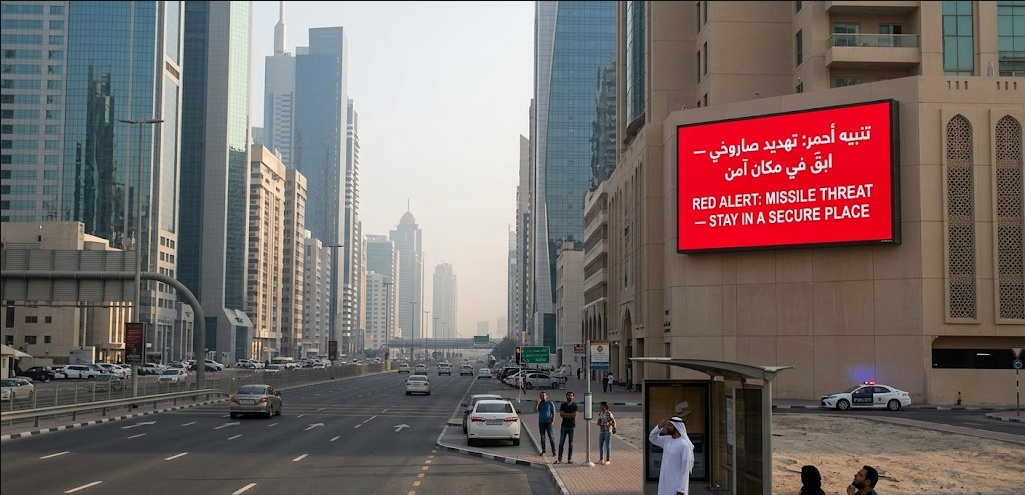
Residents across the United Arab Emirates woke to a message that no Gulf city has ever normalised: an emergency alert on their phones ordering them to seek shelter immediately. Iran had fired again — and this time, the ceasefire was not enough to hold it back. On May 4, 2026, the UAE government issued a
Residents across the United Arab Emirates woke to a message that no Gulf city has ever normalised: an emergency alert on their phones ordering them to seek shelter immediately. Iran had fired again — and this time, the ceasefire was not enough to hold it back.
On May 4, 2026, the UAE government issued a series of urgent public safety alerts — the first since the US-Iran ceasefire took effect on April 8 — instructing residents to “immediately seek a safe place in the closest secure building” due to incoming missile threats. The message landed on millions of phones across Abu Dhabi, Dubai, Sharjah, and beyond, plunging one of the world’s busiest commercial hubs into a sudden, surreal standstill.
The UAE Ministry of Defence confirmed that its air defence systems had intercepted and destroyed 12 ballistic missiles, three cruise missiles, and four drones — all launched from Iran. Four separate missile alerts were issued throughout the day, each triggering fresh waves of anxiety among a population that had believed the worst of the conflict was behind them.
Fire at Fujairah: A Strike That Landed
Not everything was intercepted. In the eastern emirate of Fujairah, a drone penetrated defences and struck the Fujairah Oil Industry Zone, triggering what witnesses described as a “large fire” visible for miles across the coastal port. Three Indian nationals working at the facility were injured and were taken to hospital for treatment.
The target was strategically significant. Fujairah is one of the world’s largest bunkering hubs and a critical maritime refuelling port — the only major oil terminal in the UAE located on the Gulf of Oman coastline, outside the Strait of Hormuz. Striking it sent a message beyond the military: that Iran could reach the arteries of global energy infrastructure even beyond the blockaded strait.
Bloomberg confirmed that an ADNOC-affiliated oil tanker navigating near the strait was also hit by Iranian drones. UAE presidential adviser Anwar Gargash condemned the attack as “maritime piracy” — an act of deliberate targeting against civilian economic infrastructure under the cover of a ceasefire.
Schools Shut, Airspace Restricted
The scale of the response to the threat underlined just how seriously Emirati authorities treated it. The Ministry of Education ordered all schools nationwide to switch to remote learning, pulling hundreds of thousands of students off campuses at short notice. The UAE subsequently announced it would restrict its airspace for a full week, disrupting commercial flight routes and airport operations across the country — a measure with immediate ripple effects on one of the world’s most-transited aviation corridors.
Residents in Dubai filmed videos from inside apartment buildings, showing the bright flashes of interceptions lighting up the night sky — an eerie spectacle over a skyline more accustomed to fireworks than air defence missiles.
Iran Denies, UAE Condemns, World Reacts
Iran’s Islamic Revolutionary Guards Corps flatly denied responsibility. A statement from the IRGC declared that its forces had “not carried out any missile or drone operations against the UAE in recent days” and dismissed the UAE Ministry of Defence’s account as “absolutely denied and devoid of any truth.”
The UAE was unmoved. Its Ministry of Foreign Affairs condemned in “the strongest terms the renewed terrorist, unprovoked Iranian attacks targeting civilian sites” and warned it reserves the “full and legitimate right to respond.” Foreign Minister Sheikh Abdullah bin Zayed called the strikes a deliberate and “treacherous” act of aggression that violated both the ceasefire and fundamental principles of international law.
The international reaction was swift and pointed. The United Kingdom declared solidarity with the UAE, stating the “escalation must cease” and calling on Iran to engage meaningfully in negotiations. Bahrain described the strikes as a “dangerous escalation threatening regional security.” Kuwait condemned the attacks as a “clear breach of freedom of navigation” in international waterways.
The Arab world — long wary of Iran’s reach into Gulf affairs — issued an unusually unified rebuke.
A Ceasefire Under Lethal Strain
The timing of the strikes added a particularly destabilising dimension. The attacks came on the same day President Trump launched Project Freedom — the US Navy operation to guide stranded commercial ships through the Strait of Hormuz — a mission Iran had explicitly warned would be treated as a hostile act.
Whether Monday’s barrage was Iran’s answer to Project Freedom, a pressure tactic in ongoing nuclear negotiations, or a signal to Gulf states paying a price for their alignment with Washington remained unclear. What was unmistakably clear was that the ceasefire, brokered through weeks of painstaking Pakistani diplomacy, had been pushed to its most dangerous edge yet.
For the 20 million residents of the UAE — a nation that built its identity on stability, commerce, and openness — the red alert on their phones was a reminder that no amount of economic ambition insulates a country from the wars that burn on its doorstep.
Market Analysis
A quick snapshot of market trends, customer behavior, and competitor movements.