
US Politics
Election Night 2026: When Will Midterm Results Be Known?
WASHINGTON, Nov. 3, 2026. Americans are voting today in the 2026 midterm elections, with control of both the House and the Senate on the ballot. If you plan to stay up for a winner, be ready for a long night. In several of the closest races, the count may run past tonight and into the…
WASHINGTON, Nov. 3, 2026. Americans are voting today in the 2026 midterm elections, with control of both the House and the Senate on the ballot. If you plan to stay up for a winner, be ready for a long night. In several of the closest races, the count may run past tonight and into the coming days or even weeks.
So when will midterm results be known? The answer depends on three things: what time polls close, how fast each state counts, and how close each race is.
Track the Numbers Behind the Vote
Voters are deciding with prices and trade on their minds. Follow both live:
Live Oil Price Tracker →
Brent and WTI in real time, the energy price behind the gas costs shaping the vote.
Live Trump Tariff Tracker →
Every tariff move as it lands, a key part of the affordability debate on the ballot.
What’s at Stake
Republicans hold the Senate 53–47, so Democrats need a net gain of four seats to take control. In the House, 218 seats make a majority, and the margin is narrow enough that a handful of districts could decide control.
That math matters for timing. If control comes down to one or two slow-counting states, the country may not know which party runs Congress until those states finish. What a change in control would mean for the Iran war, Ukraine aid and the Pentagon is covered in our guide to the midterms’ impact on foreign policy.
What Time Do Polls Close? An Hour-by-Hour Guide (ET)
Poll closing times span seven hours across the country. The first polls close in parts of Indiana and Kentucky at 6 p.m. ET. The last ones close in Alaska’s western Aleutian Islands at 1 a.m. ET Wednesday.
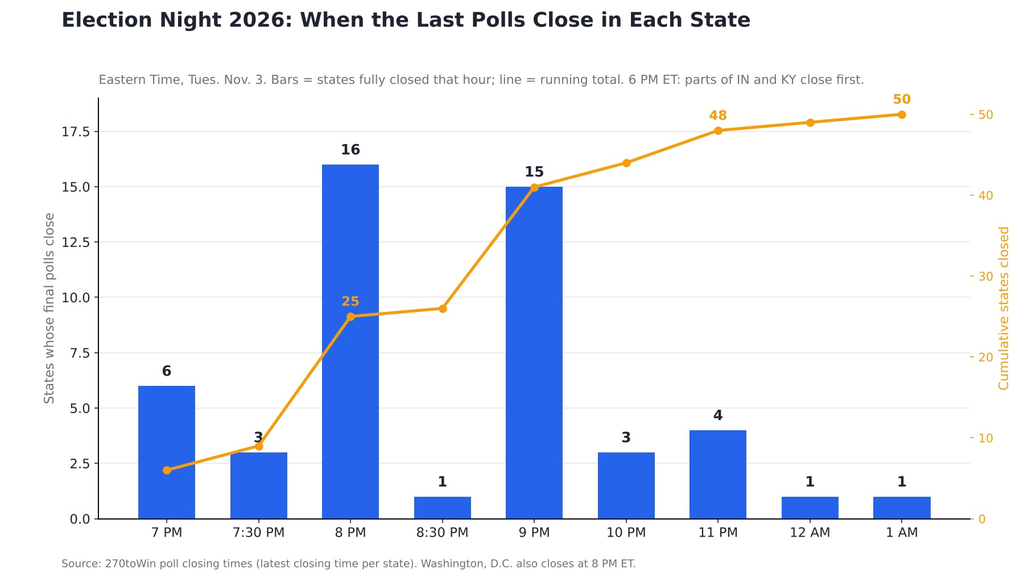
Bar chart of how many states finish voting each hour on election night, Eastern Time Half the states have finished voting by 8 p.m. ET. Source: 270toWin.
| Time (ET) | Polls fully close in |
| 7:00 p.m. | Georgia, Indiana, Kentucky, South Carolina, Vermont, Virginia |
| 7:30 p.m. | North Carolina, Ohio, West Virginia |
| 8:00 p.m. | 16 states plus D.C., including Pennsylvania, Florida, Maine, New Hampshire |
| 8:30 p.m. | Arkansas |
| 9:00 p.m. | 15 states, including Arizona, Michigan, Texas, Wisconsin, New York, Iowa |
| 10:00 p.m. | Nevada, Montana, Utah |
| 11:00 p.m. | California, Oregon, Washington, Idaho |
| 12:00–1:00 a.m. | Hawaii, Alaska |
A state’s polls closing does not mean it will report soon. Florida usually reports most of its vote within hours. Other states take much longer.
Key Senate Races to Watch, in Order
Chart of key Senate races plotted by poll closing time and typical counting speed Count-speed colors are an editorial estimate based on past cycles.
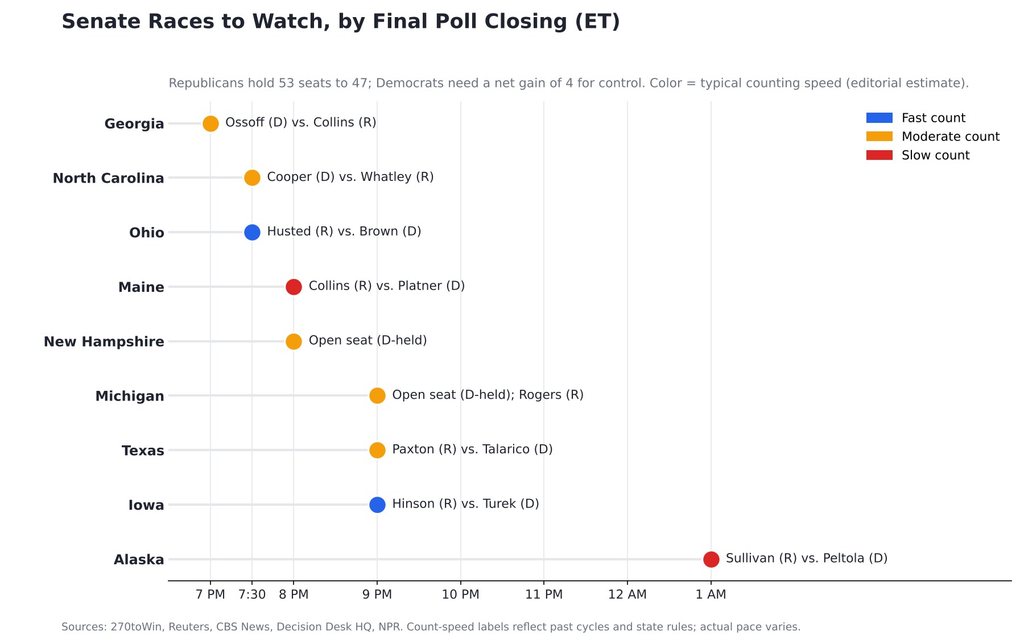
Early Evening (7 to 7:30 p.m. ET)
- Georgia: Sen. Jon Ossoff (D) vs. Rep. Mike Collins (R). If no candidate gets 50%, the race goes to a runoff.
- North Carolina: Former Gov. Roy Cooper (D) vs. Michael Whatley (R), for the open seat left by retiring Sen. Thom Tillis.
- Ohio: Sen. Jon Husted (R) vs. former Sen. Sherrod Brown (D). This is the race where data centers and electricity bills became a central issue.
Prime Time (8 to 9 p.m. ET)
- Maine: Sen. Susan Collins (R) vs. Graham Platner (D). Maine uses ranked-choice voting, which can add days if no one wins a majority.
- New Hampshire: An open, Democratic-held seat.
- Michigan: An open, Democratic-held seat, with former Rep. Mike Rogers as the Republican nominee.
- Texas: Attorney General Ken Paxton (R) vs. state Rep. James Talarico (D). Polls show a toss-up, as we explained in our Texas Senate race explainer.
- Iowa: Rep. Ashley Hinson (R) vs. state Rep. Josh Turek (D).
After Midnight
- Alaska: Sen. Dan Sullivan (R) vs. former Rep. Mary Peltola (D). Alaska is usually the slowest state to finish counting.
Why Vote Counting Delays Happen
Slow counts are normal. They are not, by themselves, a sign of a problem. Vote counting delays come from a few predictable causes.
1. Mail ballots take longer to count – Each envelope must be opened and its signature checked before the ballot is counted. In some California counties, up to half of mail ballots arrive on Election Day itself. Kim Alexander of the California Voter Foundation calls this the “pig in the python” problem.
2. Some states count ballots that arrive late – California will count ballots postmarked by Election Day that arrive by Nov. 10. Pennsylvania and Florida, by contrast, generally require mail ballots to arrive by the time polls close.
3. Voters may get time to fix ballot problems – Florida voters have until 5 p.m. on Nov. 5 to fix signature problems. North Carolina extended some fixed deadlines to five business days after the election.
4. Close margins slow down race calls – “Margins matter,” said Stephen Richer, a Republican and the former Maricopa County recorder, in an interview with NPR. Lopsided races can be called within minutes, even in states that count slowly. A two-point race in a fast-counting state can still wait until the end.
5. Ranked-choice voting and runoffs – Maine and Alaska tabulate additional rounds if no candidate wins a majority. In 2024, Alaska’s U.S. House race was not called until about two weeks after Election Day.
Delays also raise the stakes for what comes after. Trump has said he will accept the results only “if they’re honest elections”, so a slow count in a close race is worth watching. Pressure on Senate holdouts has been a feature of this term too, as in the standoff we covered when Trump posted Sen. Tom Cotton’s phone number.
When will we know who won the midterms?
- Tonight (by midnight ET): Most fast-counting states in the East and Midwest, plus any lopsided races, will likely be called.
- Wednesday through Friday: Close races in states that count a lot of mail ballots.
- Up to two weeks: California’s House races, Alaska, and any ranked-choice tabulations. Some election analysts expect House control may not be confirmed until mid-November if it comes down to California districts.
The bottom line: early leads can shift as different types of ballots are counted, a pattern often called the “red mirage” or “blue shift.” The most reliable signal is an official race call from a major decision desk such as the Associated Press, not a running vote total.
Voters are heading to the polls with the economy on their minds, including the Fed’s last decision before the midterms.
For live coverage and analysis of the midterms, visit DonaldTrump.Coach.
Frequently Questions Asked
When will midterm results be known?
Many races will be called tonight. Close races, and states that count a lot of mail ballots, may take days. California and Alaska can take up to two weeks.
What time do polls close on Election Day 2026?
The first polls close at 6 p.m. ET in parts of Indiana and Kentucky. Most states finish between 7 and 9 p.m. ET. The last polls close in Alaska at 1 a.m. ET. If you are in line before your polls close, you can still vote.
Will we get midterm results tonight?
Partly. Expect calls in many uncontested and lopsided races tonight. Control of the House or Senate may not be clear until later in the week.
Which key Senate races should I watch first?
Georgia, North Carolina, and Ohio close by 7:30 p.m. ET. Maine and New Hampshire follow at 8 p.m. ET, and Michigan, Texas, and Iowa at 9 p.m. ET.
Why are there vote counting delays?
Mail ballot verification, late-arrival grace periods, signature fixes, close margins, and ranked-choice tabulation all add time. None of these, by itself, means anything is wrong.
How many seats do Democrats need to win the Senate?
A net gain of four. Republicans currently hold 53 seats to Democrats’ 47.
References & Sources
- 270toWin: 2026 Poll Closing Times
- Ballotpedia: State Poll Opening and Closing Times
- Decision Desk HQ: Hour-by-Hour Guide to the 2026 Midterms
- NPR via KPBS: The real reason it’s going to take a while to know who won in some midterm races
- CBS News: Key Senate races that could decide control
- Reuters via Yahoo News: Eight US Senate races to watch in 2026
- The Epoch Times via California Insider: State of the fight for the US Senate as voters lock in key nominees
- Political.org: Why some midterm races may take days to call
- Good Morning America: Votes remain in long count of key midterm races (2022)