
US Politics
Washington Just Voted. Does India’s Trade Deal Survive, and What Are the Risks?
WASHINGTON – Democrats are taking control of both chambers of Congress after Tuesday’s midterm elections. In New Delhi, the result raises a question that matters to exporters, investors and anyone holding rupees: what happens to the India-US trade deal now? The short answer: the deal is not dead, but it was never finished in the…
WASHINGTON – Democrats are taking control of both chambers of Congress after Tuesday’s midterm elections. In New Delhi, the result raises a question that matters to exporters, investors and anyone holding rupees: what happens to the India-US trade deal now?
The short answer: the deal is not dead, but it was never finished in the first place. Most of the real power over tariffs on India still sits with the White House, not Capitol Hill. What changes is the pressure around the deal. There will be more oversight, more questions about tariffs, and a new set of political risks for India to manage.
Track the Numbers That Move India’s Economy
Tariffs and oil decide India’s trade outlook and the rupee. Follow both live:
Live Trump Tariff Tracker →
Every tariff moves as it lands, including the duties that hit Indian exporters.
Live Oil Price Tracker →
Brent and WTI in real time, the price that widens India’s trade deficit and weakens the rupee.
What Happened on Election Night
CBS News projected on the night of November 3 that Democrats had won the House, and later estimated they were on track for about 256 seats, up from 214. That would be their largest majority in nearly two decades. NBC News reported that Democrats flipped at least seven Senate seats, in Kansas, Iowa, Texas, Ohio, Maine, North Carolina and South Carolina, which gives them the Senate majority they lost in 2024. A handful of races were still uncalled as of Friday. For the full picture, see our breakdown of who controls Congress after the midterms and how Democrats flipped red states in the Senate, including James Talarico’s win in Texas, covered in our Texas Senate race explainer.
The new Democratic Congress is sworn in on January 3, 2027. President Trump stays in the White House, and trade policy now runs through a divided government.
First, a Reality Check: There Is No Signed Deal
Many readers assume there is a finished India US trade deal that Congress could now tear up. There isn’t one.
- February 6, 2026: Washington and New Delhi announced a framework for an interim agreement. The US said it would cut its tariff on Indian goods to 18%, and India said it intended to buy more than $500 billion of American energy, technology and other goods.
- February 7: The US removed the extra 25% “Russian oil” penalty on Indian goods.
- February 20: The US Supreme Court ruled 6-3 that the International Emergency Economic Powers Act (IEEPA) does not authorize tariffs. That removed the legal basis for both the old tariffs and the promised 18% rate.
- As of mid-October: According to trade law firm ATB Legal, there was still “no signed text, no tariff schedule and no entry-into-force date.” The 18% rate was never applied.
In early October, US Trade Representative Jamieson Greer said the two sides had “identified the items” but a deal was not imminent. India’s Commerce Minister Piyush Goyal said the fine print was still being worked out.
So the deal isn’t so much at risk of being undone as stuck where it is, in a changed political climate.
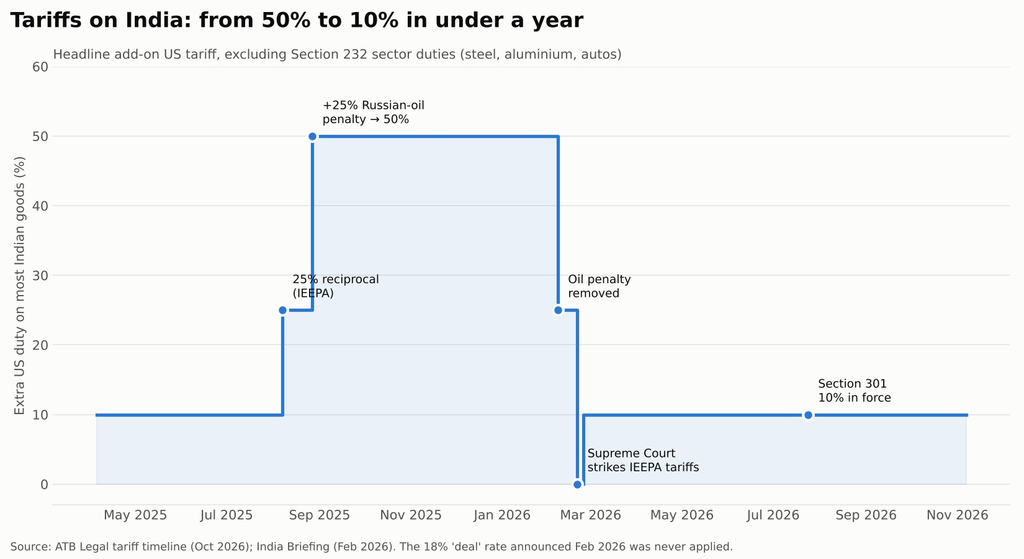
Chart: Extra US tariffs on most Indian goods fell from a peak of 50% in August 2025 to 10% under Section 301 by July 2026 The headline add-on tariff on most Indian goods peaked at 50% in August 2025 and has been 10% since July 24, 2026. Sector duties on steel, aluminium and autos apply separately.
Where Tariffs on India Stand Today
Right now, tariffs on India look like this:
| Measure | Rate | Status |
| Section 301 duty on most Indian goods | 10% | In force since July 24, 2026 |
| Section 232 sector duties (steel, aluminium, autos/parts) | Varies | Still in force |
| Section 122 global surcharge | 10% | Expired July 24, 2026 |
| IEEPA “reciprocal” and Russian-oil tariffs | 25% + 25% | Struck down / removed |
| Russia-sanctions duties (up to 100%) | Up to 100% | Authorized by law, waived Oct 16 by executive order |
| Anti-dumping/countervailing duties (e.g., solar cells) | Product-specific | Unaffected by any deal |
The key point for Indian exporters: the 10% Section 301 duty is an executive action. A Democratic Congress cannot repeal it alone. A repeal bill would need the president’s signature or a veto-proof majority, and neither looks likely. You can follow every change on our live tariff tracker.
Does the India Trade Deal Survive a Democratic Congress?
Why it most likely survives
1. The White House still drives trade – The framework is an executive-to-executive arrangement. Analysts at Jefferies expect Congress will not pass legislation that materially lowers tariffs, and they see the average effective US tariff rate staying between 10% and 20% even with a divided government.
2. India has bipartisan support in Washington – Support for closer ties with India has crossed party lines for two decades. Democrats have criticized how the administration treated New Delhi, not the relationship itself. In late 2025, Rep. Sydney Kamlager-Dove, the top Democrat on the House Foreign Affairs subcommittee covering South Asia, warned that “unless he changes course, Trump will be the American President who lost India,” and pointed out that the tariff on India had at one point been higher than the tariff on China.
3. Democrats may push for lower tariffs, not higher ones – Many Democrats ran on cost of living. Tariffs that raise prices for generic drugs, textiles and electronics, all major Indian exports, are an easy political target.
What changes
1. More oversight and hearings – Expect House committees to question the $500 billion purchase pledge. Lawmakers have already asked whether that figure adds up. Any final deal will face more public scrutiny.
2. Labor and environment demands – Democratic trade policy usually adds requirements on labor rights, environmental standards and enforcement. If the administration wants Democratic votes for a broader agreement, New Delhi may face tougher terms.
3. Agriculture and dairy stay sensitive – India has protected dairy, rice and millets. Farm-state lawmakers in both parties will keep pressing for market access, and that issue has stalled talks before.
4. A White House in a hurry – A president facing a hostile Congress often turns to foreign policy and trade wins he can deliver alone. That could speed up an interim deal signing in the coming months. It could also bring more unpredictable executive tariff threats.
The Bigger Risks for India Have Nothing to Do With Congress
When people ask “is India’s economy at risk after the US election,” the bigger threats are mostly outside Congress.
Risk 1: The Russian oil sanctions trigger
The Sanctioning Russia and Iran Act, signed September 18, allows duties of up to 100% on the largest buyers of Russian crude, and India is among the most exposed. An executive order on October 16 waived those duties, but the waiver has no end date and can be withdrawn at any time. This is the biggest single tariff risk India faces, and the Democratic Congress does not reduce it. Some Democrats are more hawkish on Russia than the administration.
Risk 2: Sector-specific duties
Section 232 tariffs on steel, aluminium and auto parts remain. Indian solar manufacturers face separate anti-dumping and countervailing duty cases with very high proposed rates. A trade deal does not automatically remove any of these.
Risk 3: Oil prices
Brent crude was trading near $100 a barrel this week, after topping $114 in late October. India imports more than 85% of its oil, so every spike widens the trade deficit and weakens the rupee. Watch the move live on our oil price tracker.
Risk 4: The H-1B fee
The $100,000 fee on new H-1B visas hits India’s IT services sector and its workforce directly. Democrats have criticized it, but undoing it would require either the White House or legislation that can survive a veto.
Rupee Outlook: A Post-Election Bounce
Markets took the result calmly. On November 6, the rupee strengthened to 94.06 per dollar, its strongest level in more than six months, according to Business Standard. Dealers credited a weaker dollar, lower oil prices, improved risk sentiment after the midterms, and renewed foreign portfolio inflows. The same relief lifted U.S. equities that week, as we covered in our report on the stock market rally after the Democratic sweep.
That is a sharp recovery from the rupee’s record low of about 96.97 per dollar in May. The fall came as foreign investors pulled roughly $20.6 billion out of Indian equities by early May and oil prices surged.
What to watch for the rupee outlook:
- Support level: Traders cited 94.30 as a level where importers keep buying dollars, which may cap further rupee gains.
- Oil: A sustained move back above $110 Brent would likely undo the bounce.
- Reserves: India’s reserves hit a record of about $786 billion in September before falling to around $721 billion by mid-October as the Reserve Bank of India defended the currency.
- The Fed: A Democratic Congress does not change the Federal Reserve’s rate path, which remains the main driver of the dollar. See our report on the Fed’s last decision before the midterms.
None of this is a forecast. Currency markets can reverse quickly, especially with oil this volatile.
What It Means for Indian Exporters
The numbers show both resilience and strain. India’s exports to the US barely moved in FY2025-26, reaching $87.3 billion, while imports from the US jumped to $52.9 billion. That cut India’s trade surplus with the US from $40.9 billion to $34.4 billion.
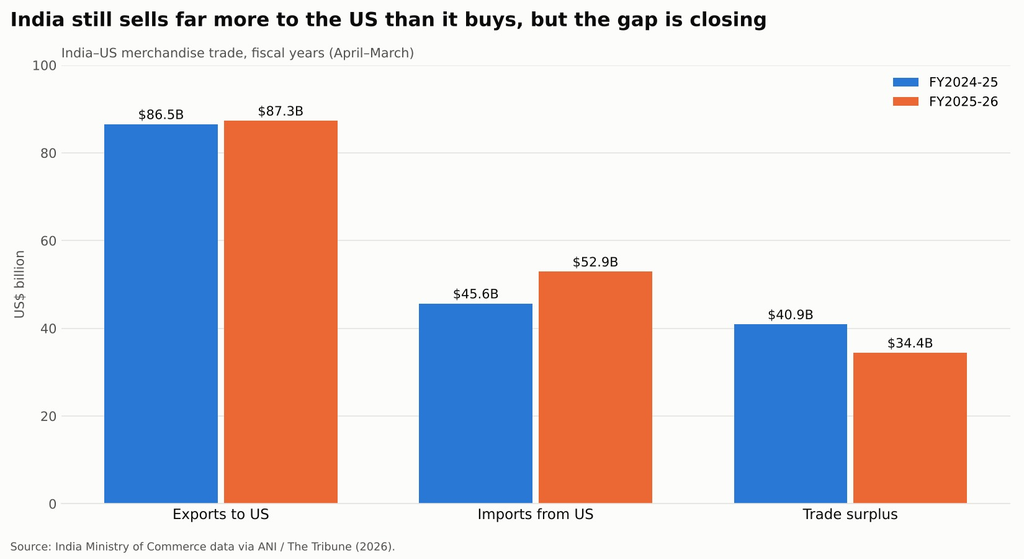
Chart: India’s exports to the US rose slightly to $87.3 billion in FY26, while imports from the US rose to $52.9 billion and the surplus shrank to $34.4 billion India still sells far more to the US than it buys, but the gap is closing. That helps New Delhi’s case in talks with Washington.
For Indian exporters, the outlook by sector:
- Pharmaceuticals and generics: Probably the safest sector. Cheap generics are popular with US voters and with Democrats focused on drug prices.
- Textiles, apparel, gems and jewelry: The most sensitive to the 10% Section 301 duty. These sectors would gain the most from a signed deal that cuts rates.
- IT services: Not directly hit by goods tariffs, but exposed to the H-1B fee and to any slowdown in US corporate spending.
- Steel, aluminium, auto parts: Still under Section 232 duties, which are unlikely to change soon.
- Solar: Exposed to separate trade-remedy duties regardless of politics.
The shrinking surplus helps India in negotiations. It shows New Delhi is buying more American goods, especially energy, which is what Washington has been asking for.
The Bottom Line
The midterms did not kill the India-US trade deal, and they will not save it either. Tariff decisions still sit mostly with the president. What the Democratic Congress adds is scrutiny, probably less tolerance for tariffs that raise consumer prices, and tougher questions on any final text.
For India, the real risks lie elsewhere: a withdrawn Russian oil waiver, an oil price spike, or a sudden executive tariff move. The rupee’s post-election bounce is welcome, but it depends on oil and global capital flows far more than on who controls Capitol Hill.
The next milestones: whether an interim agreement is signed before the new Congress takes over in January, whether the Russia-sanctions waiver holds, and whether oil stays near $100.
For live coverage of US politics and its global fallout, visit DonaldTrump.Coach.
Frequently Asked Questions
How will the US midterms affect India?
The midterms change the politics around trade more than the policy itself. Democrats now control Congress, so expect more hearings and oversight, and possibly pressure to ease tariffs that raise US consumer prices. The president still controls most tariff tools, including the 10% Section 301 duty on Indian goods.
What happens to the India US trade deal now?
Talks continue. The February 2026 framework was never signed into a legal text, and the promised 18% rate was never applied. A White House facing a Democratic Congress may push to finalize an interim deal, but any broader agreement will face tougher Democratic scrutiny on labor, environment and the $500 billion purchase pledge.
Is India’s economy at risk after the US election?
India faces real risks, but most are not about the election. The biggest are a possible withdrawal of the waiver on Russian oil sanctions duties of up to 100%, high oil prices, sector duties on steel, aluminium and autos, and the H-1B visa fee. The midterm result itself was taken calmly by markets.
What are the current tariffs on India?
Most Indian goods pay a 10% Section 301 duty on top of normal duties, in force since July 24, 2026. Steel, aluminium and autos pay separate Section 232 rates. The earlier 50% combined IEEPA tariffs were removed or struck down by the Supreme Court in February 2026.
Can a Democratic Congress remove tariffs on India?
Not easily. Congress can pass a law limiting the president’s tariff powers, but the president can veto it, and overriding a veto requires two-thirds of both chambers. Most analysts don’t expect Congress to materially lower tariffs.
What is the rupee outlook after the US midterms?
The rupee hit 94.06 per dollar on November 6, a six-month high, helped by a softer dollar, lower oil prices and foreign inflows. Its direction from here depends mainly on oil prices, the Fed and foreign investment flows, not on Congress.
Which Indian exporters are most exposed?
Textiles, apparel, gems and jewelry are most exposed to the 10% duty. Steel, aluminium and auto parts face Section 232 tariffs, and solar makers face separate trade-remedy duties. Generic pharmaceuticals look relatively safe, and IT services are mostly affected through the H-1B fee.
When does the new Democratic Congress take office?
The new Congress is sworn in on January 3, 2027. Until then, the current Republican-led Congress remains in session.
References & Sources
- CBS News, “2026 House midterm election results as Democrats capture majority” (Nov 3–6, 2026).
- NBC Washington / NBC News, “Live updates: Democrats win control of the House and Senate” (Nov 4, 2026).
- CNBC, “2026 midterm election results: House, Senate” (Nov 4, 2026).
- ATB Legal, “India US Trade Deal 2026: Status, Tariffs & Legal Position” (Oct 2026).
- India Briefing, “US-India Strike Interim Trade Deal, Cut Tariffs to 18%” (Feb 2026).
- Multibagg AI, “Where Does the India–US Trade Deal Stand After the Midterms?” (Nov 4, 2026).