
Economy
Stock Market After the Midterms: Dow Jumps 1,569 Points, Then AI Selloff Erases the Gains
NEW YORK – Wall Street did not get the election many traders had positioned for. Democrats won majorities in both the House and the Senate on Tuesday, according to AP projections, handing President Trump a divided government for the final two years of his term. Then the Dow jumped nearly 1,600 points. For the full…
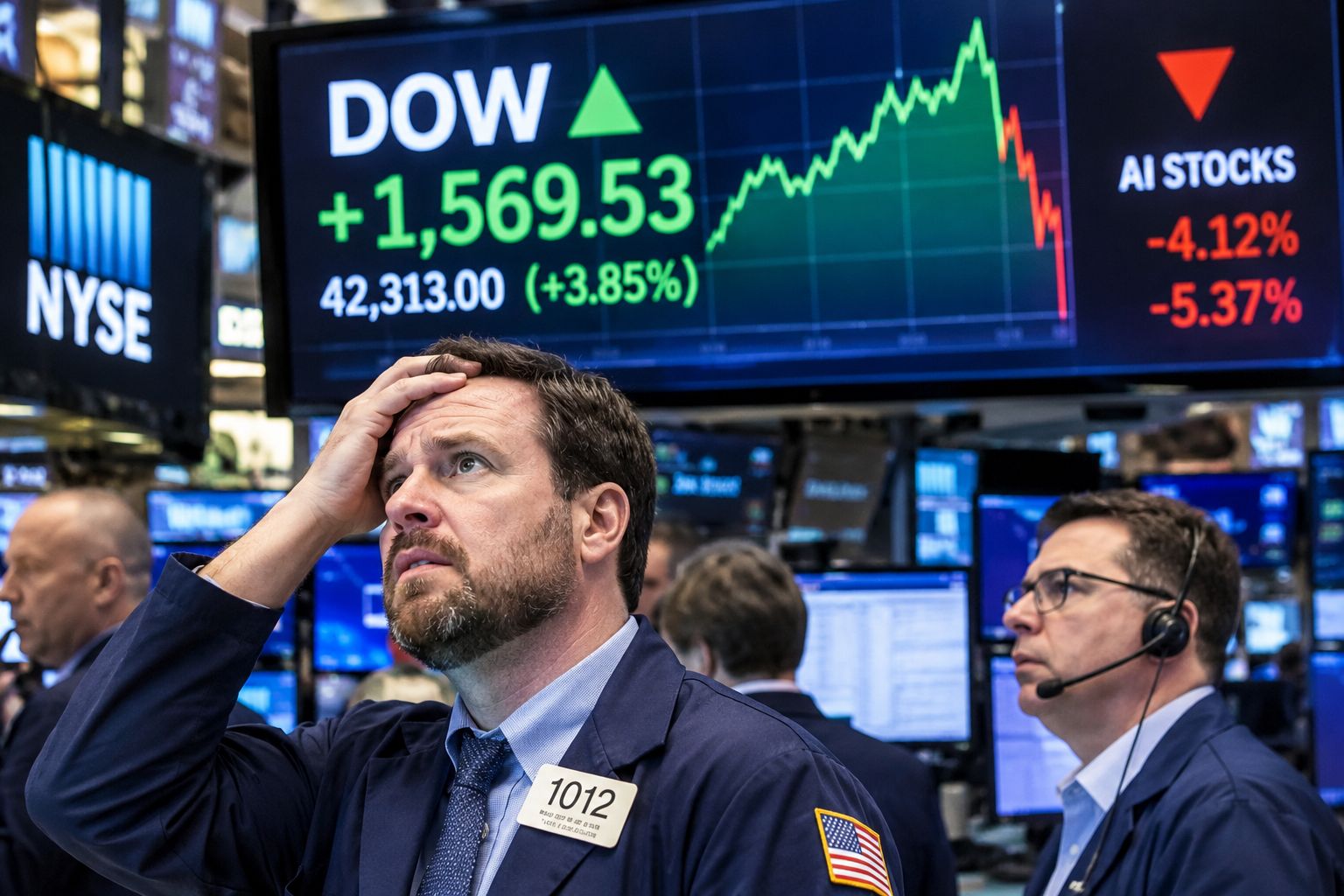
NEW YORK – Wall Street did not get the election many traders had positioned for. Democrats won majorities in both the House and the Senate on Tuesday, according to AP projections, handing President Trump a divided government for the final two years of his term. Then the Dow jumped nearly 1,600 points. For the full political picture, see our breakdown of who controls Congress after the midterms.
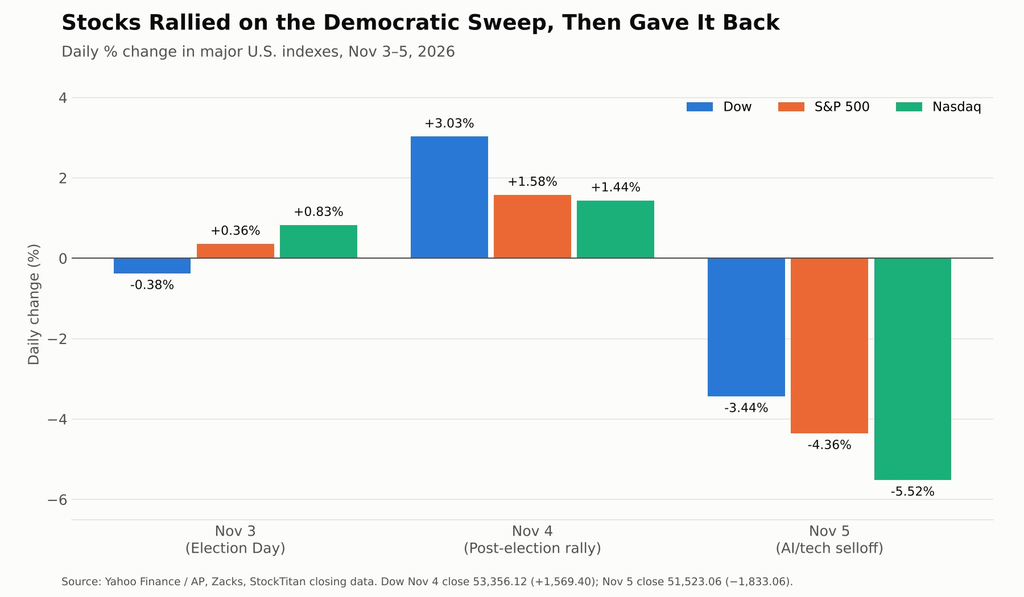
On Wednesday, Nov. 4, the Dow Jones Industrial Average rose 1,569.40 points, or 3.03%, to close at 53,356.12, its best day since April 2025 and its biggest gain of the year. The S&P 500 added 1.58% to 7,688.62, and the Nasdaq Composite gained 1.44% to 25,736.51. CNN called it the Dow’s best day after a midterm election in 44 years.
The rally did not last. On Thursday, a sharp selloff in AI and chip stocks erased those gains and more. Here is what drove both moves, and what a Democratic Congress could mean for your portfolio.
Why Did the Stock Market Go Up After the Election?
Analysts pointed to four reasons for the stock market after midterms bounce.
1. The uncertainty ended – “Investors are glad the midterms are behind them,” Adam Crisafulli of Vital Knowledge said, according to CBS News, noting it removes an obstacle heading into a seasonally strong stretch for stocks.
2. Trump accepted the results – The president told The Wall Street Journal he would work with Democrats and expected to “get along very well with them.” A smooth handoff of congressional power took a tail risk off the table. That is a notable contrast with his earlier line that he would accept results only “if they’re honest elections”.
3. Gridlock limits big surprises – With Democrats running Congress and Trump holding the veto pen, sweeping tax or spending bills are unlikely. Stephen Brown of Capital Economics said the size of Democratic gains does not change the near-term policy outlook much, because Democrats lack a filibuster-proof Senate majority and Trump can veto.
4. Oil fell hard – U.S. crude dropped more than 8% to settle at $88.12 a barrel, according to StockTitan, after Vice President JD Vance blamed the Iran war for Republican losses. Cheaper oil eases inflation fears and supports consumer stocks.
The Overnight Swing: Dow Futures Rally From a Deep Hole
The Dow futures rally started from a weak spot. Futures fell sharply overnight as results came in, with Nasdaq-100 futures touching their lowest level since July 30. By 8:45 a.m. ET, Dow futures had flipped to a gain of 1,083 points, or 2.1%, as it became clear the outcome was decisive and uncontested.
Blue Wave Markets: Who Won and Who Lost
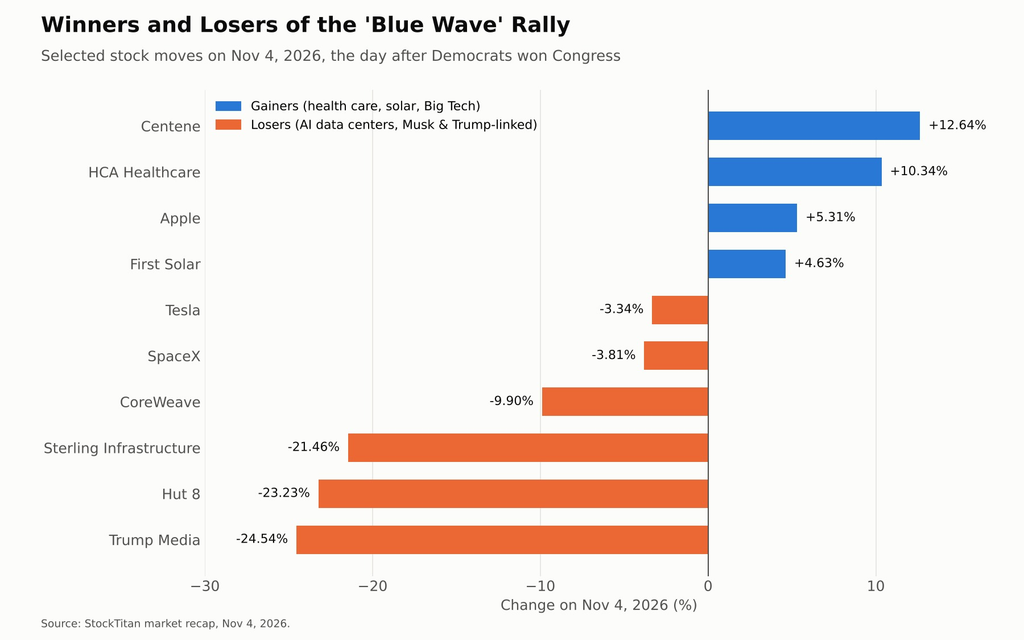
The investor reaction split sharply by sector. Health care led. Centene jumped 12.64% and HCA Healthcare rose 10.34%. Solar stocks gained, with First Solar up 4.63%. Apple rose 5.31%.
The losers were companies seen as tied to the outgoing Republican agenda or exposed to tougher oversight. Trump Media fell 24.54%. AI data center builders Hut 8 and Sterling Infrastructure each dropped more than 21%, and CoreWeave lost 9.9%. Tesla and SpaceX also slipped.
Democratic wins in states like Texas, where James Talarico beat Ken Paxton in a race we covered in our Texas Senate race explainer, are part of why investors began rethinking policy risk. Our look at how Democrats flipped red states in the Senate shows how broad that shift was.
Then Came Thursday’s AI Selloff
The good mood lasted one session. On Nov. 5, the Nasdaq plunged 5.52% to 24,315.00, falling into correction territory. The S&P 500 dropped 4.36% to 7,353.73, its worst day since April 2025, and the Dow lost 1,833.06 points, or 3.44%, to 51,523.06.
The trigger was linked to the election. Investors sold chip and AI stocks on fears that Democrats, who also won key states where public opposition to data centers had grown, could slow the AI building boom. UBS strategists estimated that about 30% of the data center additions expected in 2028 are now at risk, according to StockTitan. Micron and AMD each fell more than 17%, and Nvidia dropped 9.26%.
That opposition was a defining issue in Ohio, where Sherrod Brown won a Senate seat in a race shaped by data centers and electricity bills. LPL Research’s Jeff Buchbinder had flagged that risk a day earlier. Federal policy impacts may be limited, he said, but state and utility-level decisions on data centers could slow the buildout.
Is a Divided Government Good for Stocks?
History says divided government stocks have often done fine. Edward Jones data cited by CBS News shows the S&P 500 has risen an average of 15.5% in the six months after each of the last 14 midterm elections, going back to 1970.
But averages hide a lot. Wells Fargo Investment Institute noted that growth, inflation, interest rates and earnings matter more to markets than which party runs Congress. This week proved the point: politics set off both moves, but AI spending and profits decided how far stocks fell.
What Does a Democratic Congress Mean for Markets and Your Money?
- Fewer big fiscal surprises – Major tax cuts or spending packages are unlikely to pass without compromise.
- More oversight – Expect investigations and hearings, which can weigh on specific sectors, including AI, energy and companies tied to the administration.
- Sector rotation, not a market call – Health care and clean energy rallied. AI infrastructure sold off. Diversification matters more than picking a political side.
- Rates still rule – Traders cut their odds of a December Federal Reserve rate move to 70.1% from 82.7% after Thursday’s rout. Fed decisions and earnings will likely drive stocks more than Congress.
For long-term investors, the takeaway is simple: the election removed one source of uncertainty, but it did not change the fundamentals. Volatility is high, and reacting to a single day’s headlines rarely pays.
Frequently Asked Questions
Why did the stock market go up after the election?
Stocks rose on Nov. 4 because the midterm uncertainty ended, Trump accepted the results, oil fell more than 8%, and investors expected gridlock to block sweeping new laws. The Dow gained 1,569 points, or 3.03%.
What does a Democratic Congress mean for markets?
It likely means fewer major tax or spending changes, more oversight of industries like AI and energy, and gains for sectors such as health care and solar. Earnings and interest rates will still matter most.
How did Dow futures react to the midterm results?
Futures fell sharply overnight, then reversed. By 8:45 a.m. ET on Nov. 4, Dow futures were up 1,083 points, or 2.1%.
What is the stock market after midterms usually like?
Historically strong. Since 1970, the S&P 500 has averaged a 15.5% gain in the six months after a midterm election, according to Edward Jones.
What are blue wave markets?
“Blue wave markets” describes how stocks trade when Democrats win big. In 2026, health care and solar stocks rose, while Trump-linked and AI data center stocks fell.
Why did stocks fall the day after the rally?
On Nov. 5, investors sold AI and chip stocks over fears that Democratic wins could slow data center spending. The Nasdaq fell 5.52% into a correction, and the Dow gave back its post-election gain.
What was the investor reaction to Trump accepting the results?
Relief. Trump said he expects to “get along very well” with Democrats, which reduced the risk of a contested transfer of power in Congress.
References & Sources
- How major US stock indexes fared Wednesday 11/4/2026 – Yahoo Finance (AP)
- Dow posts biggest gain of the year after Democrats take control of Congress – CBS News
- Dow has best post-midterm elections day in 44 years as Democrats take control of Congress – CNN
- Stocks rally as Trump accepts Democratic midterm sweep – CNBC
- Stock market booms after Democratic midterm election sweep – The Hill
- The Dow Soared in the Stock Market Today, November 4, 2026 – StockTitan
- The Stock Market Today, November 5, 2026, Closed Sharply Lower as the AI Chip Selloff Spread – StockTitan
- Stock Market Today, Nov. 5 – Yahoo Finance
- Stock Market News for Nov 4, 2026 – Yahoo Finance (Zacks)
- Stock Market Today, Nov 5, 2026: US Stocks Sink as Postelection AI Fears Drive Tech Rout – Sell The News