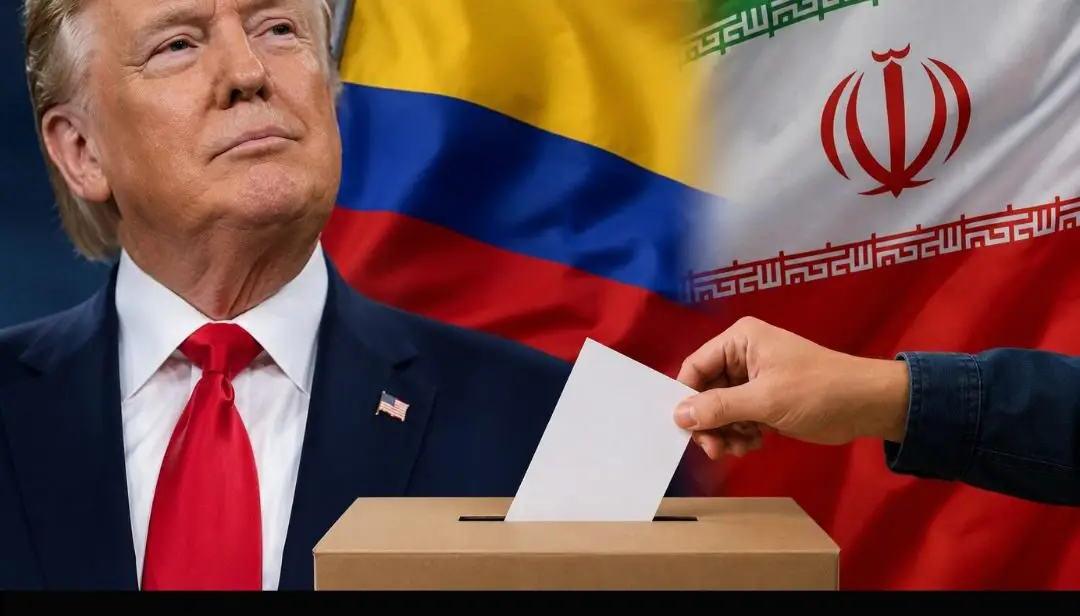
Colombia’s presidential election delivered a shock result on May 31, 2026 — and the fallout began before the final votes were counted. Abelardo de la Espriella, a 47-year-old lawyer and self-described conservative nationalist who has openly aligned himself with the political style of US President Donald Trump, finished first in the first round of voting with 43.74 percent of the vote, far exceeding pre-election polling that had placed him between 25 and 30 percent. His opponent in the June 21 runoff will be Iván Cepeda, a senator and close ally of outgoing leftist President Gustavo Petro, who finished second with 40.90 percent.
Neither candidate crossed the 50 percent threshold required for an outright win. But the immediate story is less about the runoff math and more about what happened as soon as the results became clear: Petro announced he does not recognize the election results — and his faction began alleging, without presenting evidence, that hundreds of thousands of votes had been manipulated.
A Result That Shocked the Polls
De la Espriella’s performance is genuinely striking. Newsweek described it as a “shock election result” — and the numbers justify that framing. A candidate who polled in the mid-to-high 20s won nearly 44 percent in a multi-candidate first round, suggesting either a dramatic late surge in support, significant polling error, or both.
CNN reported that De la Espriella’s campaign had centered on three themes: security and anti-cartel enforcement modeled on El Salvador’s Nayib Bukele, economic liberalization, and a promise of stronger ties with the United States and Israel. He has spoken favorably about Trump repeatedly and has been drawn into international coverage as part of the broader wave of Trump-aligned right-wing populism gaining ground across Latin America. Fox News described him as an “anti-cartel hardliner” channeling Trump in his bid to end Colombia’s leftist era.
What De la Espriella has not received — at least as of this report — is a public endorsement from Trump himself. The candidate has cultivated the association; Washington has not yet formalized it.
Petro’s Refusal and the Fraud Allegations
The more immediately consequential development is Petro’s response. Colombia One reported that the outgoing President stated he does not recognize the election results and raised concerns about the role of Thomas Greg & Sons, a private company involved in Colombia’s electoral infrastructure, in what he characterized as result manipulation. Cepeda’s camp amplified similar claims, alleging “foreign actors” had interfered in the process.
NPR reported that political leaders, analysts, and opposition figures across the spectrum criticized Petro for casting doubt on the election’s legitimacy without presenting evidence. The Colombian electoral authority has not confirmed any irregularities. The pattern — a left-wing incumbent refusing to accept unfavorable results and alleging manipulation — has regional precedent, most notably in Venezuela, and has drawn sharp condemnation from those who view it as an attempt to delegitimize a democratic outcome rather than contest it through legal channels.
Euronews noted that the allegations have gained little credibility outside Petro’s immediate political circle — but their political purpose is clear: to begin framing any De la Espriella victory in the June 21 runoff as illegitimate before it happens, seeding the ground for a contested transition.
What a De la Espriella Victory Would Mean
The geopolitical implications of a Colombian presidential shift are substantial. Petro’s government — the first explicitly left-wing administration in Colombia’s modern history — significantly strained relations with Washington over drug policy, Venezuela policy, and trade. A De la Espriella government promising stronger security ties with the US and Israel would represent a sharp reversal, aligning Colombia more closely with the Trump administration’s hemispheric posture at a moment when Washington is simultaneously managing the Iran war, the Strait of Hormuz crisis, and a broader reassertion of US influence in the Western Hemisphere.
Colombia is also the United States’ closest security partner in South America, the anchor of regional counter-narcotics cooperation, and a critical node in supply chains for coal, coffee, and cut flowers. The ideological direction of its government matters in practical terms, not just symbolic ones.
France 24 reported that conservative senator Paloma Valencia — who had sought to be Colombia’s first female president under Álvaro Uribe’s party — finished a distant third with 6.92 percent. Her voters now become a critical variable in the June 21 runoff. If the bulk of her support migrates to De la Espriella, as most analysts expect, his path to the presidency becomes considerably easier. If Cepeda can consolidate the entire left-leaning vote while also peeling off centrist voters troubled by De la Espriella’s Bukele-style rhetoric, the runoff becomes genuinely competitive.
A Pattern With a Name
Local 10 described the sequence precisely: a pro-Trump candidate surges beyond expectations, the ruling left falls behind, and the immediate response is to question the count rather than the campaign. It is a pattern being written in multiple Latin American countries simultaneously, and Colombia — the region’s third-largest economy and Washington’s most important security partner — is now its most consequential stage.
The runoff is June 21. The allegations of fraud have already begun. Both sides have three weeks to make their case to voters who, if the first-round numbers hold, appear to be moving in one direction.