Share This Article
For months, Iran used covert ship-to-ship oil transfers to dodge sanctions and keep its crude exports flowing despite international restrictions. Now, newly reviewed satellite imagery shows the United States has been running a strikingly similar operation of its own just outside the Strait of Hormuz to keep Gulf oil moving during the most volatile stretch of the US-Iran conflict.
According to a Reuters investigation, the U.S. military has overseen scores of secretive ship-to-ship oil transfers since early May, deploying aerial and water drones, along with helicopters, to guide tanker convoys to waiting vessels just beyond the world’s most critical energy chokepoint.
A Familiar Tactic, Flipped
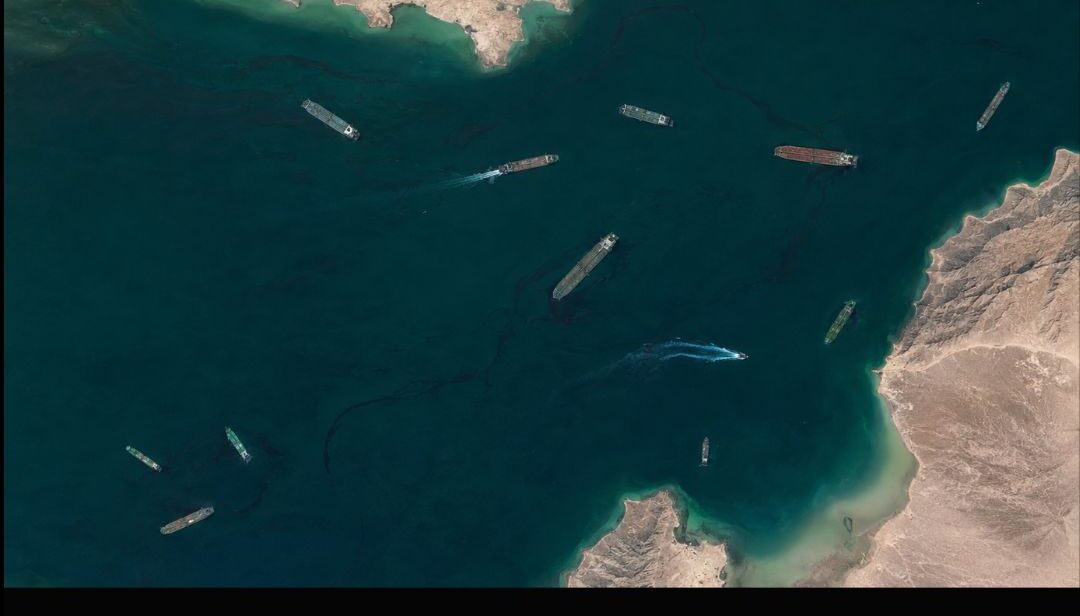
The operation unfolds at two specific locations identified by eleven sources familiar with the effort: one off the coast of Fujairah in the United Arab Emirates, and the other off Oman’s port of Sohar. Reuters reviewed more than a dozen satellite images taken between May 2 and June 11 showing ship-to-ship transfers involving state-owned Gulf tanker fleets and internationally operated vessels that receive the oil.
The method itself is not new it’s Iran’s own playbook. The operation on the edge of the Strait of Hormuz employs a shuttling technique long used by Iran to skirt sanctions. A separate Reuters investigation published May 20 had already documented how Tehran built its own system for ushering ships through the opposite side of the strait, involving island checkpoints, diplomatic arrangements, and transit fees.
The scale of the American version has grown quickly. It started in early May, and at least 116 ships have been involved in the transfers, according to shipping data and satellite imagery. Activity peaked on June 11, when 17 pairs of ships could be seen carrying out simultaneous oil transfers at the two sites, according to satellite images reviewed by Reuters. As of Tuesday this week, 12 pairs of ships could be seen side-by-side in the Gulf of Oman: eight off the coast of Sohar in Oman and four near Fujairah.
Fully Military-Run, Quietly Denied
Unlike Iran’s smuggling network, which relies on private intermediaries and shell companies, the American operation appears to be a direct extension of U.S. Central Command. The American transfer operations are fully controlled by the US military, said eight of the sources, including a private security contractor who has been involved in the transfers. Tankers reportedly sail to a designated meeting point ahead of the strait, then stagger their departures for security.
Despite the documentation, Washington has been cagey about confirming details. In response to Reuters questions, a U.S. defense official said no Central Command forces are taking part in an offshore ship-to-ship oil transfer operation. The White House referred questions to Centcom, and the Iranian government did not respond to requests for comment about the transfer operation.
The Apache Connection
The covert program drew unwanted attention on June 9, when an Apache helicopter was shot down by Iranian forces, triggering retaliatory U.S. airstrikes. According to four sources, including a former U.S. official with direct knowledge of the incident, the helicopter was involved in the mission at the time it was downed. Using satellite imagery, Reuters counted six pairs of tanker ships clustered together in a small area off the port of Sohar the day the Apache was shot down, though the news agency could not independently confirm the aircraft’s exact role in that day’s transfer activity. Both crew members were rescued by a drone boat, U.S. officials said.
Why It Matters: A Fragile Peace Deal in the Balance
The revelations land at an especially sensitive moment for the US-Iran agreement. Just days earlier, on June 14, senior US officials confirmed that President Trump, Vice President JD Vance, and Iran’s chief negotiator, Parliament Speaker Mohammad Bagher Ghalibaf, had digitally signed a memorandum of understanding intended to end the broader conflict including a provision to fully reopen the Strait of Hormuz and lift the U.S. naval blockade on Iranian ports. A formal in-person signing was scheduled for June 19 in Geneva.
Vance described the document as preliminary, telling reporters it was “about a page and a half” and largely structural, leaving the toughest issues including Iran’s nuclear stockpile and longer-term security arrangements for the strait to a 60-day technical negotiation period. He added that Washington’s expectation was for the strait to eventually be “opened in a toll-free way for the long term.”
The disclosure of the U.S. smuggling-style operation complicates that narrative. It suggests that even as diplomats negotiated a public reopening of Hormuz, American forces had already been running an off-the-books logistics workaround for more than a month raising questions about how much US influence over the waterway has actually relied on improvisation rather than formal control.
For more on the broader Strait of Hormuz reopening and the terms of the ceasefire framework, see Al Jazeera’s coverage of the US-Iran deal signing.
The Bigger Picture
Whether the ship-to-ship transfer program continues now that Hormuz is nominally reopening remains unclear. Mines reportedly still need to be cleared from sections of the strait, and shipowners are expected to make their own risk assessments before resuming normal transits. Until then, the satellite record suggests Washington’s workaround built on a tactic it spent years sanctioning Iran for using may keep running quietly in the background.

Oil & Energy Markets
A look at crude price swings, OPEC supply moves, and how energy markets react to geopolitical shocks.

Geopolitics & Conflict
Breaking down how wars, ceasefires, and diplomatic deals ripple through global trade and security.
US Foreign Policy
Coverage of Trump administration negotiations, sanctions, and strategic decisions shaping world events.
Economy & Inflation
Tracking how commodity prices, gas costs, and supply chains affect everyday consumers.