Op Sindoor 2.0? How the Iran War Is Rewriting India’s Military Playbook Against Pakistan
Theo Jorden
Share This Article
New Delhi / Islamabad — When India launched Operation Sindoor its precisely calibrated cross-border strike package targeting terrorist infrastructure in Pakistan and Pakistan-occupied Kashmir the world took notice. But military planners in New Delhi were watching something else entirely: how Israel and Iran were fighting their war, and what lessons it held for the next
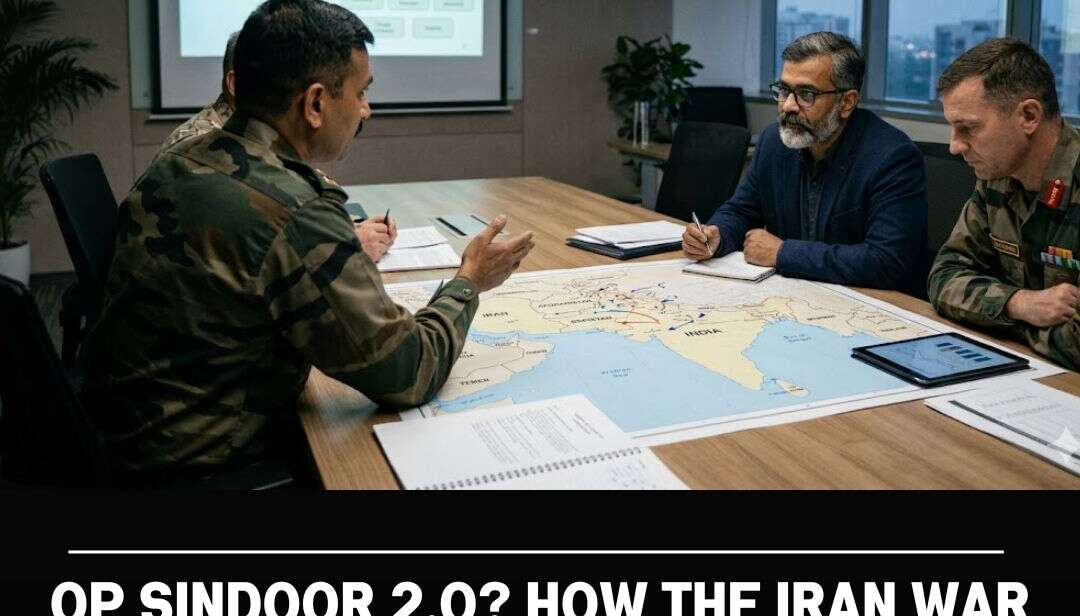
New Delhi / Islamabad — When India launched Operation Sindoor its precisely calibrated cross-border strike package targeting terrorist infrastructure in Pakistan and Pakistan-occupied Kashmir the world took notice. But military planners in New Delhi were watching something else entirely: how Israel and Iran were fighting their war, and what lessons it held for the next chapter of India’s own strategic doctrine. What is emerging, defence analysts say, is the blueprint for what could be called Op Sindoor 2.0 a faster, deeper, and more technologically layered military posture that is quietly rewriting India’s playbook against Pakistan.
The Iran-Israel War as a Live Laboratory
For India’s military establishment, the ongoing Iran-Israel conflict has functioned as an unprecedented real-world stress test of concepts that Indian defence planners have been theorising about for years: multi-domain warfare, precision strike saturation, layered missile defence, and the use of drone swarms to overwhelm air defence networks before committing conventional assets.
Israel’s operational model — lightning precision strikes against high-value infrastructure, followed by rapid escalation dominance to prevent retaliation from gaining momentum — mirrors, in several key respects, the logic India applied during Operation Sindoor. But the Iran war has shown that adversaries are adapting. Iran’s response demonstrated that even a technologically inferior opponent can complicate a precision-strike campaign through volume, misdirection, and dispersed launch platforms.
India’s strategic community absorbed that lesson immediately.
“What the Iran-Israel exchange proved is that the first strike must be comprehensive enough to degrade retaliation capacity — not just symbolic enough to make a political point,” said one retired Indian Army general speaking to a defence think tank in New Delhi last month. “Sindoor was the proof of concept. The next iteration cannot afford to be incremental.”
What Op Sindoor Established and Where It Left Gaps
Operation Sindoor was a landmark moment in Indian military history. It demonstrated that India had both the political will and the precision capability to conduct cross-border strikes, absorb international pressure, and manage escalation without triggering full-scale war. The operation achieved its declared objectives: destruction of terrorist launch infrastructure, degradation of command nodes, and the delivery of a clear strategic message to Rawalpindi.
But critics within India’s own defence establishment have noted what Sindoor did not do. It did not neutralise Pakistan’s tactical nuclear posturing, which Islamabad deployed rhetorically almost immediately as an escalation brake. It did not address Pakistan’s rapidly expanding drone inventory, much of which is sourced from Chinese manufacturers and Turkish platforms. And it did not test India’s ability to sustain multi-front pressure — a scenario that becomes increasingly relevant as the China-Pakistan strategic axis deepens.
Iran’s Lessons, Applied to the Pakistan Theatre
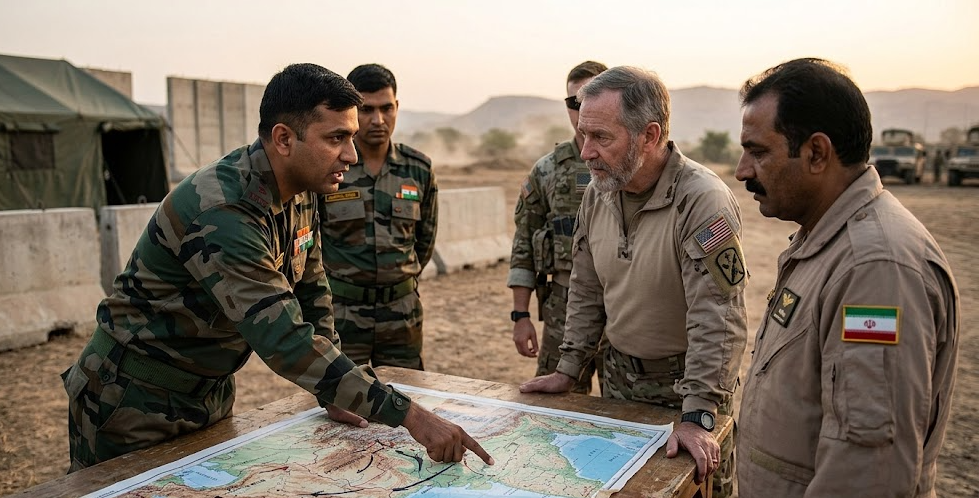
The Iran war has handed Indian planners a set of concrete operational insights that are now being integrated into revised doctrine.
Drone swarm saturation — Iran’s use of large drone waves to overwhelm Israeli and U.S. naval and ground-based air defence systems has accelerated India’s own investment in counter-drone systems and autonomous strike platforms. India’s Defence Research and Development Organisation (DRDO) has fast-tracked several loitering munition programmes in direct response.
Dispersed launch architecture — Iran demonstrated that mobile, road-based missile launchers are significantly harder to pre-empt than fixed sites. Indian intelligence now assesses that Pakistan has restructured elements of its own tactical missile deployment along similar lines, complicating pre-strike planning for any Op Sindoor 2.0 scenario.
Layered air defence integration — Israel’s Iron Dome, David’s Sling, and Arrow system interoperability offered India’s defence establishment a live case study in integrated air defence architecture. India’s own S-400 deployment, combined with indigenous Akash systems, is being restructured in light of the Iran war’s air battle data.
Pakistan’s Recalibration and the New Escalation Ladder
Islamabad has not been a passive observer of these developments. Pakistani military planners have studied the Iran-Israel conflict with equal intensity — and have drawn their own conclusions. Chief among them: that missile volume and speed, not just precision, is the new currency of deterrence.
Pakistan’s accelerated acquisition of Chinese CM-400AKG hypersonic air-launched missiles and expanded Fatah-series rocket artillery directly reflects these post-Iran war calculations. Pakistan’s air defence establishment is also widely believed to have deepened technical cooperation with Beijing in the aftermath of Sindoor, seeking to close the qualitative gap that India’s operation exposed.
The escalation ladder between India and Pakistan — always a uniquely dangerous construct given both nations’ nuclear status — now has more rungs, more ambiguity, and more potential for miscalculation than at any point in the past decade.
The Doctrine India Is Building
What Op Sindoor 2.0 would look like, if it ever materialised, is not a public document. But based on defence procurement patterns, military exercise structures, and statements from Indian Army and Air Force leadership, its outlines are increasingly visible.
It would be faster — compressed decision-to-strike timelines designed to preempt Pakistani escalation management. It would be deeper — targeting not just terrorist infrastructure but the military logistics and air defence nodes that enable Pakistan’s response capacity. And it would be multi-domain — integrating cyber operations, electronic warfare, and space-based surveillance in ways that Operation Sindoor’s first iteration only partially employed.
The Iran war did not create India’s strategic ambition. But it has sharpened it — and handed New Delhi a detailed operational manual for what 21st-century precision warfare against a nuclear-armed regional adversary actually looks like under fire.
Oil & Energy Markets
A look at crude price swings, OPEC supply moves, and how energy markets react to geopolitical shocks.