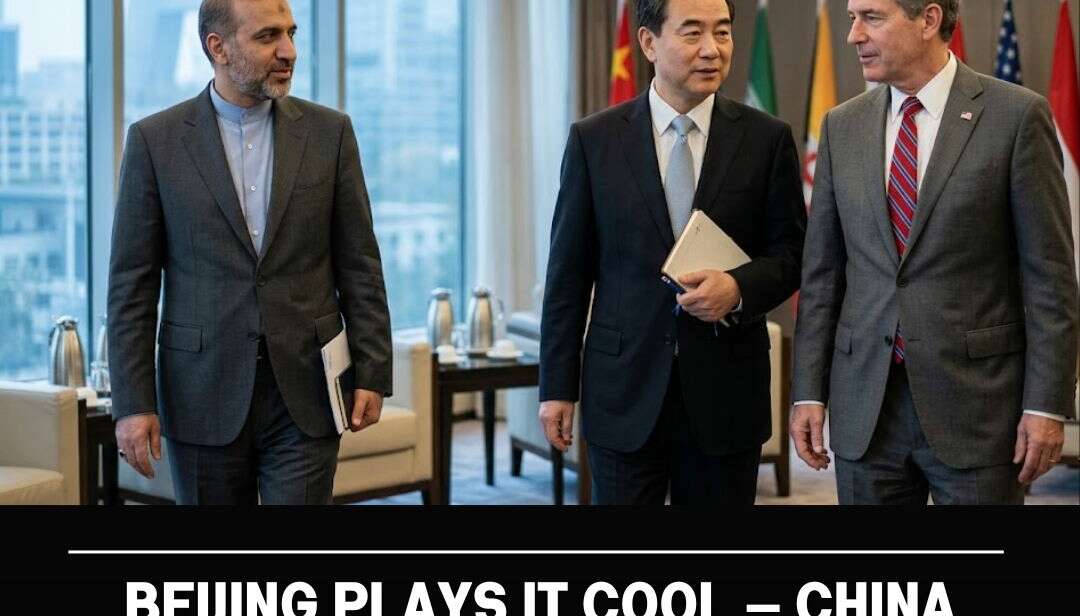
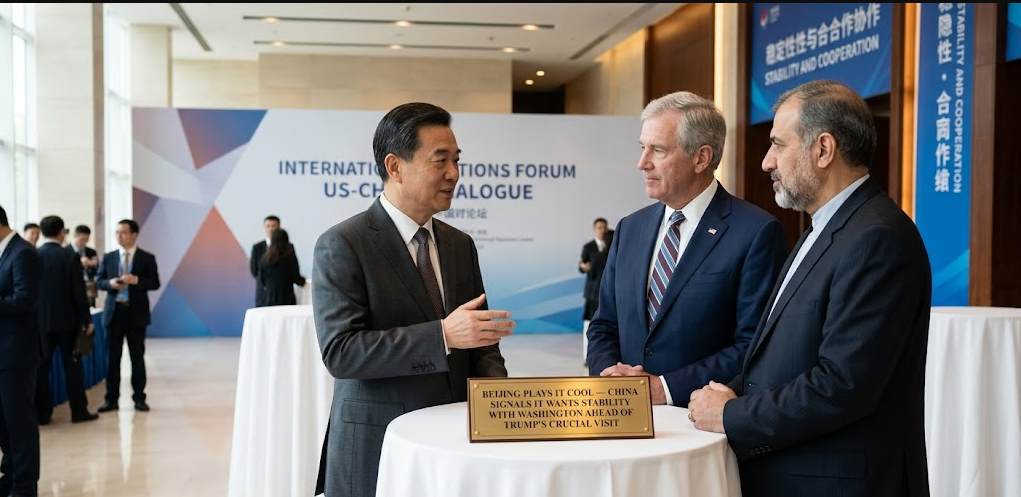
Beijing Plays It Cool China Signals It Wants Stability With Washington Ahead of Trump’s Crucial Visit
Theo Jorden
Share This Article
Beijing / Washington — In the corridors of Zhongnanhai, the word being used most frequently right now is wending — stability. As President Donald Trump prepares for what diplomats on both sides are billing as a crucial visit that could reshape the trajectory of the world’s most consequential bilateral relationship, Beijing has shifted into a
Beijing / Washington — In the corridors of Zhongnanhai, the word being used most frequently right now is wending — stability. As President Donald Trump prepares for what diplomats on both sides are billing as a crucial visit that could reshape the trajectory of the world’s most consequential bilateral relationship, Beijing has shifted into a mode of studied, deliberate calm. The signals are unmistakable: China wants this moment to work, and it is willing to manage its tone, its rhetoric, and its regional posture to give it the best possible chance of doing so.
The Diplomatic Temperature Drop
Just weeks ago, US-China relations appeared to be sliding toward a dangerous new low. Tariff escalations had reached levels not seen since the height of the first Trump trade war. Taiwan Strait tensions had spiked following a series of PLA naval exercises. And Chinese state media — typically a reliable barometer of Beijing’s internal temperature was running a steady drumbeat of anti-Washington commentary that left little room for optimism.
Then, almost overnight, the tone shifted.
Chinese Foreign Minister Wang Yi hosted a quietly productive session with U.S. counterparts on the sidelines of a multilateral forum, describing the bilateral relationship as one requiring “mutual respect and practical cooperation.” State media pulled back on its most aggressive commentary. And senior officials within the Chinese Communist Party’s foreign affairs apparatus began signalling, through back-channels and track-two academic exchanges, that Beijing was prepared to engage seriously provided Washington came to the table with reciprocal seriousness.
The message from Beijing was clear: China is not interested in a confrontation right now. It wants a stable plateau.
Why Beijing Is Playing It Cool
Understanding China’s current diplomatic posture requires understanding the pressures operating beneath the surface. China’s economy, while still the world’s second largest, is navigating a set of structural headwinds that Beijing’s leadership cannot afford to ignore. The property sector crisis that began with Evergrande has not fully resolved. Youth unemployment remains stubbornly elevated. Export growth — long the engine of Chinese economic confidence — has slowed under the weight of Western tariff barriers and supply chain restructuring driven explicitly by decoupling policies in Washington, Brussels, and Tokyo.
A prolonged, escalating confrontation with the United States is something China’s economy is poorly positioned to absorb right now. Xi Jinping, who has staked enormous personal and institutional credibility on delivering prosperity alongside national rejuvenation, understands that a destabilised US-China relationship in 2026 carries domestic political costs that cannot be easily managed through nationalist messaging alone.
There is also a strategic calculation at play. With the United States deeply engaged in managing the Iran-Israel conflict, supporting Ukraine, and navigating a fractious domestic political environment, Beijing sees an opportunity — not to exploit American distraction, but to lock in a period of managed coexistence that allows China to consolidate its economic recovery and technological development without the drag of an active great-power confrontation.
What China Is Offering — and What It Wants Back
Beijing’s stability signals are not unconditional. Chinese officials have made clear, through multiple channels, what they expect in return for a cooperative atmosphere around Trump’s visit.
On trade, China is pushing for a structured rollback of tariffs imposed during and after the first Trump administration — or at minimum, a freeze on new tariff escalation and a credible timeline for negotiation.
On Taiwan, Beijing wants a reaffirmation of the one-China policy in terms strong enough to push back against what Chinese officials describe as “creeping recognition” of Taiwanese sovereignty in U.S. legislative and diplomatic language.
On technology, China is seeking carve-outs or phased reviews of semiconductor export controls that have cut Chinese firms off from advanced chip architectures — restrictions Beijing views as an existential economic threat dressed in national security language.
In exchange, Washington can expect Chinese gestures on fentanyl precursor enforcement — an issue Trump has elevated to a top bilateral priority — alongside possible movement on North Korea diplomatic coordination and climate finance discussions that give the administration multilateral credibility without requiring domestic legislative action.
Trump’s Leverage — and His Incentives
Trump arrives at this moment with more leverage than any U.S. president has carried into a China engagement in years. The tariff architecture his administration has constructed, combined with U.S. leadership of the global semiconductor restriction regime, has given Washington genuine economic coercive capacity over Beijing.
But Trump also has strong incentives to deliver a win. A successful summit with Xi — one that produces visible trade concessions, a stability framework, and the optics of two great powers managing their rivalry like adults — would be a major domestic and foreign policy achievement. It would demonstrate that the maximum pressure approach produces results rather than simply producing tension.
The challenge is sequencing. Trump’s team wants deliverables before easing pressure. Beijing wants pressure eased before delivering. The gap between those two positions is precisely where diplomacy either succeeds or collapses.
Beijing’s Bet on Trump’s Deal Instinct
Ultimately, China’s cool, stability-signalling posture ahead of the visit reflects a calculated bet on something Beijing believes it understands about Donald Trump: that he is, at his core, a dealmaker who wants to leave the room with something he can hold up.
Xi Jinping’s team is engineering the conditions under which Trump can do exactly that — while ensuring that whatever deal emerges protects China’s core interests and buys Beijing the time and space it needs to navigate its economic moment.
Whether Washington reads this for what it is — a tactically generous but strategically patient move by a rival playing a longer game — will determine whether Trump’s crucial visit produces durable stability or simply the appearance of it.
Oil & Energy Markets
A look at crude price swings, OPEC supply moves, and how energy markets react to geopolitical shocks.