Share This Article
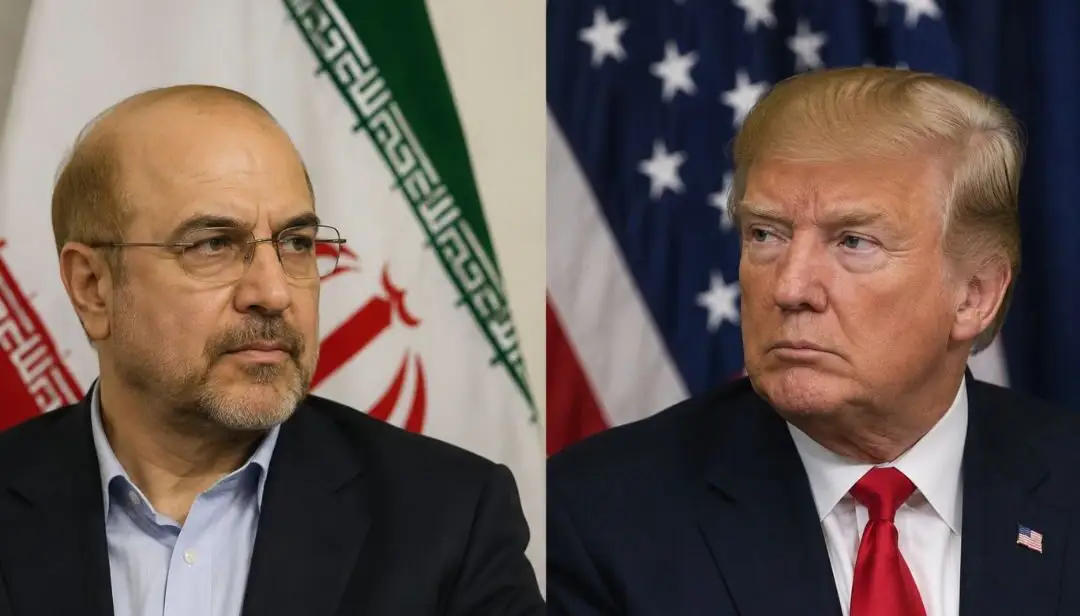
Sixteen days into a sixty day diplomatic window, Iran’s parliament speaker Mohammad Bagher Ghalibaf is drawing lines in the sand. On July 3, Ghalibaf issued his sharpest public warning yet, stating that Tehran will “resume proportionate actions” if the United States and Israel fail to meet their obligations under the Islamabad Memorandum of Understanding. The statement landed at a moment when the ceasefire has no active mediation, no enforcement body, and no arbitration mechanism to resolve disputes exposing a structural weakness at the heart of the US nuclear agreement that could unravel the deal before its most critical phase even begins.
Ghalibaf: Nuclear Rights Are Non-Negotiable
Iran’s parliament speaker Ghalibaf has emerged as the most prominent and assertive voice in Tehran’s negotiating posture. As the head of Iran’s delegation at the Islamabad talks, he co-led a twenty one hour negotiating session alongside Foreign Minister Abbas Araghchi that produced the fourteen point memorandum signed on June 17. Since then, he has defined the terms of Iran’s participation with unusual bluntness.
In a July 1 television interview, Ghalibaf declared that Iran’s nuclear rights and red lines are “non-negotiable,” insisting that Tehran’s nuclear program remains fully within the framework of the Nuclear Non Proliferation Treaty and under International Atomic Energy Agency supervision. He also confirmed that Iran would not advance to the next phase of the negotiations until five key provisions of the MOU were implemented, with the situation in Lebanon topping the list.
“We prioritised the issue of Lebanon,” Ghalibaf said, “and today you see that relative calm has been established there. The follow up is serious, and the talks are still ongoing, and until these five clauses are consolidated and finalised, we will not enter the next stage of implementing the other clauses of the memorandum.”
Two days later, he escalated further, warning that Iran was “ready for war” if commitments were not honored. The back to back statements reflect both the internal pressure Ghalibaf faces from Iran’s hardline factions and his strategic effort to anchor Tehran’s opening position in the sixty day window.
What the Memorandum Actually Says on Nuclear Issues
The US nuclear dimension of the Islamabad MOU is notably thin for a document that justified months of conflict. Article 8 states that Iran will not acquire a nuclear weapon. The memorandum also references a mechanism for Iran to “down blend” its stockpile of sixty percent enriched uranium, a level requiring only modest additional enrichment to reach weapons grade purity. Crucially, however, no timeframe is set for IAEA inspectors to verify these commitments.
IAEA Director General Rafael Grossi confirmed this himself in late June, saying nuclear site inspections would happen but that the timing was “not essential.” Iran’s Foreign Ministry went further, with spokesman Esmaeil Baghaei stating that Tehran had neither met with Grossi nor had any clear schedule for inspectors to access its damaged nuclear facilities. Washington and Tehran have also offered contradictory public accounts of what has actually been agreed. Vice President JD Vance claimed Iran had consented to IAEA inspections as “a major milestone.” Iranian officials denied any such commitment had been made.
That contradiction is not a minor technicality. Since June 2025, the IAEA had been blocked by Tehran from visiting enrichment sites where Iran is believed to hold enough highly enriched uranium for as many as ten nuclear weapons. The restoration of those inspection rights was among the central justifications the Trump administration offered for the entire war.
An Enforcement Vacuum
The deeper problem, as analysts have consistently highlighted, is that the MOU contains almost no functioning enforcement architecture. Chatham House’s June 2026 assessment concluded that there is “little agreement and there seems little prospect the gaps in the MoU can be filled over the next 60 days. Much is left impossibly vague.” Twelve days into the framework, no arbitrators had been named and no enforcement body had been formed. As of this writing, sixteen days in, that remains unchanged.
The Lake Lucerne monitoring group, established as talks moved to Switzerland, has no emergency protocol and no authority to compel compliance. The result, as one analysis described it, is a ceasefire governed entirely by self certification, meaning each party independently determines whether the other has complied, whether a breach has occurred, and what response is justified. Iran demonstrated exactly how this plays out in practice. On June 25 through 27, both sides accused the other of violating the MOU first. The dispute was resolved not through Article 12’s promised mechanism but through a phone call brokered by Qatar’s Emir.
Ghalibaf’s warning on July 3 operates inside precisely this vacuum. When Iran declares a US violation, as it has already done regarding Article 1 and the Lebanon provisions, no institution exists to adjudicate the claim or assess proportionality.
A Censored Interview and Internal Divisions
The enforcement debate has collided with a sharp domestic controversy in Tehran. On July 1, Iran’s state broadcaster cut short a pre recorded interview with Ghalibaf mid sentence while he was explaining the mechanism for releasing frozen Iranian assets abroad. Parliament’s media office confirmed the full interview had been delivered to the broadcaster in advance, and the abrupt cut drew immediate protests from the Majlis.
The censored section reportedly covered IAEA inspections of nuclear sites, the $300 billion reconstruction credit included in the MOU, Ghalibaf’s responses to Trump’s public statements, and what was described as Supreme Leader Mojtaba Khamenei’s “strategic message.” The incident exposed the depth of internal disagreement over how the deal is being presented to the Iranian public. Hardline factions, including the Paydari Front, have led street protests calling for Ghalibaf’s resignation and describing the MOU as a betrayal of the 1979 revolution.
What the Sixty Day Window Must Deliver
The technical negotiations now underway have been organized into four formal working groups covering sanctions, nuclear affairs, reconstruction, and monitoring. The nuclear track faces the steepest climb. The Soufan Center has noted that the JCPOA’s technically intricate verification architecture took two full years to negotiate, and a new nuclear accord will almost certainly require far more than sixty days to finalize.
For a detailed breakdown of how the MOU’s nuclear clauses compare to the original JCPOA framework, see our full Iran nuclear deal analysis.
For further reading on the international legal dimensions of the enforcement question, the Council on Foreign Relations has published a comprehensive assessment at cfr.org.
What is clear is that Iran’s parliament speaker Ghalibaf has positioned himself as the gatekeeper of Tehran’s next move. His demand that Lebanon provisions be fulfilled before nuclear talks advance, combined with explicit threats to resume military action, signals that the US nuclear memorandum is entering its most dangerous phase — one in which the absence of any enforcement body is not an administrative oversight but a potential trigger.
References and Sources
- The Tribune India, “Iran’s nuclear rights are non-negotiable: Ghalibaf says key commitments under MoU need to be fulfilled,” July 1, 2026
- House of Saud / Conflict Pulse, “Ghalibaf Warns Iran Will Resume Proportionate Actions,” July 3, 2026
- Iran International, “Iran parliament cries censorship after Ghalibaf interview cut short,” July 1, 2026
- Times of Israel, “Deal a ‘declaration of US defeat,’ chief Iran envoy says, as IAEA vows inspections,” June 2026
- CBS News, “Nuclear site inspections will happen, but timing not essential, IAEA chief says,” June 2026
- The Soufan Center, “Next Steps on the US Iran Agreement,” June 22, 2026
- Wikipedia, “Islamabad Memorandum”
- Al Jazeera, “Nuclear inspectors and frozen assets: What Iran and US can’t agree on,” June 23, 2026

Oil & Energy Markets
A look at crude price swings, OPEC supply moves, and how energy markets react to geopolitical shocks.

Geopolitics & Conflict
Breaking down how wars, ceasefires, and diplomatic deals ripple through global trade and security.
US Foreign Policy
Coverage of Trump administration negotiations, sanctions, and strategic decisions shaping world events.
Economy & Inflation
Tracking how commodity prices, gas costs, and supply chains affect everyday consumers.